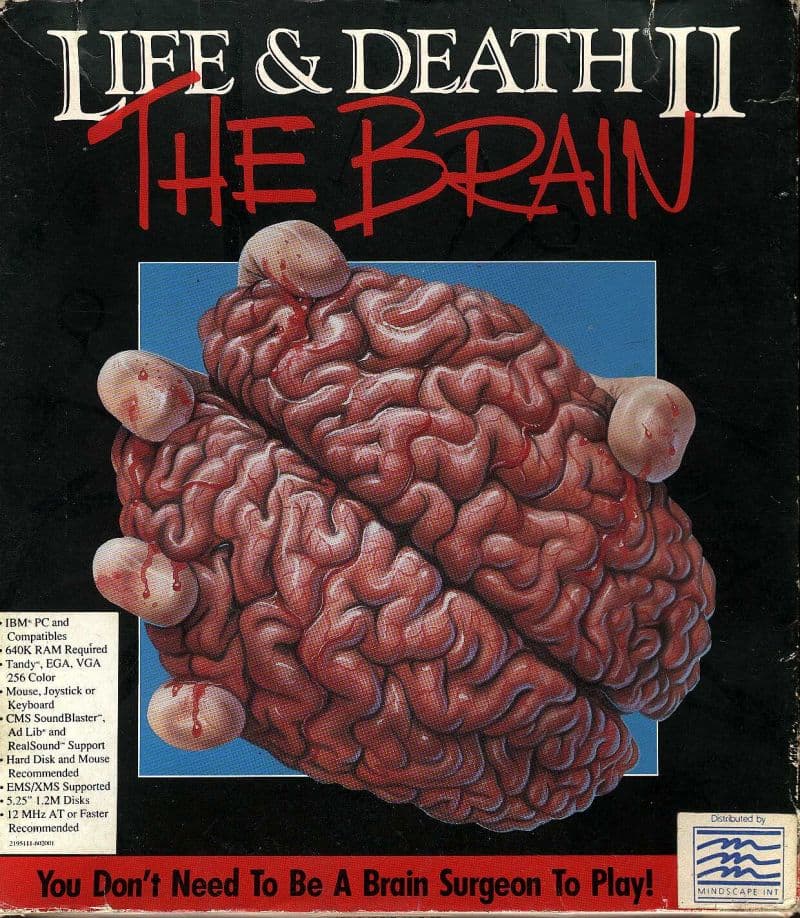
Playing Life & Death II: The Brain means learning the hard way that sticking a patient with a pacemaker inside an MRI machine will end their life instantly.
The original 1988 Life & Death forced players to cut open virtual abdomens, but the 1990 sequel shifts the stakes directly to neurosurgery. Designed by Dr. Myo Thant, this simulation places you as an intern inside Toolworks General Hospital, where every bad guess or missed step sends a patient straight to the autopsy table. Upgraded from the original's crude CGA and EGA visuals to full 256-color VGA, the 1990 release renders human organs, brains, and blood clots in explicit detail across a top-down, flip-screen setup.
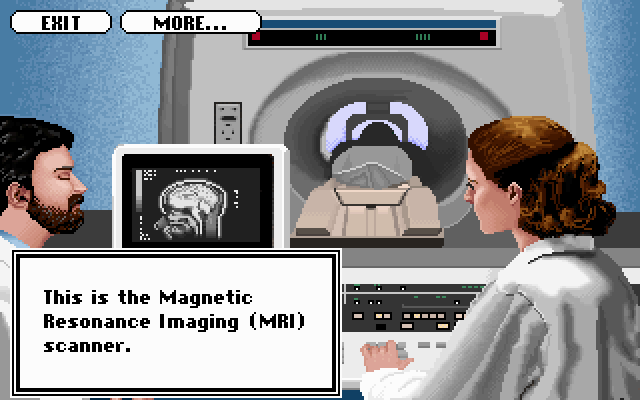
Before you ever lay hands on a bone drill, you have to work through the hospital exam rooms, running neurological tests on confused patients. You poke their faces with pins to test nerve sensitivity, tap their knees with a reflex hammer, and check if their pupils respond properly to light. When simple physical exams leave you stumped, you move to diagnostic imaging to order CAT scans and MRIs, or flip through the built-in medical reference manual to cross-reference symptoms. Skipping the reading is a death sentence; if you misdiagnose a case of cocaine addiction as a brain tumor or put a metal pacemaker through a magnetic scanner, the game ends that patient's life right on the exam table.
The game demands an exact routine. You cannot simply guess your way through a case file, because the patients suffer from distinct, realistic conditions like subdural hematomas, aneurysms, and localized lesions. If you are serious about surviving your intern shift in the Life & Death II: The Brain MS-DOS game, reading the physical manual is not optional advice, it is an essential part of the design. Without understanding which nerve pathway controls which limb, you will order the wrong scans, misread the test results, and scrub into surgery completely unprepared.
Once you confirm a diagnosis that requires surgery, gameplay transitions to the operating room, where the tone shifts from careful investigation to stressful micromanagement. Your display transforms into a bird's-eye view of the patient's exposed skull, flanked by vital sign monitors displaying EKG waveforms, CO2 output, blood pressure, and urine production. Audio shifts too; on an AdLib or Sound Blaster card, the continuous rhythmic beep of the heart monitor establishes a baseline rhythm that speeds up the moment blood pressure drops or oxygen levels plunge.
Performing brain surgery plays out like executing an endless, strict checklist where a single pixel-level mistake ruins everything. You slice open the scalp with a scalpel, clamp off bleeding vessels, and use a bone drill to cut through the cranium. From there, you work with clamps and suction tubes to tie off leaking aneurysms or pull blood clots away from delicate tissue. There is zero room for creative solutions; if you drill half a millimeter off target or forget to keep the patient properly sedated while monitoring gas ratios, the heart rate drops flat, sound card bleeps flatten into a single long tone, and the operation halts immediately.
This rigid approach is precisely where the controls feel most punishing. Using a mouse to navigate tiny surgical hitboxes demands total precision, and slightly slipping off a blood vessel with a clip tool can tear an artery beyond repair. Contemporary reviewers noted this strict demand for accuracy; in ACE magazine, Rik Haynes gave the game a score of 799 out of 1000 while noting that players would likely spend far more time failing in the classroom than actually succeeding in surgery. Les Ellis, writing for Raze magazine with an 87% rating, joked that failing intern surgeons might want to apply for a job down at the morgue instead.
What keeps players coming back despite the crushing difficulty is how the game handles failure. When a patient dies on your table or succumbs to a wrong diagnostic procedure, you do not simply see a generic game over screen. Instead, the screen cuts to the hospital morgue, where the coroner and his staff sit around the newly arrived corpse, eating pizza off paper plates and delivering dark punchlines about your incompetence.
These gallows-humor intermissions became the defining memory for anyone who played it on an IBM-compatible machine in the early nineties. The morgue crew will mockingly applaud your failure with quips like, "Jeez, looks like they let one of the rookies take the scalpel!" or crack jokes about putting pacemakers into MRI units. It provides a sharp contrast to the cold, clinical pressure of the operating room, cutting the tension right before the game penalizes you for your mistakes.
After the morgue staff has their laugh, you are sent straight to the hospital classroom for a mandatory lecture. Here, the senior chief of surgery walks through your exact procedural mistake on a blackboard, explaining where your diagnosis went sideways or which vessel you severed during drilling. *Computer Gaming World* highlighted this balance at release, praising developer The Software Toolworks, Inc. for combining real medical instruction with dark entertainment. It turns every death into a practical lesson, ensuring that while losing is frustrating, you usually learn which step of the surgical manual you skipped.
While the simulation mechanics created by publisher The Software Toolworks, Inc. were impressive for 1990, the game suffers from clear design limits once you understand its internal logic. Once you memorize the diagnostic chart and master the specific mouse movements required to drill open a cranium without slipping, the mystery vanishes. Every surgery becomes a repetitive exercise in following the same rigid sequence of actions, turning what felt like a dynamic medical emergency into a static checklist routine.
The unforgiving control scheme exacerbates this problem during long sessions. Because a minor mouse drag can instantly kill a patient who took fifteen minutes to diagnose, the game frequently crosses the line from tense to outright unfair. Once you successfully cure every medical condition available in the hospital rotation and earn your promotions, there are no randomized complications or secret scenarios left to discover, leaving very little reason to replay the campaign.
Despite those flaws, it was an ambitious project that treated medical simulation with surprising seriousness long before modern simulator games existed. Few early educational titles were this uncompromising or refused so completely to hold your hand.
You can test your surgical skills and read about early medical simulations without tracking down retro PC hardware or setting up vintage sound drivers. If you want to experience the stress of the operating room firsthand, you can play Life & Death II: The Brain free in your browser right now with no setup required.
When you start your first shift, spend your first few minutes in the patient exam room running sensory tests with the pin and hammer before jumping straight into diagnostic scans. You will immediately notice how sensitive the reflex tests are and how quickly an improper MRI request ends with a trip to the morgue. See if you can keep your first patient alive through diagnostic testing before the coroner's crew starts eating lunch near your table.
Playing Life & Death II: The Brain means learning the hard way that sticking a patient with a pacemaker inside an MRI machine will end their life instantly.
The original 1988 Life & Death forced players to cut open virtual abdomens, but the 1990 sequel shifts the stakes directly to neurosurgery. Designed by Dr. Myo Thant, this simulation places you as an intern inside Toolworks General Hospital, where every bad guess or missed step sends a patient straight to the autopsy table. Upgraded from the original's crude CGA and EGA visuals to full 256-color VGA, the 1990 release renders human organs, brains, and blood clots in explicit detail across a top-down, flip-screen setup.
Before you ever lay hands on a bone drill, you have to work through the hospital exam rooms, running neurological tests on confused patients. You poke their faces with pins to test nerve sensitivity, tap their knees with a reflex hammer, and check if their pupils respond properly to light. When simple physical exams leave you stumped, you move to diagnostic imaging to order CAT scans and MRIs, or flip through the built-in medical reference manual to cross-reference symptoms. Skipping the reading is a death sentence; if you misdiagnose a case of cocaine addiction as a brain tumor or put a metal pacemaker through a magnetic scanner, the game ends that patient's life right on the exam table.
The game demands an exact routine. You cannot simply guess your way through a case file, because the patients suffer from distinct, realistic conditions like subdural hematomas, aneurysms, and localized lesions. If you are serious about surviving your intern shift in the Life & Death II: The Brain MS-DOS game, reading the physical manual is not optional advice, it is an essential part of the design. Without understanding which nerve pathway controls which limb, you will order the wrong scans, misread the test results, and scrub into surgery completely unprepared.

Once you confirm a diagnosis that requires surgery, gameplay transitions to the operating room, where the tone shifts from careful investigation to stressful micromanagement. Your display transforms into a bird's-eye view of the patient's exposed skull, flanked by vital sign monitors displaying EKG waveforms, CO2 output, blood pressure, and urine production. Audio shifts too; on an AdLib or Sound Blaster card, the continuous rhythmic beep of the heart monitor establishes a baseline rhythm that speeds up the moment blood pressure drops or oxygen levels plunge.
Performing brain surgery plays out like executing an endless, strict checklist where a single pixel-level mistake ruins everything. You slice open the scalp with a scalpel, clamp off bleeding vessels, and use a bone drill to cut through the cranium. From there, you work with clamps and suction tubes to tie off leaking aneurysms or pull blood clots away from delicate tissue. There is zero room for creative solutions; if you drill half a millimeter off target or forget to keep the patient properly sedated while monitoring gas ratios, the heart rate drops flat, sound card bleeps flatten into a single long tone, and the operation halts immediately.
This rigid approach is precisely where the controls feel most punishing. Using a mouse to navigate tiny surgical hitboxes demands total precision, and slightly slipping off a blood vessel with a clip tool can tear an artery beyond repair. Contemporary reviewers noted this strict demand for accuracy; in ACE magazine, Rik Haynes gave the game a score of 799 out of 1000 while noting that players would likely spend far more time failing in the classroom than actually succeeding in surgery. Les Ellis, writing for Raze magazine with an 87% rating, joked that failing intern surgeons might want to apply for a job down at the morgue instead.
What keeps players coming back despite the crushing difficulty is how the game handles failure. When a patient dies on your table or succumbs to a wrong diagnostic procedure, you do not simply see a generic game over screen. Instead, the screen cuts to the hospital morgue, where the coroner and his staff sit around the newly arrived corpse, eating pizza off paper plates and delivering dark punchlines about your incompetence.
These gallows-humor intermissions became the defining memory for anyone who played it on an IBM-compatible machine in the early nineties. The morgue crew will mockingly applaud your failure with quips like, "Jeez, looks like they let one of the rookies take the scalpel!" or crack jokes about putting pacemakers into MRI units. It provides a sharp contrast to the cold, clinical pressure of the operating room, cutting the tension right before the game penalizes you for your mistakes.

After the morgue staff has their laugh, you are sent straight to the hospital classroom for a mandatory lecture. Here, the senior chief of surgery walks through your exact procedural mistake on a blackboard, explaining where your diagnosis went sideways or which vessel you severed during drilling. *Computer Gaming World* highlighted this balance at release, praising developer The Software Toolworks, Inc. for combining real medical instruction with dark entertainment. It turns every death into a practical lesson, ensuring that while losing is frustrating, you usually learn which step of the surgical manual you skipped.
While the simulation mechanics created by publisher The Software Toolworks, Inc. were impressive for 1990, the game suffers from clear design limits once you understand its internal logic. Once you memorize the diagnostic chart and master the specific mouse movements required to drill open a cranium without slipping, the mystery vanishes. Every surgery becomes a repetitive exercise in following the same rigid sequence of actions, turning what felt like a dynamic medical emergency into a static checklist routine.
The unforgiving control scheme exacerbates this problem during long sessions. Because a minor mouse drag can instantly kill a patient who took fifteen minutes to diagnose, the game frequently crosses the line from tense to outright unfair. Once you successfully cure every medical condition available in the hospital rotation and earn your promotions, there are no randomized complications or secret scenarios left to discover, leaving very little reason to replay the campaign.
Despite those flaws, it was an ambitious project that treated medical simulation with surprising seriousness long before modern simulator games existed. Few early educational titles were this uncompromising or refused so completely to hold your hand.
You can test your surgical skills and read about early medical simulations without tracking down retro PC hardware or setting up vintage sound drivers. If you want to experience the stress of the operating room firsthand, you can play Life & Death II: The Brain free in your browser right now with no setup required.
When you start your first shift, spend your first few minutes in the patient exam room running sensory tests with the pin and hammer before jumping straight into diagnostic scans. You will immediately notice how sensitive the reflex tests are and how quickly an improper MRI request ends with a trip to the morgue. See if you can keep your first patient alive through diagnostic testing before the coroner's crew starts eating lunch near your table.
The on-screen keyboard and gamepad mapping the browser player uses on a phone, a tablet or a controller, as opposed to the real keys above. $PRO members make their own in the player and share them here; anyone can pick one to play with.
Cheat codes, console commands and memory pokes for Life & Death II: The Brain — each one verified and attributed.
Sign in to submitThe on-screen keyboard and gamepad mapping the browser player uses on a phone, a tablet or a controller, as opposed to the real keys above. $PRO members make their own in the player and share them here; anyone can pick one to play with.
Cheat codes, console commands and memory pokes for Life & Death II: The Brain — each one verified and attributed.
Sign in to submit