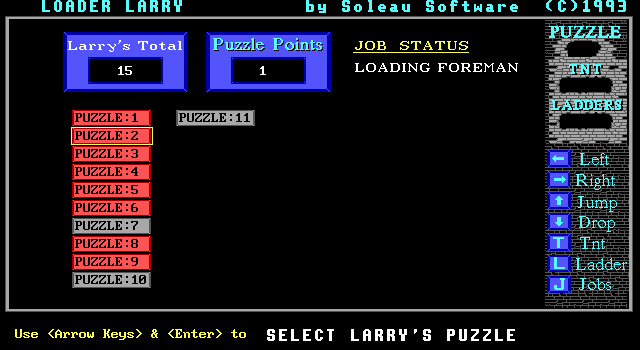
Loader Larry
Loader Larry turns warehouse labor into a sharp test of spatial logic, asking you to guide an ambitious dock worker through single-screen rooms full of crates, explosives, and ladders.
When warehouse work becomes a battle of logic
Most players who stumbled onto shareware disks in 1992 expected simple arcade action, but William Soleau delivered something far more deliberate. You control Larry Lontrose, a part-time dock worker determined to climb the corporate ladder by reaching the exit door in each level. There are no hazards chasing you down, no timer ticking away, and no weapons to fire. Success comes down to analyzing the fixed screen layout before making your first move.
The core mechanics look simple on the first few levels. Larry moves left and right, climbs ladders, drops off ledges, and carries objects across the screen. Because you can only jump or climb when structures exist to support you, every move requires careful planning. If you stack a box in the wrong spot or drop a key object into a pit, you immediately trap yourself and must restart the stage.
This focus on clean spatial puzzles set it apart from typical platformers of the era. Instead of testing your reflexes, it forces you to think three moves ahead like a chess player working with heavy cargo.
Mastering physics and TNT in Loader Larry
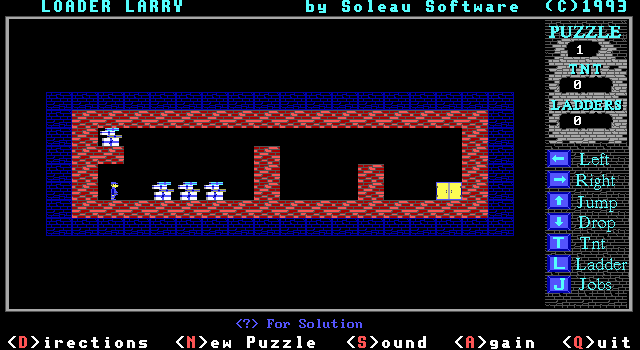
The depth of this 1992 title comes from how different warehouse objects interact with one another on a single screen. As you progress through the puzzle stages, the game continuously introduces new elements that modify how you traverse the room:
- Wooden Crates: The primary building blocks that you can push, carry, stack, or drop to create steps and bridge gaps.
- Balloons: Floating objects that rise upward, lifting obstacles out of your way or providing temporary clearance.
- TNT Charges: Explosive blocks used to blast open stubborn brick walls that block the exit door.
- Ladders: Fixed vertical pathways that allow Larry to carry items between different elevation levels.
Detonating TNT requires particular care. Because explosives clear away structural walls permanently, blowing up a block in the wrong order can ruin the floor you needed to walk across later. A classic puzzle game design pattern emerges here: every solution is perfectly logical, yet one minor oversight renders the entire room unwinnable.
The EGA and VGA graphics at 640x350 resolution are plain, relying on simple tile patterns for brick walls and basic blocky shapes for crates. The PC speaker audio offers only bare-bones beeps when you drop a box or clear a level. Yet the clean visual layout means you never struggle to read the board, allowing you to focus entirely on the mechanics.
Shareware limits and the difficulty spike in Loader Larry
Like many titles published by Soleau Software, the distribution model was built around shareware disks. The free version gave players access to the first 20 levels, while registering the full game for $12 unlocked all 40 rooms. For many kids in the nineties, those initial 20 levels were more than enough to test their patience.
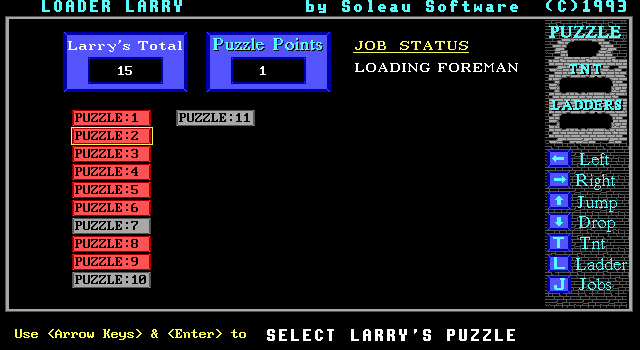
The difficulty ramps up sharply once you pass the introductory stages. Early levels teach you how to stack two boxes to reach a high ladder, but later stages demand complex sequences of hauling TNT across narrow platforms while juggling floating balloons. The puzzles get brutal, requiring exact execution where a single misstep forces a full level restart.
This steep curve is where some players bounced off. Without an undo button, making a mistake on a late-stage puzzle means redoing a long sequence of tedious box-pushing. Yet solving a room after twenty minutes of trial and error provides a genuine sense of accomplishment that few action games could match at the time.
Where William Soleau built a puzzle foundation
Soleau Software built an entire business on self-published PC logic games, and this release shows the creator's knack for clean rulesets. Compressed using PKLITE to fit neatly onto small floppy disks, the Loader Larry MS-DOS game ran smoothly on almost any IBM-compatible computer available at the time. The registered version even used simple activation keys distributed in registration collections, such as code 77A23R9 for version 1.2.
The game left a lasting impression on independent puzzle designers. Decades later, its clear push-and-destroy warehouse mechanics directly inspired the 2023 Steam release Super Retro BoxBot. While modern titles add undo functions and high-resolution visuals, the core satisfaction of clearing a congested room remains unchanged.
If you enjoy pure logic challenges without time pressure, this shareware staple still works well. It strips away all unnecessary clutter to deliver forty rooms of uncompromising warehouse logistics.
How to play Loader Larry online today
You can play Loader Larry online right now in your web browser with zero setup required. Modern emulation handles the original EGA graphics and PC speaker sound effects automatically, letting you experience the full puzzle loop instantly.
When you start your run, remember that boxes fall as soon as support is removed beneath them. Pay close attention to where you detonate your first stick of TNT on level five, as clearing the lower wall early will leave Larry trapped without a way back up.