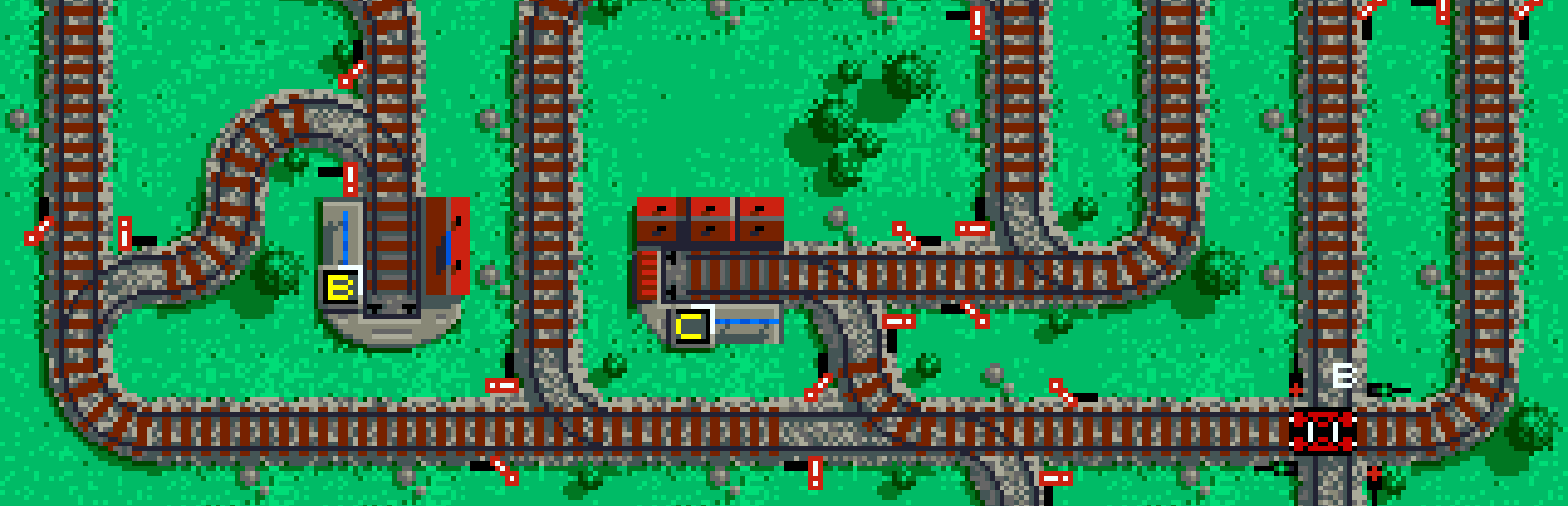

You start a round of Locomotion with a quiet board and two empty tracks, but within thirty seconds three engines are speeding toward the exact same junction with no brakes.
Playing this puzzle game from a top-down perspective means keeping track of an entire rail grid at once. You operate a mouse cursor over a flip-screen board filled with track switches, stations labeled with letters, and single-engine locomotives spawning at random intervals. Each train needs to reach a station matching its destination tag before the time limit runs out, and your only direct control over the network is toggling track junctions by clicking them.
When an engine encounters a junction set in the wrong direction, it halts completely until you click the switch into alignment. If a train pulls into the wrong station, it reverses direction immediately and heads back out onto the main line. Should two locomotives collide, they explode into a cloud of smoke, costing you points and burning precious time on the clock. A fast-forward button lets you speed up slow-moving trains across clear tracks, but holding it down while a grid is crowded usually triggers a catastrophe.
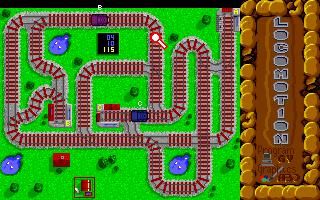
Designed and programmed by André Wüthrich, Locomotion was developed by Prestige Softwareentwicklung GmbH and published by Kingsoft GmbH in 1992. The concept adapted the appeal of a physical model railroad layout into a fast-paced sorting puzzle. It launched on multiple home systems, including the Amiga, Atari ST, Commodore 64, and PC.
On PC hardware, the Locomotion MS-DOS game featured crisp VGA visuals alongside AdLib FM synth audio that provided a energetic, mechanical soundtrack. The campaign layout splits over 100 stages into lettered sets ranging from A to L, taking you through simple oval loops, desert environments, and futuristic track arrangements. Completing an entire set provides a password, allowing you to skip straight back to that difficulty tier on your next session.
The pacing scales up aggressively as you advance through the lettered sets. Early levels give you plenty of track space to isolate trains, but middle stages flood the grid with faster engines and tight junction webs. German gaming magazine Amiga Joker handed the Amiga release a 58% score back in 1992, pointing out that the constant fast-clicking loop could get repetitive during long play sessions.
A persistent design issue occurs when new trains spawn at a station right as another engine arrives at that same target, causing an unavoidable wreck through no fault of your own. Players also frequently run into accessibility hurdles, particularly because the graphics rely heavily on color distinction. Distinguishing between yellow and green engine cabs under strict time limits is difficult for color-blind players, leading to wrong turns on crowded maps.
For players who get tired of the brutal difficulty curve in the later standard stages, the built-in construction editor offers a flexible alternative. The tool gives you a blank canvas to construct custom railway systems and test your own track logic. User stages fill up lettered sets M through X, extending the life of the software considerably.
Designing an impossibly complex maze of tracks and trying to keep five trains running without a collision is often more satisfying than playing the pre-made campaign levels. It changes the experience from a frantic test of reflexes into a thoughtful spatial puzzle.
While visual accessibility flaws and sudden spawner wrecks can frustrate you, the core mechanism is genuinely clever. The simple loop of switching junctions under pressure delivers instant feedback, and hitting the fast-forward button when you have successfully routed four trains simultaneously feels great. Anyone into route-planning puzzles or digital model trains will find a smart bit of software here.
You can play Locomotion free in your browser today, directly through your web browser with nothing to install. Load up set A to get a feel for flipping switches under time pressure, then hop into the editor to try building your own high-speed track trap.
You start a round of Locomotion with a quiet board and two empty tracks, but within thirty seconds three engines are speeding toward the exact same junction with no brakes.
Playing this puzzle game from a top-down perspective means keeping track of an entire rail grid at once. You operate a mouse cursor over a flip-screen board filled with track switches, stations labeled with letters, and single-engine locomotives spawning at random intervals. Each train needs to reach a station matching its destination tag before the time limit runs out, and your only direct control over the network is toggling track junctions by clicking them.
When an engine encounters a junction set in the wrong direction, it halts completely until you click the switch into alignment. If a train pulls into the wrong station, it reverses direction immediately and heads back out onto the main line. Should two locomotives collide, they explode into a cloud of smoke, costing you points and burning precious time on the clock. A fast-forward button lets you speed up slow-moving trains across clear tracks, but holding it down while a grid is crowded usually triggers a catastrophe.

Designed and programmed by André Wüthrich, Locomotion was developed by Prestige Softwareentwicklung GmbH and published by Kingsoft GmbH in 1992. The concept adapted the appeal of a physical model railroad layout into a fast-paced sorting puzzle. It launched on multiple home systems, including the Amiga, Atari ST, Commodore 64, and PC.
On PC hardware, the Locomotion MS-DOS game featured crisp VGA visuals alongside AdLib FM synth audio that provided a energetic, mechanical soundtrack. The campaign layout splits over 100 stages into lettered sets ranging from A to L, taking you through simple oval loops, desert environments, and futuristic track arrangements. Completing an entire set provides a password, allowing you to skip straight back to that difficulty tier on your next session.
The pacing scales up aggressively as you advance through the lettered sets. Early levels give you plenty of track space to isolate trains, but middle stages flood the grid with faster engines and tight junction webs. German gaming magazine Amiga Joker handed the Amiga release a 58% score back in 1992, pointing out that the constant fast-clicking loop could get repetitive during long play sessions.
A persistent design issue occurs when new trains spawn at a station right as another engine arrives at that same target, causing an unavoidable wreck through no fault of your own. Players also frequently run into accessibility hurdles, particularly because the graphics rely heavily on color distinction. Distinguishing between yellow and green engine cabs under strict time limits is difficult for color-blind players, leading to wrong turns on crowded maps.

For players who get tired of the brutal difficulty curve in the later standard stages, the built-in construction editor offers a flexible alternative. The tool gives you a blank canvas to construct custom railway systems and test your own track logic. User stages fill up lettered sets M through X, extending the life of the software considerably.
Designing an impossibly complex maze of tracks and trying to keep five trains running without a collision is often more satisfying than playing the pre-made campaign levels. It changes the experience from a frantic test of reflexes into a thoughtful spatial puzzle.
While visual accessibility flaws and sudden spawner wrecks can frustrate you, the core mechanism is genuinely clever. The simple loop of switching junctions under pressure delivers instant feedback, and hitting the fast-forward button when you have successfully routed four trains simultaneously feels great. Anyone into route-planning puzzles or digital model trains will find a smart bit of software here.
You can play Locomotion free in your browser today, directly through your web browser with nothing to install. Load up set A to get a feel for flipping switches under time pressure, then hop into the editor to try building your own high-speed track trap.
How Locomotion is played — the keys the game listens to, grouped by what they do.
Highlighted keys are mapped — hover or tap one to see what it does.
Keymap is incomplete as an official MS-DOS manual or reference card listing full keyboard bindings was not found.
The on-screen keyboard and gamepad mapping the browser player uses on a phone, a tablet or a controller, as opposed to the real keys above. $PRO members make their own in the player and share them here; anyone can pick one to play with.
Cheat codes, console commands and memory pokes for Locomotion — each one verified and attributed.
Sign in to submitHow Locomotion is played — the keys the game listens to, grouped by what they do.
Highlighted keys are mapped — hover or tap one to see what it does.
Keymap is incomplete as an official MS-DOS manual or reference card listing full keyboard bindings was not found.
The on-screen keyboard and gamepad mapping the browser player uses on a phone, a tablet or a controller, as opposed to the real keys above. $PRO members make their own in the player and share them here; anyone can pick one to play with.
Cheat codes, console commands and memory pokes for Locomotion — each one verified and attributed.
Sign in to submit