


Lotus: The Ultimate Challenge
Checking…
Lotus: The Ultimate Challenge took the fast pseudo-3D engine from its Amiga origins, added an endless procedural track generator, and pushed classic behind-view arcade driving straight onto PC monitors in 1993.
Speed, scenery, and the RECS track generator in Lotus: The Ultimate Challenge
Before custom track editors became standard in racing games, developer Magnetic Fields introduced the Racing Environment Construction Set (RECS). Instead of making you place every curve with a mouse cursor, RECS lets you adjust slider parameters for difficulty, turn frequency, steepness of hills, hazards, and scenery across 13 distinct environment types. The system then encodes the whole layout into a short letter-and-digit string, giving players a way to swap thousands of tailored courses via scribbled code numbers long before online file sharing.
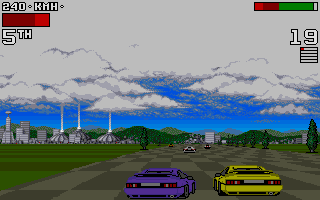
When you sit down to race the 1993 MS-DOS game, you choose between three distinct British sports cars: the Lotus Esprit S4, the Elan SE, or the futuristic M200 concept car. Tracks send you hurtling through motorways, pitch-black night stretches, and rain-slicked roads cluttered with roadworks. You have to juggle manual or automatic gear shifting, watch fuel levels to manage mandatory pit stops, and dodge deep puddles that drag your velocity down in an instant.
Where the asphalt bites back: handling, AI rivals, and hardware quirks
The core handling in this release drops any attempt at forgiving modern physics. Turn into a corner without easing off the gas, and without traction control to save you, your car spins into the scenery. Hit a roadside tree or barrier at top speed and your vehicle can suddenly flip end-over-end, wiping out every second of lead you built over the previous lap.
Playing in championship mode pits you against a full grid of 19 computer-controlled opponents sporting cheeky names like Alain Phosphate and Crash-Hard Banger. The AI drivers stick to their line no matter what, and contact only ever seems to penalize your machine. Even if you drive a flawless leg and cross the finish line first, the grid positioning logic resets you right back to the rear of the pack for the next race, turning every event into a high-speed overtake drill.
For PC gamers running period hardware, the game delivered smooth frame rates on 386 and 486 systems. However, fast CPU speeds on later DOS machines trigger a notorious runtime error: a divide overflow crash on execution caused by a specific instruction set sequence (`FB F7 F1`). Tech-savvy players had to hunt down hex edits (`FB 90 90`) or run software slowdown tools just to stop the game from dropping back to the command prompt instantly.

How Lotus: The Ultimate Challenge captures the classic DOS engine sound
Ported over to the PC by Cygnus Software Engineering and published by Gremlin Interactive Ltd., the conversion replaced the graphics of earlier iterations with the updated Lotus Esprit S4 model. Patrick Phelan composed the driving audio soundtrack, which adjusts gracefully depending on what sound hardware your machine carries.
The audio card support includes options for basic PC Speaker, standard AdLib FM synthesis, and full Roland MT-32 or LAPC-I MIDI modules. Here is how the mechanics and features line up across modes:
- Selectable Roster: Choose between the Lotus Esprit S4, Elan SE, and M200 concept model.
- Two Main Game Modes: Compete in full points-based championships or single-player time trials with checkpoint countdowns.
- Split-Screen Multiplayer: Simultaneous two-player racing on a single display screen.
- RECS Code Engine: Procedural track creation with custom code strings for sharing.
While the computer drivers can feel unfair and the tree-collision physics remain unforgiving, the sense of raw forward motion holds up exceptionally well. The combination of custom RECS courses, split-screen head-to-head competition, and punchy synth soundtrack makes it a highlight of early nineties PC arcade driving.
Why you should play Lotus: The Ultimate Challenge online today
If you want to experience classic 16-bit era arcade racing without messing around with CPU slowdown utilities, memory managers, or hex patches, you can play Lotus: The Ultimate Challenge free in your browser right now. Everything runs within your browser window with zero installation required, letting you hop directly into the driver's seat within seconds.
To get started, launch into a quick time trial, select the Lotus Esprit S4, and try generating a high-difficulty track code in the RECS menu. You will immediately notice how fast the horizon moves, how aggressive the cornering demands to be, and how much precision it takes to survive a wet night track at full throttle.
How Lotus: The Ultimate Challenge is played — the keys the game listens to, grouped by what they do.
- Movement
- Action
Highlighted keys are mapped — hover or tap one to see what it does.
Control mapping derived from provided documentation. Secondary player controls and system keys are incomplete in available sources.
Players' controls
Touch and gamepad controls
The on-screen keyboard and gamepad mapping the browser player uses on a phone, a tablet or a controller, as opposed to the real keys above. $PRO members make their own in the player and share them here; anyone can pick one to play with.
Make your own touch controlsPRO
- 1Open the editorSign in below, then pick what to make. The game starts with the editor open over it.
- 2Place your keysAdd keys and drag them where your thumbs rest, or map a controller's buttons. Test plays the game with them; Save keeps them, and you play with them from then on.
- 3Share themShare them right after saving in the game, or name and share them here. Players vote, and the best become this game's controls for everyone.
Go PROSee how it worksSign in+20 XP for sharing · +50 XP if yours become the game's own
- The game's own controlsKeyboardGamepadWhat every player starts with.In use
2 screenshots
From the archive
No gameplay video yet
No gameplay video for Lotus: The Ultimate Challenge yet. Sign in to add one.
No reviews yet
Tell the community what you think of Lotus: The Ultimate Challenge. Reviews are public and tied to your username.
No archived manuals for Lotus: The Ultimate Challenge yet
No manuals archived for this title yet. Sign in to upload the first scan.
Cheat codes, console commands and memory pokes for Lotus: The Ultimate Challenge — each one verified and attributed.
Sign in to submitNo cheats yet for this title
Know a working cheat, poke or trainer? Add it with the button above. Moderators check every entry before it goes live.
No archived soundtrack for Lotus: The Ultimate Challenge yet
No soundtrack archived for this title yet. Sign in to upload the first rip.
No save states for Lotus: The Ultimate Challenge yet
No save states for this title yet. Sign in to share one.
Discussions
Sign in to post- Threads0
- Total posts0
- Online now6
Community · Lotus: The Ultimate Challenge
Who's contributing, and what's new
- Reviews0
- Threads0
- Uploadsapproved0
- Contributors0
Recent activity