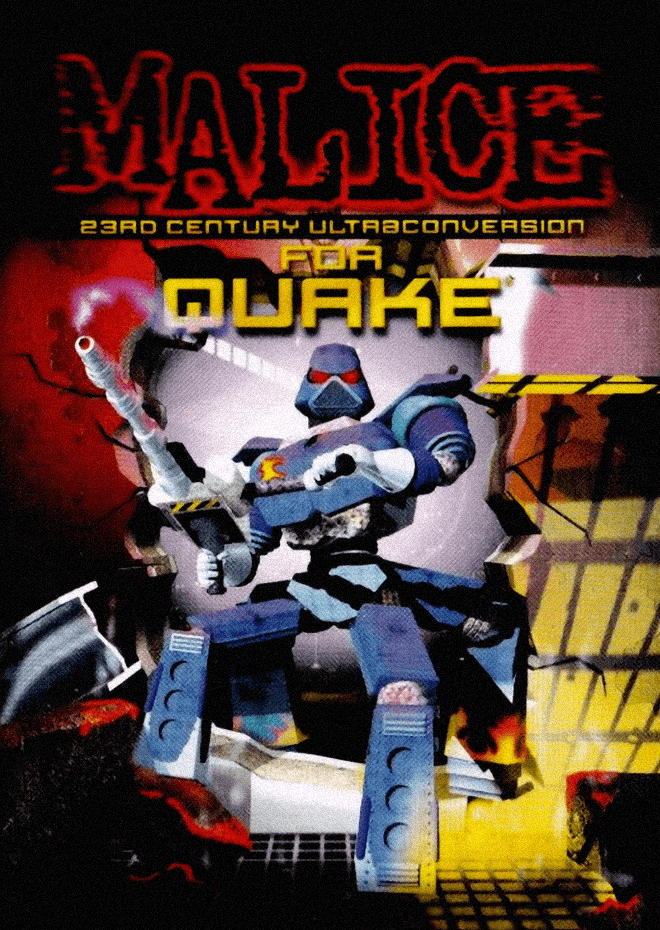

Starting up Malice: 23rd Century Ultraconversion for Quake for the first time usually meant staring at a black screen while keying in custom console impulse commands just to reload your gun.
Most commercial map packs in the late nineties felt like cash-in floppy disks stuffed with user maps harvested off local bulletin boards. Team Epochalypse, who later rebranded as Ratloop, Inc., took a completely different path after financing their production budget through their previous add-on Shrak. Instead of giving players another brown medieval castle full of Ogres, they tore out id Software’s original art assets and rewrote the gameplay mechanics from the ground up.
The attitude hits you before you even complete the first real level. In an early cutscene, the main character walks up behind the original leather-armored Quake hero, blasts him in the spine, and calls him an asswipe. It was a clear declaration of independence: this was no longer a game about gothic runed arches and Eldritch horrors, but a cyberpunk hitman simulation set in the year 2304.
You play as Damage, a bandana-wearing mercenary taking contracts for Colonel Bossman and the B.O.S.S. crime syndicate. Your ultimate target is Takahiro, the head of Takahiro Industries, which requires shooting your way through 18 distinct levels packed with armed guards, killer drones, terrorists, and lethal mercbabe models. In 1997, it delivered one of the boldest mechanical overhauls ever attempted on the engine.
The immediate shift in gameplay comes down to how much interaction Ratloop forced into a technology that was originally designed around pressing buttons to open doors. Level environments feature movable crates, active assembly lines, working forklifts, and conveyer belts that pull you straight into hazardous machinery if you lose your footing. Navigating the levels feels grounded in concrete physical spaces rather than floating abstract mazes.
To survive these facilities, Damage relies on a slate of specialized equipment known as Toyz alongside his standard military hardware. The tactical toolset alters how you traverse the 18 missions:
When combat erupts, the weapon balance feels aggressive and heavy. Dual pistols and rapid-fire Uzis replace the original shotgun, while heavy ordnance comes in the form of a portable minigun, a wide-clearing flamethrower, and an explosive devastation tool known as The Punisher. James Anderson provided an industrial electro soundtrack that gives every firefight inside clean corporate lobbies and gritty back-alley precincts momentum.
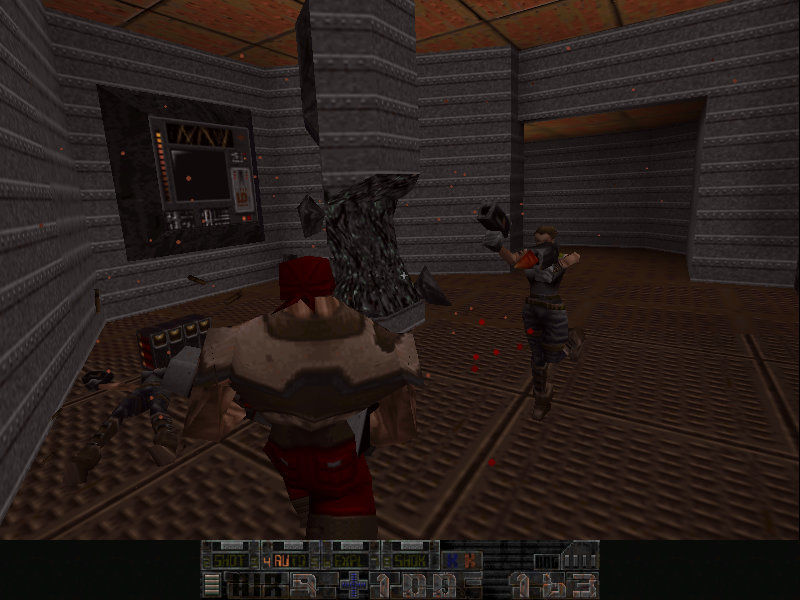
The ambition of the conversion often collided directly with key interface limitations. Because the original game menu was never designed to handle inventory management, manual reloading, or complex gadget activation, players had to assign raw impulse codes to their keyboard via the console commands. If you did not read the manual thoroughly, simple tasks like reloading your Uzi or deploying a parachute mid-fall felt absurdly obtuse.
Level design was equally uncompromising and routinely drove players to absolute frustration. Sprawling maps like The Lab, Area 33, and The 7th Precinct relied on confusing networks of teleporters, hidden wall switches, and unforgiving jumping puzzles. Without an in-game map to rely on, finding the single switch required to unlock a door three floors away turned into a painstaking hunt through industrial rooms.
Progression could stall completely due to technical bugs in early retail releases. On level D8B, geometry errors famously trapped players inside geometry with no legitimate exit, forcing developers to publicly instruct users to enter the fly cheat code into the console just to pass through the broken doorway until a fix was released. It was a messy execution, yet the sheer volume of new mechanics kept players pressing forward.
Quantum Axcess published this project during a brief window in PC history when high-end modifications were sold directly on store shelves. GT Interactive later recognized its quality by bundling it into the official Resurrection Pack for Quake in 1998, and it even saw a rare port to RISC OS computers. While contemporary magazine reviews were split between praising its fresh sci-fi aesthetic and condemning its obscure switch hunts, the sheer creative risk holds up far better than standard map add-ons of the period.
The shooting feels sharp, the weapon weight feels satisfying, and the cybernetic corporate aesthetic carries a distinct, gritty personality. The lack of built-in modern key menus is an awkward hurdle, but once your controls are configured, driving a mini-sub through flooded security pipes is a genuine blast. Anyone interested in late-nineties action games owes it to themselves to experience how far modders could push early full-3D software.
You can play Malice: 23rd Century Ultraconversion for Quake online right now without messing around with nineties console commands or autoexec config scripts. You can run this vintage Malice: 23rd Century Ultraconversion for Quake MS-DOS game straight from your web browser, giving you instant access to its hoverboard navigation, hard-hitting weapons, and corporate hitman missions within seconds. Jump straight into the training academy, bind your weapons, and see how Ratloop reinvented early 3D shooting.
Starting up Malice: 23rd Century Ultraconversion for Quake for the first time usually meant staring at a black screen while keying in custom console impulse commands just to reload your gun.
Most commercial map packs in the late nineties felt like cash-in floppy disks stuffed with user maps harvested off local bulletin boards. Team Epochalypse, who later rebranded as Ratloop, Inc., took a completely different path after financing their production budget through their previous add-on Shrak. Instead of giving players another brown medieval castle full of Ogres, they tore out id Software’s original art assets and rewrote the gameplay mechanics from the ground up.
The attitude hits you before you even complete the first real level. In an early cutscene, the main character walks up behind the original leather-armored Quake hero, blasts him in the spine, and calls him an asswipe. It was a clear declaration of independence: this was no longer a game about gothic runed arches and Eldritch horrors, but a cyberpunk hitman simulation set in the year 2304.
You play as Damage, a bandana-wearing mercenary taking contracts for Colonel Bossman and the B.O.S.S. crime syndicate. Your ultimate target is Takahiro, the head of Takahiro Industries, which requires shooting your way through 18 distinct levels packed with armed guards, killer drones, terrorists, and lethal mercbabe models. In 1997, it delivered one of the boldest mechanical overhauls ever attempted on the engine.
The immediate shift in gameplay comes down to how much interaction Ratloop forced into a technology that was originally designed around pressing buttons to open doors. Level environments feature movable crates, active assembly lines, working forklifts, and conveyer belts that pull you straight into hazardous machinery if you lose your footing. Navigating the levels feels grounded in concrete physical spaces rather than floating abstract mazes.
To survive these facilities, Damage relies on a slate of specialized equipment known as Toyz alongside his standard military hardware. The tactical toolset alters how you traverse the 18 missions:
When combat erupts, the weapon balance feels aggressive and heavy. Dual pistols and rapid-fire Uzis replace the original shotgun, while heavy ordnance comes in the form of a portable minigun, a wide-clearing flamethrower, and an explosive devastation tool known as The Punisher. James Anderson provided an industrial electro soundtrack that gives every firefight inside clean corporate lobbies and gritty back-alley precincts momentum.
The ambition of the conversion often collided directly with key interface limitations. Because the original game menu was never designed to handle inventory management, manual reloading, or complex gadget activation, players had to assign raw impulse codes to their keyboard via the console commands. If you did not read the manual thoroughly, simple tasks like reloading your Uzi or deploying a parachute mid-fall felt absurdly obtuse.
Level design was equally uncompromising and routinely drove players to absolute frustration. Sprawling maps like The Lab, Area 33, and The 7th Precinct relied on confusing networks of teleporters, hidden wall switches, and unforgiving jumping puzzles. Without an in-game map to rely on, finding the single switch required to unlock a door three floors away turned into a painstaking hunt through industrial rooms.
Progression could stall completely due to technical bugs in early retail releases. On level D8B, geometry errors famously trapped players inside geometry with no legitimate exit, forcing developers to publicly instruct users to enter the fly cheat code into the console just to pass through the broken doorway until a fix was released. It was a messy execution, yet the sheer volume of new mechanics kept players pressing forward.
Quantum Axcess published this project during a brief window in PC history when high-end modifications were sold directly on store shelves. GT Interactive later recognized its quality by bundling it into the official Resurrection Pack for Quake in 1998, and it even saw a rare port to RISC OS computers. While contemporary magazine reviews were split between praising its fresh sci-fi aesthetic and condemning its obscure switch hunts, the sheer creative risk holds up far better than standard map add-ons of the period.
The shooting feels sharp, the weapon weight feels satisfying, and the cybernetic corporate aesthetic carries a distinct, gritty personality. The lack of built-in modern key menus is an awkward hurdle, but once your controls are configured, driving a mini-sub through flooded security pipes is a genuine blast. Anyone interested in late-nineties action games owes it to themselves to experience how far modders could push early full-3D software.
You can play Malice: 23rd Century Ultraconversion for Quake online right now without messing around with nineties console commands or autoexec config scripts. You can run this vintage Malice: 23rd Century Ultraconversion for Quake MS-DOS game straight from your web browser, giving you instant access to its hoverboard navigation, hard-hitting weapons, and corporate hitman missions within seconds. Jump straight into the training academy, bind your weapons, and see how Ratloop reinvented early 3D shooting.
How Malice: 23rd Century Ultraconversion for Quake is played — the keys the game listens to, grouped by what they do.
Highlighted keys are mapped — hover or tap one to see what it does.
Malice uses Quake's standard control scheme for basic movement, but adds specific bindings for new features.
The on-screen keyboard and gamepad mapping the browser player uses on a phone, a tablet or a controller, as opposed to the real keys above. $PRO members make their own in the player and share them here; anyone can pick one to play with.
Cheat codes, console commands and memory pokes for Malice: 23rd Century Ultraconversion for Quake — each one verified and attributed.
Sign in to submitHow Malice: 23rd Century Ultraconversion for Quake is played — the keys the game listens to, grouped by what they do.
Highlighted keys are mapped — hover or tap one to see what it does.
Malice uses Quake's standard control scheme for basic movement, but adds specific bindings for new features.
The on-screen keyboard and gamepad mapping the browser player uses on a phone, a tablet or a controller, as opposed to the real keys above. $PRO members make their own in the player and share them here; anyone can pick one to play with.
Cheat codes, console commands and memory pokes for Malice: 23rd Century Ultraconversion for Quake — each one verified and attributed.
Sign in to submit