


When Master of Magic hit store shelves in 1994, it offered something no other strategy game had dared attempt: taking the empire-building foundation of Civilization and saturating it with wild, unchecked tactical spellcasting across two distinct dimensions.
The chaotic genius of custom wizards and dual worlds
You start a game by building a wizard from scratch or selecting a preset master, picking your spell books across five magic colors heavily inspired by early trading card design, and selecting a starting race from fourteen options ranging from ordinary High Men to extraplanar Dark Elves. Your choice determines which world you land on: Arcanus, a fertile landscape of green fields and familiar medieval fantasy, or Myrror, a dark alternate dimension packed with stronger races, powerful mana nodes, and terrifying neutral beasts. The strategic contrast between the two planes immediately shapes your whole campaign, as travel between them requires finding rare wizard towers or researching high-tier planar portal magic.
The early game relies on standard strategy tactics: expanding your first city, building basic infrastructure, and sending small warbands out through the fog of war. But instead of just claiming empty farmland, your scouts encounter ancient ruins, forgotten dungeons, and elemental mana nodes guarded by neutral monsters. Clearing these spots rewards you with gold, magical artifacts, and raw mana power to fuel your spell research. If you claim a mana node, you must send a magic spirit to meld with it, locking down a steady turn-by-turn stream of power that feed directly into your casting pool or spell research rate.
When two armies collide, the board shifts from the top-down overland map to a zoomed-in isometric combat grid where tactical positioning takes over. Here, army composition and direct spellcasting matter far more than pure numbers:
- Physical unit traits like flying, armor piercing, and ranged missile attacks dictate initial positioning on the tactical grid.
- Hero units hired from taverns can be equipped with weapons and armor looted from cleared dungeons to act as unstoppable frontline champions.
- Direct combat spells let your wizard drop fireballs onto packed formations, cure friendly units, or summon mid-battle creatures right behind enemy lines.
- Global overland enchantments cast outside of combat can alter world weather, starve enemy economies, or raise massive undead armies across whole continents.
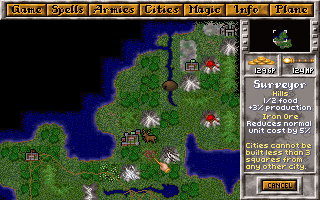
How broken balance creates ridiculous army builds
Designer Steve Barcia and the programming team at SimTex, Inc. created an engine closely tied to their work on Master of Orion, leaning heavily into player freedom over tight competitive balance. Rather than forcing every faction into a sanitized numerical symmetry, the game lets you stack magical traits and racial passives into hilarious power combinations. You might play as Halflings with absurd slingers that demolish heavily armored knights before they reach your front line, or choose Klackons to aggressively out-produce everyone else through unyielding labor bonuses.
The most famous example, passed around by players for decades, is the notorious Adamantium Flying Paladins build. By conquering an adamantium ore site on Myrror, casting high-tier Life Magic buffs like Flight and Invulnerability onto elite High Elf or High Men Paladins, you create a squad of glowing, flying, unstoppable juggernauts. Watching four units of Paladins glide over sea channels and obliterate an enemy wizard's fortress in a single turn was the absolute peak of nineties DOS strategy.
That extreme flexibility cuts both ways, however. Because map generation, starting magic traits, and race placements vary so violently, difficulty curves in this 1994 release swing wildly from turn to turn. You might spawn next to a friendly node and snowball into an almighty archmage within fifty turns, or land right beside a hostile rival wizard armed with Death Magic who systematically drains your population before you finish building a basic barracks.
Launch disasters, essential patches, and late-game micro-management
When published by MicroProse Software, Inc., the retail release gained immediate notoriety for being an unplayable, bug-ridden release. The original version crashed constantly, suffered from broken spell calculations, and featured an AI so incompetent that enemy armies routinely stood still while player spells decimated them. It took the famous version 1.31 patch in March 1995 to clean up the code, stabilize the game engine, and give the computer players enough teeth to put up a genuine fight.
Even with the official fixes and later fan-made patches, structural headaches persist once your empire spans both planes. Late-game management becomes a grueling grind of manual administration:
The interface offers no build queues for cities, meaning you must manually assign new construction projects across dozens of settlements every few turns. There is no automated auto-buy setting for rushing city improvements, and managing endless garrisons across two massive maps turns the final march toward victory into an endless exercise in unit clicks. Furthermore, late-game AI still struggles with high-level wizard play, often failing to defend its home fortress effectively against fully geared hero parties.
Musically, the game shines bright thanks to compositions by George "Fat Man" Sanger and David Govett. The soundtrack makes fantastic use of standard Sound Blaster FM synthesis and General MIDI gear, giving each wizard realm a distinct, memorable acoustic atmosphere that stays stuck in your head long after you turn off your monitor.
Conquer Arcanus and Myrror right in your browser
If you want to experience a classic Master of Magic MS-DOS game run today, you will find that its core decision loop holds up well despite the UI friction. Combining weird spell books, gearing up overpowered heroes, and conquering two worlds at once is still a blast that modern strategy titles rarely dare to replicate. Late-game micromanagement will test your patience, but the early expansion push will keep you clicking Next Turn until 2 AM.
You can play Master of Magic online right now, completely free in your browser with zero setup. Launch it directly in your tab, pick your custom magic books, hire your first hero, and test out your favorite wild unit builds without needing to configure a single local archive or install an emulator.
How Master of Magic is played — the keys the game listens to, grouped by what they do.
- Action
- Interface
- Left click — Purify corrupted land
Highlighted keys are mapped — hover or tap one to see what it does.
Configuration and sound setup are managed via INSTALL.EXE; key remapping is not supported.
Players' controls
Touch and gamepad controls
The on-screen keyboard and gamepad mapping the browser player uses on a phone, a tablet or a controller, as opposed to the real keys above. $PRO members make their own in the player and share them here; anyone can pick one to play with.
Make your own touch controlsPRO
- 1Open the editorSign in below, then pick what to make. The game starts with the editor open over it.
- 2Place your keysAdd keys and drag them where your thumbs rest, or map a controller's buttons. Test plays the game with them; Save keeps them, and you play with them from then on.
- 3Share themShare them right after saving in the game, or name and share them here. Players vote, and the best become this game's controls for everyone.
Go PROSee how it worksSign in+20 XP for sharing · +50 XP if yours become the game's own
- The game's own controlsKeyboardGamepadWhat every player starts with.In use
2 screenshots
From the archive
No gameplay video yet
No gameplay video for Master of Magic yet. Sign in to add one.
No reviews yet
Tell the community what you think of Master of Magic. Reviews are public and tied to your username.
No archived manuals for Master of Magic yet
No manuals archived for this title yet. Sign in to upload the first scan.
Cheat codes, console commands and memory pokes for Master of Magic — each one verified and attributed.
Sign in to submitNo cheats yet for this title
Know a working cheat, poke or trainer? Add it with the button above. Moderators check every entry before it goes live.
No archived soundtrack for Master of Magic yet
No soundtrack archived for this title yet. Sign in to upload the first rip.
No save states for Master of Magic yet
No save states for this title yet. Sign in to share one.
Discussions
Sign in to post- Threads0
- Total posts0
- Online now6
Community · Master of Magic
Who's contributing, and what's new
- Reviews0
- Threads0
- Uploadsapproved0
- Contributors0
Recent activity
Nothing here yet
Reviews, discussion threads and approved uploads appear here as members add them.