
Playing Master of Orion means making ruthless choices: you spend your first turns pulling sliders back and forth to decide if your colonies should build factories, clean up pollution, or crank out colony ships.
Civilization in deep space without the planetary bloat
Most strategy games released around 1993 forced you to manage every single town or planet by hand. Master of Orion skips that headache entirely. Instead of clicking through dozens of individual planet screens every single turn to queue up buildings, designer Steve Barcia organized each colony around five basic budget sliders: Ship Construction, Industry, Ecology, Defense, and Technology.
If a new colony needs infrastructure, you dump everything into Industry. Once the factories are built, you shift that money into Ecology to scrub the toxic waste so your population can grow. If a rival fleet enters the system, you slide resources into Defense to raise shield grids and missile bases. It is a lean system that keeps the focus squarely on high-level empire expansion, which is why journalist Alan Emrich famously coined the term "4X" (eXplore, eXpand, eXploit, eXterminate) while previewing the early build for Computer Gaming World.
Ten alien species and custom ship building
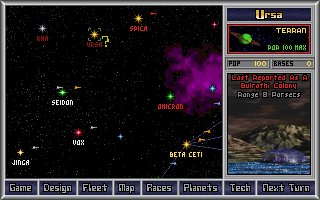
Choosing your race at the start drastically changes your strategy. Playing as the Bulrathi lets you bully neighbors in ground invasions with sheer physical strength, while the Silicoids ignore environmental pollution entirely, colonizing fiery or radioactive rocks that would kill anyone else. The Psilons get a massive boost to scientific research, making them ideal for players who like to out-tech their foes.
When war starts, victory depends on how well you tailor your fleet in the ship designer. You do not just build generic cruisers; you pick the hull size, engine speeds, shields, cloaking devices, and weapon payloads. Designing a stack of cheap frigates packed with biological weapons to wipe out enemy populations before landing troops is just as viable as building massive dreadnoughts wrapped in heavy armor.
Spies, copy protection, and the Guardian of Orion
Diplomacy in this strategy game goes well beyond basic trade agreements. You can send spies to sabotage enemy factories or steal military tech, though getting caught offends opponents quickly. If you want a massive shortcut to victory, you can hunt down Orion, a planet packed with lost technology. Standing in your way is the Guardian, a massive automated warship that will instantly vaporize under-prepared invasion fleets.
MicroProse and SimTex, Inc. also put a creative spin on anti-piracy protection. Instead of outright crashing if you failed the manual check, the executable quietly corrupted game variables. Your income would drop to zero, enemy empires would instantly gain maxed-out tech, and the AI would gang up on you within five turns.
Where the 1993 design starts to show its age
For all its strengths, the original DOS version has clear rough edges. The pixel art UI looks functional rather than flashy, and late-game fleet battles can drag down to a crawl when hundreds of small ships crowd the tactical screen. The AI opponent will also pull absurd amounts of free resources on higher difficulty settings rather than outsmarting you strategically.
Yet despite these visual limitations, the game holds up better than many of its contemporaries published by MicroProse Software, Inc. during the early nineties. The slider mechanics prevent the mid-game slog that ruins larger space simulations, making every turn move at a rapid pace.
How to play Master of Orion free in your browser today
If you want to experience the original hit from 1993, you can play Master of Orion online right here in your browser. There is nothing to install or configure, so you can jump straight into the galaxy map within seconds.
Start a game on a small map as the Psilons for your first run. Watching how fast your tech tree expands as you slide all your budget into research gives you an instant feel for why this space simulator redefined strategy gaming.
How Master of Orion is played — the keys the game listens to, grouped by what they do.
- Movement
- Action
- Interface
- Left click — Select or center screen
Highlighted keys are mapped — hover or tap one to see what it does.
A mouse is highly recommended for standard gameplay. System options like sound and input are set using INSTALL.EXE.
Players' controls
Touch and gamepad controls
The on-screen keyboard and gamepad mapping the browser player uses on a phone, a tablet or a controller, as opposed to the real keys above. $PRO members make their own in the player and share them here; anyone can pick one to play with.
Make your own touch controlsPRO
- 1Open the editorSign in below, then pick what to make. The game starts with the editor open over it.
- 2Place your keysAdd keys and drag them where your thumbs rest, or map a controller's buttons. Test plays the game with them; Save keeps them, and you play with them from then on.
- 3Share themShare them right after saving in the game, or name and share them here. Players vote, and the best become this game's controls for everyone.
Go PROSee how it worksSign in+20 XP for sharing · +50 XP if yours become the game's own
- The game's own controlsKeyboardGamepadWhat every player starts with.In use
2 screenshots
From the archive
No gameplay video yet
No gameplay video for Master of Orion yet. Sign in to add one.
No reviews yet
Tell the community what you think of Master of Orion. Reviews are public and tied to your username.
No archived manuals for Master of Orion yet
No manuals archived for this title yet. Sign in to upload the first scan.
Cheat codes, console commands and memory pokes for Master of Orion — each one verified and attributed.
Sign in to submitNo cheats yet for this title
Know a working cheat, poke or trainer? Add it with the button above. Moderators check every entry before it goes live.
No archived soundtrack for Master of Orion yet
No soundtrack archived for this title yet. Sign in to upload the first rip.
No save states for Master of Orion yet
No save states for this title yet. Sign in to share one.
Discussions
Sign in to post- Threads0
- Total posts0
- Online now6
Community · Master of Orion
Who's contributing, and what's new
- Reviews0
- Threads0
- Uploadsapproved0
- Contributors0
Recent activity