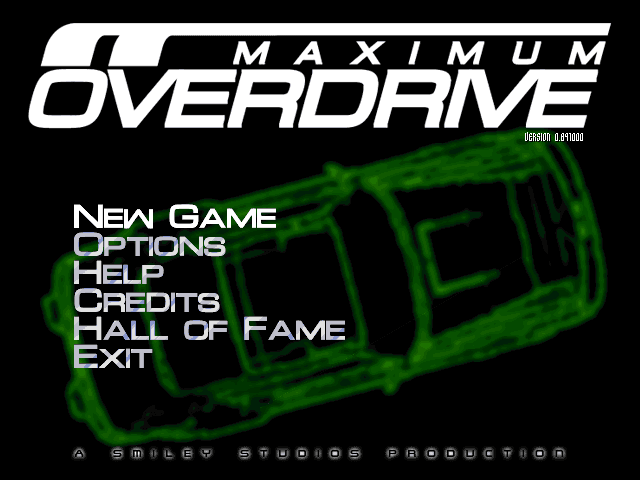
In Maximum Overdrive, you are dropped straight into top-down vehicular combat where ten cars slam into each other on narrow tarmac while scrambling for random powerups.
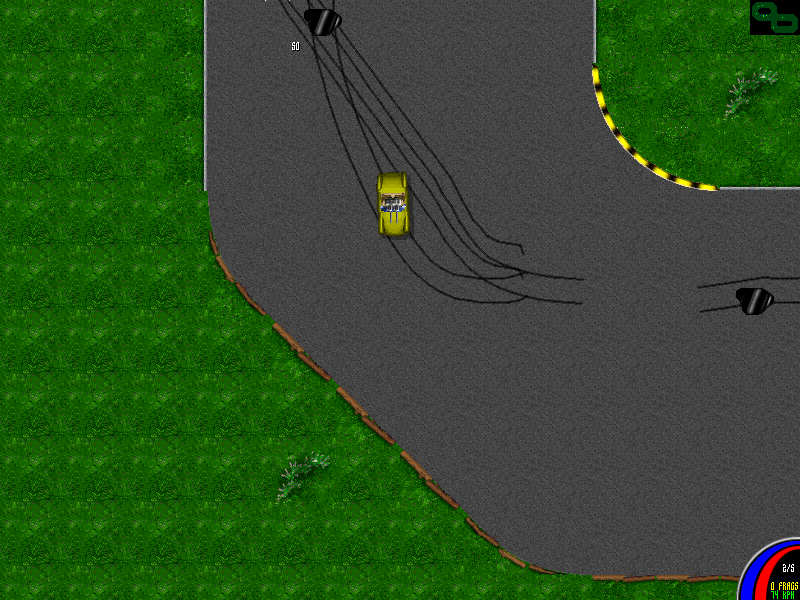
You boot up the game, pick the number of players, and find yourself immediately sitting on a grid surrounded by engine smoke and aggressive competitors. The camera locks overhead, giving you a clear view of the sweeping turns and hairpin bends, but that bird's-eye view does not make staying on the road any easier. Cars bump against each other with real inertia, and taking a corner too fast sends you sliding sideways directly into the outer walls.
The core loop follows the classic top-down combat arcade formula made famous by titles like Death Rally. As you speed around the circuit, glowing weapon pick-ups spawn periodically on the racing line. Grabbing one lets you fire off projectiles at the vehicles ahead of you, turning a simple hot lap into a frantic survival match where staying in front means dodging rockets from behind.
Everything runs fast and fluid right out of the box. The game scales up to ten vehicles on track simultaneously, filling the display with tight packs of stock cars fighting for every inch of position. The collision physics feel punchy, and the visual effects give explosions and tire smoke a clean, readable look that keeps the action legible even when four cars detonate in the same turn.
Developer Michael Davies built this project using the popular Allegro programming library, which was a favorite among PC hobbyist coders at the turn of the millennium. Thanks to those underlying C structures, the game achieves smooth frame rates and responsive keyboard handling that rivaled commercial DOS releases of the late 1990s. The engine handles multiple sprite layers, track physics, and sound routines without breaking a sweat on period-accurate hardware.
However, the project reached a sudden halt at version 0.891. Because development stopped before reaching a 1.0 milestone, several planned systems never materialized. There are no grand career modes, no persistent garages, no vehicle upgrade trees, and no named rival drivers to track across a season. What you get is a raw, mechanical proof of concept that nailed its core driving feel but lacked the wrapped-around framework of a finished retail release.
The incomplete nature of the build extends to car selection as well. Instead of buying vehicles or picking your favorite chassis in a showroom menu, the game assigns vehicles to human players and computer drivers at random. One round you might end up in a fast, nimble racer, and the next you are stuck struggling with heavy steering in a bulky truck. It adds an element of chaotic party-game luck, but it removes the tactical choice serious driving fans usually expect from a racing / driving game.
Because the main executable officially shipped with only a single finished circuit, the track editor included with the download carries a huge amount of the game's replay value. This utility allows you to lay down custom asphalt tiles, define wall boundaries, set starting grid coordinates, and place powerup spawn markers. Designing a punishing course filled with dead-end chicanes takes only a few minutes, giving crafty players a way to generate fresh racing lines when the default oval gets predictable.
Local multiplayer is where the design shows its true strengths. Up to four human players can share a single keyboard in split-screen mode, competing against each other and up to six computer drivers filled into the remaining grid spots. Trying to crowd four pairs of hands around one board while steering through tight chicanes creates a hilarious, noisy mess that modern online multiplayer rarely replicates.
The top-down perspective works heavily in favor of this shared-screen setup. Knowing where your opponents are, who just picked up a missile powerup, and where the next track hazard lies allows you to plan aggressive block passes well in advance. It delivers the same immediate, tactile satisfaction that made combat racers standard fare on home computers throughout the late nineties.
If you try running this freeware release on vintage hardware or a local installation, you will quickly hit a infamous technical wall. The executable relies on DOS extender routines that clash with standard memory managers, meaning you usually need a specially modified version of CWSDPMI.EXE just to launch the executable in modern emulation setups without crashing to a prompt.
The single built-in track also means single-player sessions exhaust their content quickly. Without custom user tracks loaded into the directory, racing against nine computer opponents on the same loop over and over again offers little long-term motivation. The AI drivers follow rigid racing lines, so once you master the powerup timings and corner braking points, victory becomes a predictable routine rather than a dynamic challenge.
Despite those missing standard features, Michael Davies crafted something that plays surprisingly well in short bursts. The driving mechanics have real weight, the weapons hit hard, and the visual feedback is crisp. It gives a fascinating glance at what homebrew developers were building around the year 2000 right before MS-DOS gaming faded away entirely in favor of native Windows 98 development.
You do not need to hunt down modified memory extenders, tweak configuration files, or build your own track files just to experience this piece of PC history. You can play Maximum Overdrive free in your browser right now with all four keyboard inputs supported and ready to go.
Whether you want to try out the split-screen action with friends or just see how intense a ten-car pileup looks in top-down view, you can play Maximum Overdrive online right here without installing anything. Load up the grid, grab the first rocket spawn on turn one, and see if you can hold off nine aggressive cars to take the checkered flag.
In Maximum Overdrive, you are dropped straight into top-down vehicular combat where ten cars slam into each other on narrow tarmac while scrambling for random powerups.
You boot up the game, pick the number of players, and find yourself immediately sitting on a grid surrounded by engine smoke and aggressive competitors. The camera locks overhead, giving you a clear view of the sweeping turns and hairpin bends, but that bird's-eye view does not make staying on the road any easier. Cars bump against each other with real inertia, and taking a corner too fast sends you sliding sideways directly into the outer walls.
The core loop follows the classic top-down combat arcade formula made famous by titles like Death Rally. As you speed around the circuit, glowing weapon pick-ups spawn periodically on the racing line. Grabbing one lets you fire off projectiles at the vehicles ahead of you, turning a simple hot lap into a frantic survival match where staying in front means dodging rockets from behind.
Everything runs fast and fluid right out of the box. The game scales up to ten vehicles on track simultaneously, filling the display with tight packs of stock cars fighting for every inch of position. The collision physics feel punchy, and the visual effects give explosions and tire smoke a clean, readable look that keeps the action legible even when four cars detonate in the same turn.
Developer Michael Davies built this project using the popular Allegro programming library, which was a favorite among PC hobbyist coders at the turn of the millennium. Thanks to those underlying C structures, the game achieves smooth frame rates and responsive keyboard handling that rivaled commercial DOS releases of the late 1990s. The engine handles multiple sprite layers, track physics, and sound routines without breaking a sweat on period-accurate hardware.
However, the project reached a sudden halt at version 0.891. Because development stopped before reaching a 1.0 milestone, several planned systems never materialized. There are no grand career modes, no persistent garages, no vehicle upgrade trees, and no named rival drivers to track across a season. What you get is a raw, mechanical proof of concept that nailed its core driving feel but lacked the wrapped-around framework of a finished retail release.
The incomplete nature of the build extends to car selection as well. Instead of buying vehicles or picking your favorite chassis in a showroom menu, the game assigns vehicles to human players and computer drivers at random. One round you might end up in a fast, nimble racer, and the next you are stuck struggling with heavy steering in a bulky truck. It adds an element of chaotic party-game luck, but it removes the tactical choice serious driving fans usually expect from a racing / driving game.
Because the main executable officially shipped with only a single finished circuit, the track editor included with the download carries a huge amount of the game's replay value. This utility allows you to lay down custom asphalt tiles, define wall boundaries, set starting grid coordinates, and place powerup spawn markers. Designing a punishing course filled with dead-end chicanes takes only a few minutes, giving crafty players a way to generate fresh racing lines when the default oval gets predictable.
Local multiplayer is where the design shows its true strengths. Up to four human players can share a single keyboard in split-screen mode, competing against each other and up to six computer drivers filled into the remaining grid spots. Trying to crowd four pairs of hands around one board while steering through tight chicanes creates a hilarious, noisy mess that modern online multiplayer rarely replicates.
The top-down perspective works heavily in favor of this shared-screen setup. Knowing where your opponents are, who just picked up a missile powerup, and where the next track hazard lies allows you to plan aggressive block passes well in advance. It delivers the same immediate, tactile satisfaction that made combat racers standard fare on home computers throughout the late nineties.
If you try running this freeware release on vintage hardware or a local installation, you will quickly hit a infamous technical wall. The executable relies on DOS extender routines that clash with standard memory managers, meaning you usually need a specially modified version of CWSDPMI.EXE just to launch the executable in modern emulation setups without crashing to a prompt.
The single built-in track also means single-player sessions exhaust their content quickly. Without custom user tracks loaded into the directory, racing against nine computer opponents on the same loop over and over again offers little long-term motivation. The AI drivers follow rigid racing lines, so once you master the powerup timings and corner braking points, victory becomes a predictable routine rather than a dynamic challenge.
Despite those missing standard features, Michael Davies crafted something that plays surprisingly well in short bursts. The driving mechanics have real weight, the weapons hit hard, and the visual feedback is crisp. It gives a fascinating glance at what homebrew developers were building around the year 2000 right before MS-DOS gaming faded away entirely in favor of native Windows 98 development.
You do not need to hunt down modified memory extenders, tweak configuration files, or build your own track files just to experience this piece of PC history. You can play Maximum Overdrive free in your browser right now with all four keyboard inputs supported and ready to go.
Whether you want to try out the split-screen action with friends or just see how intense a ten-car pileup looks in top-down view, you can play Maximum Overdrive online right here without installing anything. Load up the grid, grab the first rocket spawn on turn one, and see if you can hold off nine aggressive cars to take the checkered flag.
How Maximum Overdrive is played — the keys the game listens to, grouped by what they do.
Highlighted keys are mapped — hover or tap one to see what it does.
Maximum Overdrive supports up to 4 players on a single keyboard, as well as a mouse-driven menu interface.
The on-screen keyboard and gamepad mapping the browser player uses on a phone, a tablet or a controller, as opposed to the real keys above. $PRO members make their own in the player and share them here; anyone can pick one to play with.
Cheat codes, console commands and memory pokes for Maximum Overdrive — each one verified and attributed.
Sign in to submitHow Maximum Overdrive is played — the keys the game listens to, grouped by what they do.
Highlighted keys are mapped — hover or tap one to see what it does.
Maximum Overdrive supports up to 4 players on a single keyboard, as well as a mouse-driven menu interface.
The on-screen keyboard and gamepad mapping the browser player uses on a phone, a tablet or a controller, as opposed to the real keys above. $PRO members make their own in the player and share them here; anyone can pick one to play with.
Cheat codes, console commands and memory pokes for Maximum Overdrive — each one verified and attributed.
Sign in to submit