
MDK
aka MDK: Mission Laguna Beach · Murder Death Kill
Shiny Entertainment's 1997 action game MDK drops you straight out of an airplane, glides you across surreal alien mining rigs, and forces you to shoot distant target locks through a helmet-mounted sniper scope zoomed in a hundred times over.
Falling into the bizarre sci-fi world of MDK
You start every mission plunged into open air. As Kurt Hectic, a space-station janitor shoved into a slick leather-like Coil Suit by his boss Dr. Fluke Hawkins, your task is to dive from orbit onto city-sized alien mining vehicles known as Minecrawlers. The entry sequence functions as a high-speed free-fall minigame where you steer past atmospheric heat and incoming fire to gather power-ups before touching down on locations like Laguna Beach, Lindfield, and Sparrow Pit.
Once your boots hit the floor, the full weirdness of the invading Stream Riders takes over. Minecrawlers carry sprawling arenas filled with alien grunts called Bottrocks, swirling wind tunnels, and massive arena-sized puzzles. To navigate these metal behemoths, Kurt relies on a metallic ribbon parachute built into his suit, letting you float across wide chasms and ride warm air currents indefinitely to reach high ledges.
The combat shifts constantly between rapid arena running and stationary long-distance target shooting. One moment you are spraying heavy fire into swarms of grunts, and the next you are standing completely still, aiming down a high-precision helmet lens to pick off a door lock mounted on a tower half a mile away.
Software rendering that left hardware acceleration behind
Conceived and designed by Nick Bruty at Shiny Entertainment, Inc., the project moved in a very different technical direction from its contemporaries. While other studios in 1997 insisted players buy specialized 3D graphics cards, lead programmers Andy Astor and Martin Brownlow created a custom software-rendering engine and their own internal programming language. Producer David Perry helped oversee a technical structure built to render massive open geometry without hardware assistance.
That architectural bet meant the original release ran smoothly on a standard Pentium processor running between 60 and 90 MHz. The team even left in developer cheat codes like 486ok and 486willbeslow, allowing players with older processors to bypass the system check and run the engine anyway, albeit at a crawl. Coupled with dynamic music produced by Tommy Tallarico and Todd Dennis that escalated alongside the action, it delivered high-speed 3D visuals straight through standard PC sound cards and processors.
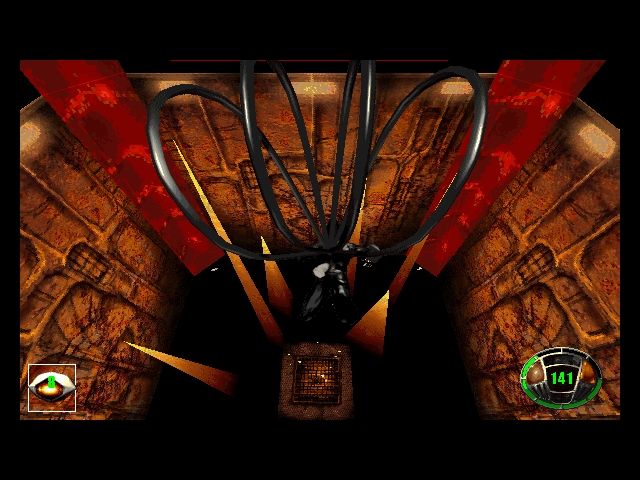
When published in North America by Playmates Interactive Entertainment, Inc., the combination of sleek aesthetic design and technical efficiency turned heads immediately. Reviews across major computer magazines praised the fluid framerates achieved without add-on hardware, establishing the engine as a premier example of late-nineties software engineering.
Sniper scopes, giant bombs, and oddball humor
Combat relies on two primary suit functions. Kurt's right arm features a rapid-fire Chaingun for clearing roomfuls of enemies, while his helmet converts into a sniper rifle capable of 100x optical magnification. Entering sniper mode alters the game loop dramatically, locking your feet to the floor while opening up specialized ammunition types:
- Sniper Mortars for long-range artillery strikes on distant turrets.
- Homing Sniper Grenades that track fast-moving enemy commanders around corners.
- The World's Most Interesting Bomb, an explosive device that forces nearby alien grunts to gather around it in curiosity before detonating.
- Holo-Kurt Decoys that draw enemy fire away from your position during heavy firefights.
Between firefights, the game constantly switches up its style. You will disguise yourself as an alien sentry robot to fool door guards, ride energy streams at high speed, and steer Kurt down giant snow tracks on an improvised snowboard. The developers padded the levels with tongue-in-cheek secrets, including hidden Earthworm Jim heads scattered on floors that drop heavy cows onto nearby enemies or onto Kurt himself when stepped on.
Even the name contained its own running joke. While fans and gaming magazines assumed the letters stood for Murder Death Kill or the main characters Max, Doc, and Kurt, the development team consistently insisted in interviews that the initials officially stood for nothing at all.
Where the suit fits and where the controls pinch
For all its visual flair and mechanical surprises, the experience is not without friction. The original keyboard layout uses rigid tank-style controls, forcing you to freeze in place whenever you open the sniper interface. Trying to make subtle adjustments to your aim while taking direct enemy fire can make controls feel stiff to modern hands, and early releases lacked fully customizable key bindings.
The campaign is also notoriously short. Spanning just 6 large level sets, experienced players can easily reach the final boss battle against Gunter Glut in a single long sitting. The narrative connecting these missions remains bare, serving mostly as a light scaffold to shuttle Kurt from one bizarre Minecrawler location to another.
Despite those flaws, the sheer variety of play keeps it fresh throughout its brief runtime. Compared to other major 3D titles among action games from 1997, its refusal to take itself seriously gave it a sharp, distinct personality. It went on to become a major commercial success, selling over 400,000 units by mid-1998 and half a million copies globally before its sequel arrived.
You can play MDK free in your browser right now
If you want to experience that hundred-fold zoom and drop a giant cow onto alien grunts without tracking down vintage hardware, you can play MDK online right now. It loads directly as an MDK MS-DOS game inside your browser window, giving you full access to Kurt's entire arsenal with nothing to install and no complex setup required.
Load up World 1, jump straight out of the drop ship, and fire off the World's Most Interesting Bomb into a crowd of Bottrocks to see why this bizarre shooter still holds up so well today.