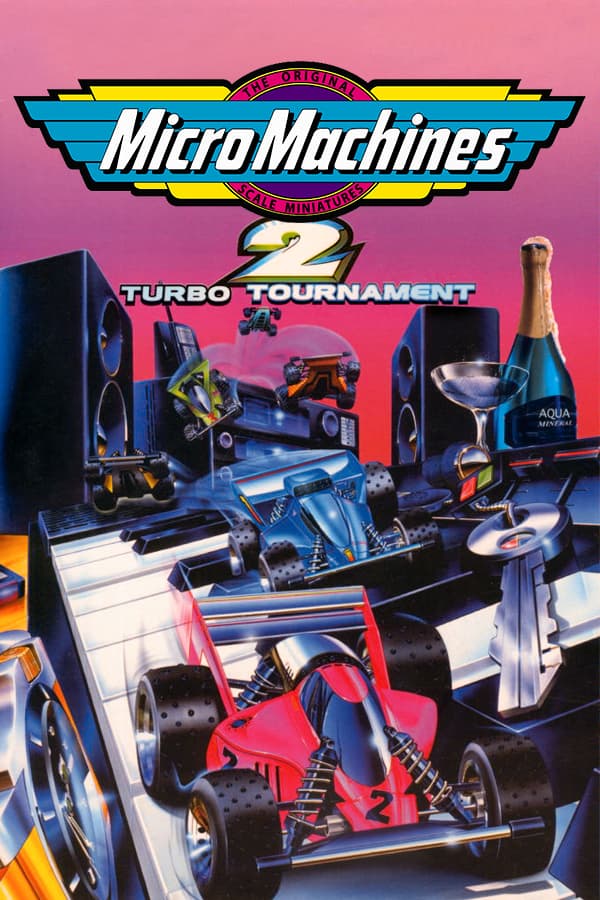
Micro Machines 2: Turbo Tournament takes tiny toy vehicles and pitches them across pool tables, kitchen counter tops, and toilet bowls in a top-down arcade dash where one wrong turn drops you off the wood into space.
When Codemasters needed a follow-up to their original miniature racer, they turned to Supersonic Software Ltd. to build a fresh game from scratch. The original programmer was unavailable, so the team coded a brand-new engine for this 1995 release. What landed on MS-DOS retains the distinct core of the series, but it plays with a noticeably different rhythm than its console siblings.
If you come to the MS-DOS racing game straight from the Mega Drive version, the first thing you notice is how close the virtual camera sits to your car. The framing is tighter, cutting off your sightlines and giving you far less time to react to an incoming curve. To balance that claustrophobic view, the developers dialed back the raw speed and gave the tires firmer traction. You skid less, but you must read the track layout with real precision if you want to stay on the tabletop.
The steering is quick and twitchy. Every vehicle type handles distinctly, forcing you to adjust your muscle memory instantly from one stage to the next. High-strung Formula 1 cars demand microscopic adjustments on straightaways, while hovercrafts turn like floating soap bars that refuse to grip the surface. Steering a powerboat across water hazard troughs feels nothing like steering a quad bike through mud, and mastering all of them is the only way to clear the single-player campaign.
The stage design is where the game shows off its personality. You race over kitchen counters scattered with cutlery and stray peas, across workshop tables where spinning drill bits and buzz saws threaten to chop your chassis, and along dusty attic floorboards filled with loose clutter. One track sends you looping around the rim of a toilet bowl, while another turns a music room into a soundboard where your tires tap out notes across piano keys and xylophones.
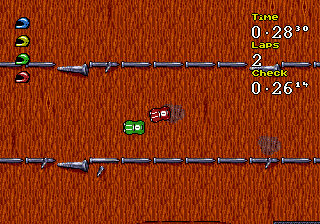
The environments are detailed, even if the background props remain static obstacles rather than animated hazards. What makes them dangerous is how quickly the edge of a desk arrives when you overcook a turn. Fall off the side of a billiards table or misjudge a leap off a ruler, and your vehicle tumbles off screen to concede a point. Interactive elements like crumbling sand dunes on beach stages and spinning workshop machinery make clean racing an exercise in crowd control.
Not every course is a joy to navigate, however. The game features some severe difficulty spikes that bring progress to a jarring halt. The track known as Ferry Fiasco remains infamous among players for its unforgiving timing and tight margins, where one minor mistake leaves you stranded in the water. Worse still are the bonus time-trial stages featuring the giant-wheeled truck Rufftrux. The vehicle responds awkwardly to inputs, turning those mandatory clock-chasing events into brick walls for everyone except dedicated masters of the physics engine.
While the solo challenge provides plenty of friction, multiplayer is where the game shines brightest. The PC release supports four players driving simultaneously on a single computer using shared keyboard controls, joysticks, or a Gravis GamePad. Squeezing three friends around one keyboard leads to physical jostling that matches the collision physics on screen, making head-to-head battles genuinely chaotic.
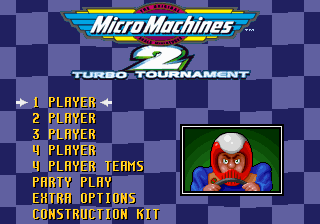
If you have a bigger crowd, the built-in hot-seat mode lets up to 16 players take turns competing across tournament brackets. The roster of drivers includes a colorful cast of cartoon characters alongside real-world British television host Violet Berlin, who makes a cameo as a selectable racer. To top off the package, The Codemasters Software Company Limited included Red Book CD-audio music tracks composed by Tim Bartlett and Gerard Gourley, giving the PC release a crisp, punchy audio backdrop.
The best part of the MS-DOS release is the built-in Construction Kit. This track editor gives you direct access to the game’s tile sets, letting you lay down custom ribbons of asphalt, pool felt, or kitchen linoleum. Designing custom layouts with brutal jump angles and cruel hairpin turns lets you torture your local player group with tailor-made courses long after you clear the official championships.
The single-player campaign has some real rough edges. The tight framing on PC makes track memory far more important than raw reaction time, and the difficulty leaps in the Rufftrux stages can make you want to throw your controller across the room. Still, the responsive vehicle physics, creative household environments, and track creation kit keep the action fast and satisfying.
It holds up best as a local party game, standing alongside period classics like Super Off Road and Death Rally in its ability to turn simple position battles into loud shouting matches. If you want to sample a classic piece of 90s top-down racing, you can read more about its history on Wikipedia or dive straight into the action yourself.
You can play Micro Machines 2: Turbo Tournament free in your browser right now, with full keyboard support and zero setup required. Jump into a Head-to-Head race, pick Violet Berlin or your favorite driver, and see how long you can keep a toy car on a kitchen table without driving off the rim.
Micro Machines 2: Turbo Tournament takes tiny toy vehicles and pitches them across pool tables, kitchen counter tops, and toilet bowls in a top-down arcade dash where one wrong turn drops you off the wood into space.
When Codemasters needed a follow-up to their original miniature racer, they turned to Supersonic Software Ltd. to build a fresh game from scratch. The original programmer was unavailable, so the team coded a brand-new engine for this 1995 release. What landed on MS-DOS retains the distinct core of the series, but it plays with a noticeably different rhythm than its console siblings.
If you come to the MS-DOS racing game straight from the Mega Drive version, the first thing you notice is how close the virtual camera sits to your car. The framing is tighter, cutting off your sightlines and giving you far less time to react to an incoming curve. To balance that claustrophobic view, the developers dialed back the raw speed and gave the tires firmer traction. You skid less, but you must read the track layout with real precision if you want to stay on the tabletop.
The steering is quick and twitchy. Every vehicle type handles distinctly, forcing you to adjust your muscle memory instantly from one stage to the next. High-strung Formula 1 cars demand microscopic adjustments on straightaways, while hovercrafts turn like floating soap bars that refuse to grip the surface. Steering a powerboat across water hazard troughs feels nothing like steering a quad bike through mud, and mastering all of them is the only way to clear the single-player campaign.
The stage design is where the game shows off its personality. You race over kitchen counters scattered with cutlery and stray peas, across workshop tables where spinning drill bits and buzz saws threaten to chop your chassis, and along dusty attic floorboards filled with loose clutter. One track sends you looping around the rim of a toilet bowl, while another turns a music room into a soundboard where your tires tap out notes across piano keys and xylophones.
The environments are detailed, even if the background props remain static obstacles rather than animated hazards. What makes them dangerous is how quickly the edge of a desk arrives when you overcook a turn. Fall off the side of a billiards table or misjudge a leap off a ruler, and your vehicle tumbles off screen to concede a point. Interactive elements like crumbling sand dunes on beach stages and spinning workshop machinery make clean racing an exercise in crowd control.
Not every course is a joy to navigate, however. The game features some severe difficulty spikes that bring progress to a jarring halt. The track known as Ferry Fiasco remains infamous among players for its unforgiving timing and tight margins, where one minor mistake leaves you stranded in the water. Worse still are the bonus time-trial stages featuring the giant-wheeled truck Rufftrux. The vehicle responds awkwardly to inputs, turning those mandatory clock-chasing events into brick walls for everyone except dedicated masters of the physics engine.
While the solo challenge provides plenty of friction, multiplayer is where the game shines brightest. The PC release supports four players driving simultaneously on a single computer using shared keyboard controls, joysticks, or a Gravis GamePad. Squeezing three friends around one keyboard leads to physical jostling that matches the collision physics on screen, making head-to-head battles genuinely chaotic.
If you have a bigger crowd, the built-in hot-seat mode lets up to 16 players take turns competing across tournament brackets. The roster of drivers includes a colorful cast of cartoon characters alongside real-world British television host Violet Berlin, who makes a cameo as a selectable racer. To top off the package, The Codemasters Software Company Limited included Red Book CD-audio music tracks composed by Tim Bartlett and Gerard Gourley, giving the PC release a crisp, punchy audio backdrop.
The best part of the MS-DOS release is the built-in Construction Kit. This track editor gives you direct access to the game’s tile sets, letting you lay down custom ribbons of asphalt, pool felt, or kitchen linoleum. Designing custom layouts with brutal jump angles and cruel hairpin turns lets you torture your local player group with tailor-made courses long after you clear the official championships.
The single-player campaign has some real rough edges. The tight framing on PC makes track memory far more important than raw reaction time, and the difficulty leaps in the Rufftrux stages can make you want to throw your controller across the room. Still, the responsive vehicle physics, creative household environments, and track creation kit keep the action fast and satisfying.
It holds up best as a local party game, standing alongside period classics like Super Off Road and Death Rally in its ability to turn simple position battles into loud shouting matches. If you want to sample a classic piece of 90s top-down racing, you can read more about its history on Wikipedia or dive straight into the action yourself.
You can play Micro Machines 2: Turbo Tournament free in your browser right now, with full keyboard support and zero setup required. Jump into a Head-to-Head race, pick Violet Berlin or your favorite driver, and see how long you can keep a toy car on a kitchen table without driving off the rim.
How Micro Machines 2: Turbo Tournament is played — the keys the game listens to, grouped by what they do.
Highlighted keys are mapped — hover or tap one to see what it does.
Controls can be remapped using SETUP.EXE. Track Editor optionally supports the mouse.
The on-screen keyboard and gamepad mapping the browser player uses on a phone, a tablet or a controller, as opposed to the real keys above. $PRO members make their own in the player and share them here; anyone can pick one to play with.
Cheat codes, console commands and memory pokes for Micro Machines 2: Turbo Tournament — each one verified and attributed.
Sign in to submitHow Micro Machines 2: Turbo Tournament is played — the keys the game listens to, grouped by what they do.
Highlighted keys are mapped — hover or tap one to see what it does.
Controls can be remapped using SETUP.EXE. Track Editor optionally supports the mouse.
The on-screen keyboard and gamepad mapping the browser player uses on a phone, a tablet or a controller, as opposed to the real keys above. $PRO members make their own in the player and share them here; anyone can pick one to play with.
Cheat codes, console commands and memory pokes for Micro Machines 2: Turbo Tournament — each one verified and attributed.
Sign in to submit