
Playing Might and Magic II: Gates to Another World means balancing party mortality against the slow ticking of a clock that actively ages your heroes until they die of old age. New World Computing built a sprawling first-person RPG that rewards careful party planning while punishing anyone unprepared for its brutal early steps.
Your journey begins in the town of Middlegate with zero gold, basic gear, and six fresh recruits who start with little more than the clothes on their backs. Success in this role-playing game demands careful party composition, as quest locations and magical items actively restrict access based on gender, alignment, and race. A uniform party of good human males will brick your progress early, forcing you to maintain a diverse roster that includes two new character classes introduced for this sequel: the lightly armored, high-damage Barbarian and the stealthy Assassin.
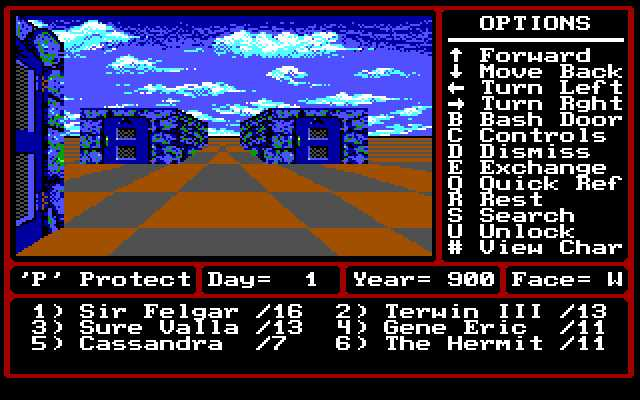
Every character can learn up to two secondary skills, and picking the right pair completely changes how you navigate the step-by-step turn-based movement. Assigning Cartography turns off the headache of manually drawing grid paper maps, while Pickpocket gives your party a steady stream of extra gold in crowded taverns. You can also recruit up to two hired mercenaries to fill gaps in your lineup, provided you can afford their daily wage demands as you step out into the wilderness.
Progression relies heavily on visiting local towns to handle spell distribution and training. Higher-tier magic is not simply handed out when your casters gain experience; you must physically find specific guilds and temples scattered across the world and pay cash to unlock higher spell tiers. That design choice means your party strength is tied as much to your bank balance and geography as it is to raw battle statistics.
Time is a literal enemy in this campaign. Beyond the time-travel subquests required to piece together the narrative, every step, resting period, and tavern visit advances the calendar. As years pass, your party members suffer from character aging, which gradually degrades physical attributes like strength and speed before eventually causing characters to drop dead from natural causes. You can buy magical anti-aging treatments at high costs, but mismanaging time during long dungeon crawls creates real, permanent consequences for veteran adventurers.
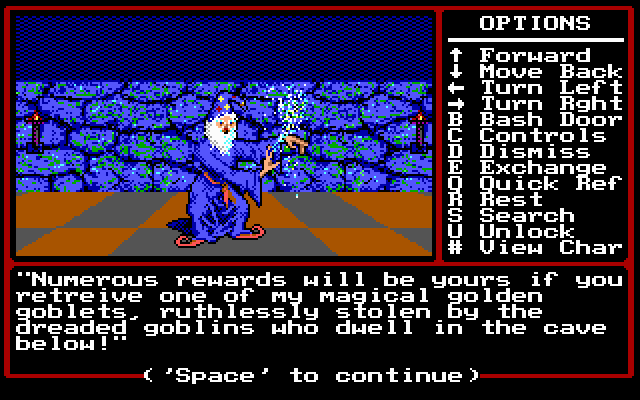
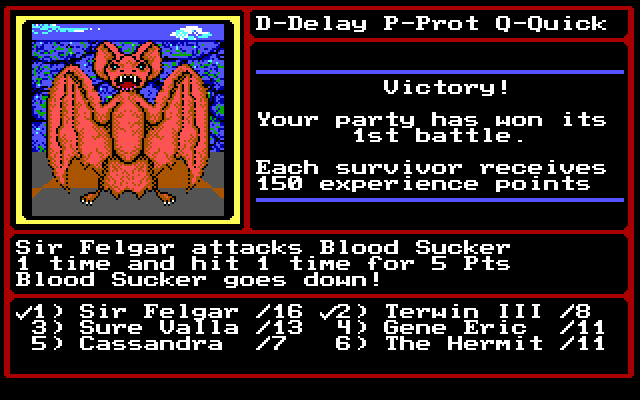
Combat pits your squad against massive groups of monsters, ranging from low-level Conjurors and Witch's cats to fierce Griffins in open terrain. However, the game's difficulty curve suffers from a notorious balancing glitch centered on the infamous "Cuisinart" monster encounters. Defeating these specific enemies awards astronomical payouts up to 7,500,000 experience points in a single fight, instantly boosting a mid-level party into godhood and completely skipping weeks of intended dungeon grinding.
When original magazine reviewers evaluated the release, opinions split sharply over its difficulty and structural choices. While Dragon Magazine praised its massive world and quest design, European publications like Germany's PC Games handed down a cooler 66% rating, calling out the harsh early difficulty and restrictive spell purchases. Contemporary UK outlet The Games Machine landed closer to a 73%, noting that the detailed NPC responses and map depth compensated for the slow initial pacing.
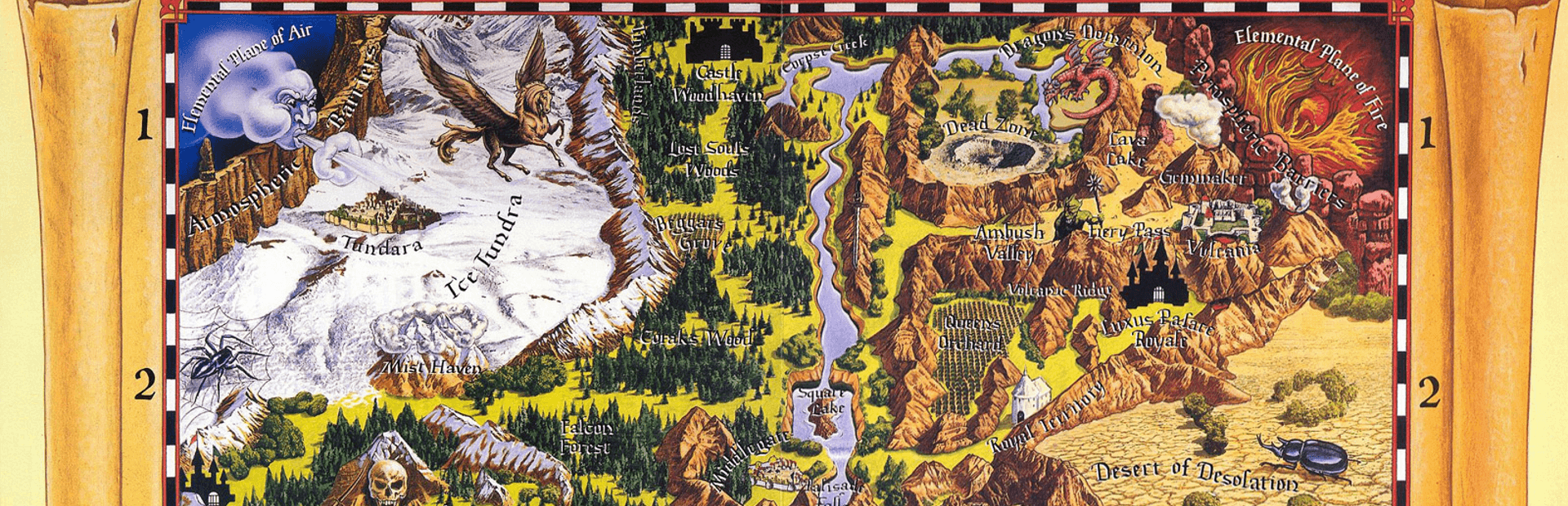
Exploration spans a massive range of environments, taking you from murky sewers beneath starter towns directly into high-level keeps like Mandagual's Keep. The original design by Jon Van Caneghem and Michaela Van Caneghem kept the grid-based first-person viewport of the original title while expanding visual detail. Ported to the PC by Inside Out Software, Inc., the 1988 MS-DOS release delivered crisp CGA and EGA visuals created by Avril Harrison and Jeff Griffeath, alongside audio tuned by composer Raoul Kraushaar.
The main narrative arc tasks you with stopping the villain Sheltem from altering the orbit of CRON and destroying the realm. Much like the original installment, the story eventually peels back its high-fantasy facade to reveal a heavy science-fiction twist. Learning that CRON is actually a giant planetary starship caught players off guard at release, though some felt reusing the spaceship revelation from the first game lacked novelty.
To survive the entire journey, a well-rounded party must master a few specific operational habits:
Decades later, the DOS version of Might and Magic II is a fascinating piece of late-eighties RPG engineering. The opening hours are brutal, and forcing players to buy basic gear with nonexistent starter funds is a questionable design choice. Yet the freedom to explore CRON, experiment with secondary skills, and construct tailored party builds offers a level of depth that many modern dungeon crawlers struggle to match.
If you enjoy turn-based party management, map drawing, and tactical turn order, this entry delivers dozens of hours of pure exploration. While the Cuisinart exploit can ruin character progression if abused, ignoring the trick leaves you with a tight, challenging campaign that respects your strategic choices and punishes foolish overextension.
You can play Might and Magic II: Gates to Another World online right now, free in your browser with zero extra setup. Jump straight into Middlegate, create a mixed party of six adventurers with different races and alignments, and assign Cartography right away so you do not get lost in the sewers. It runs immediately in your browser tab, letting you test your party builds against the monsters of CRON in just a few clicks.
Playing Might and Magic II: Gates to Another World means balancing party mortality against the slow ticking of a clock that actively ages your heroes until they die of old age. New World Computing built a sprawling first-person RPG that rewards careful party planning while punishing anyone unprepared for its brutal early steps.
Your journey begins in the town of Middlegate with zero gold, basic gear, and six fresh recruits who start with little more than the clothes on their backs. Success in this role-playing game demands careful party composition, as quest locations and magical items actively restrict access based on gender, alignment, and race. A uniform party of good human males will brick your progress early, forcing you to maintain a diverse roster that includes two new character classes introduced for this sequel: the lightly armored, high-damage Barbarian and the stealthy Assassin.
Every character can learn up to two secondary skills, and picking the right pair completely changes how you navigate the step-by-step turn-based movement. Assigning Cartography turns off the headache of manually drawing grid paper maps, while Pickpocket gives your party a steady stream of extra gold in crowded taverns. You can also recruit up to two hired mercenaries to fill gaps in your lineup, provided you can afford their daily wage demands as you step out into the wilderness.
Progression relies heavily on visiting local towns to handle spell distribution and training. Higher-tier magic is not simply handed out when your casters gain experience; you must physically find specific guilds and temples scattered across the world and pay cash to unlock higher spell tiers. That design choice means your party strength is tied as much to your bank balance and geography as it is to raw battle statistics.
Time is a literal enemy in this campaign. Beyond the time-travel subquests required to piece together the narrative, every step, resting period, and tavern visit advances the calendar. As years pass, your party members suffer from character aging, which gradually degrades physical attributes like strength and speed before eventually causing characters to drop dead from natural causes. You can buy magical anti-aging treatments at high costs, but mismanaging time during long dungeon crawls creates real, permanent consequences for veteran adventurers.
Combat pits your squad against massive groups of monsters, ranging from low-level Conjurors and Witch's cats to fierce Griffins in open terrain. However, the game's difficulty curve suffers from a notorious balancing glitch centered on the infamous "Cuisinart" monster encounters. Defeating these specific enemies awards astronomical payouts up to 7,500,000 experience points in a single fight, instantly boosting a mid-level party into godhood and completely skipping weeks of intended dungeon grinding.
When original magazine reviewers evaluated the release, opinions split sharply over its difficulty and structural choices. While Dragon Magazine praised its massive world and quest design, European publications like Germany's PC Games handed down a cooler 66% rating, calling out the harsh early difficulty and restrictive spell purchases. Contemporary UK outlet The Games Machine landed closer to a 73%, noting that the detailed NPC responses and map depth compensated for the slow initial pacing.
Exploration spans a massive range of environments, taking you from murky sewers beneath starter towns directly into high-level keeps like Mandagual's Keep. The original design by Jon Van Caneghem and Michaela Van Caneghem kept the grid-based first-person viewport of the original title while expanding visual detail. Ported to the PC by Inside Out Software, Inc., the 1988 MS-DOS release delivered crisp CGA and EGA visuals created by Avril Harrison and Jeff Griffeath, alongside audio tuned by composer Raoul Kraushaar.
The main narrative arc tasks you with stopping the villain Sheltem from altering the orbit of CRON and destroying the realm. Much like the original installment, the story eventually peels back its high-fantasy facade to reveal a heavy science-fiction twist. Learning that CRON is actually a giant planetary starship caught players off guard at release, though some felt reusing the spaceship revelation from the first game lacked novelty.
To survive the entire journey, a well-rounded party must master a few specific operational habits:
Decades later, the DOS version of Might and Magic II is a fascinating piece of late-eighties RPG engineering. The opening hours are brutal, and forcing players to buy basic gear with nonexistent starter funds is a questionable design choice. Yet the freedom to explore CRON, experiment with secondary skills, and construct tailored party builds offers a level of depth that many modern dungeon crawlers struggle to match.
If you enjoy turn-based party management, map drawing, and tactical turn order, this entry delivers dozens of hours of pure exploration. While the Cuisinart exploit can ruin character progression if abused, ignoring the trick leaves you with a tight, challenging campaign that respects your strategic choices and punishes foolish overextension.
You can play Might and Magic II: Gates to Another World online right now, free in your browser with zero extra setup. Jump straight into Middlegate, create a mixed party of six adventurers with different races and alignments, and assign Cartography right away so you do not get lost in the sewers. It runs immediately in your browser tab, letting you test your party builds against the monsters of CRON in just a few clicks.
How Might and Magic II: Gates to Another World is played — the keys the game listens to, grouped by what they do.
Highlighted keys are mapped — hover or tap one to see what it does.
Controls derived from partial secondary source notes as full reference card table was unavailable.
The on-screen keyboard and gamepad mapping the browser player uses on a phone, a tablet or a controller, as opposed to the real keys above. $PRO members make their own in the player and share them here; anyone can pick one to play with.
Cheat codes, console commands and memory pokes for Might and Magic II: Gates to Another World — each one verified and attributed.
Sign in to submitHow Might and Magic II: Gates to Another World is played — the keys the game listens to, grouped by what they do.
Highlighted keys are mapped — hover or tap one to see what it does.
Controls derived from partial secondary source notes as full reference card table was unavailable.
The on-screen keyboard and gamepad mapping the browser player uses on a phone, a tablet or a controller, as opposed to the real keys above. $PRO members make their own in the player and share them here; anyone can pick one to play with.
Cheat codes, console commands and memory pokes for Might and Magic II: Gates to Another World — each one verified and attributed.
Sign in to submit