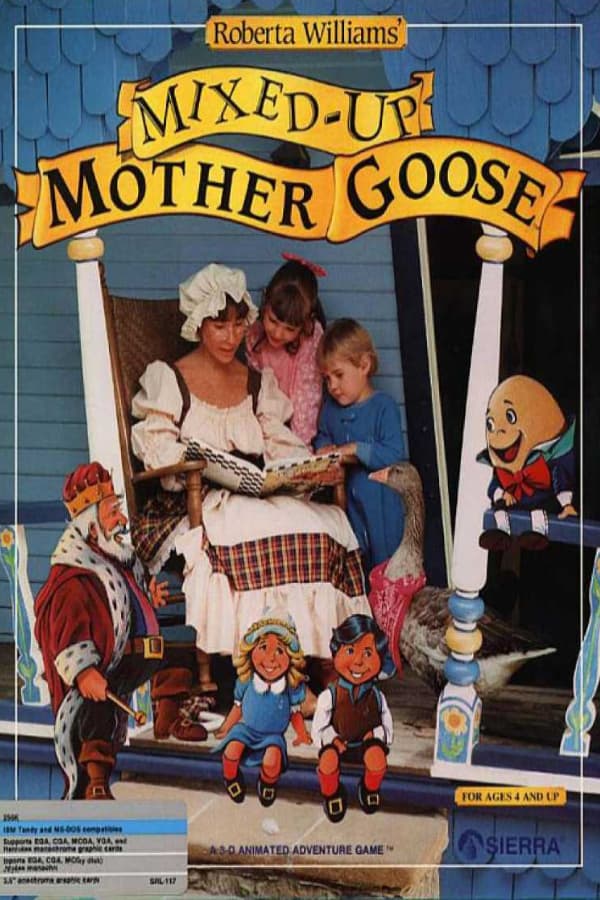
By stripping away complex parser commands and fatal mistakes, Mixed-Up Mother Goose turned traditional computer interaction into a clean item-matching game built for young children.
Most graphic adventure releases from Sierra On-Line, Inc. in the late eighties were notorious for punishing player mistakes. One wrong step off a precipice or an improper verb typed into the prompt meant an immediate game over. Designer Roberta Williams took a radically different direction for this project. She removed the traditional text interface entirely, choosing direct character control so four-year-olds could navigate screens without typing a single word.
Programmed by David Slayback on Sierra's Adventure Game Interpreter (AGI) engine, the 1987 release relied on visual cues instead of command lines. Upon starting, you select from eight customizable child avatars before getting transported to Mother Goose Land. There are no combat encounters, no secret chambers, no health bars, and no game-over screens. Interaction happens automatically when your sprite bumps into objects or non-player characters.
Visual presentation relied on standard 16-color EGA graphics, featuring screen-by-screen flip-screen progression rather than smooth scrolling. Gerald Moore handled the art design, while Al Lowe and Amenda Lombardo arranged the musical score. Every time you return a missing item to its rightful owner, the PC speaker or add-on sound card plays a short, monophonic version of the corresponding nursery rhyme as a reward.
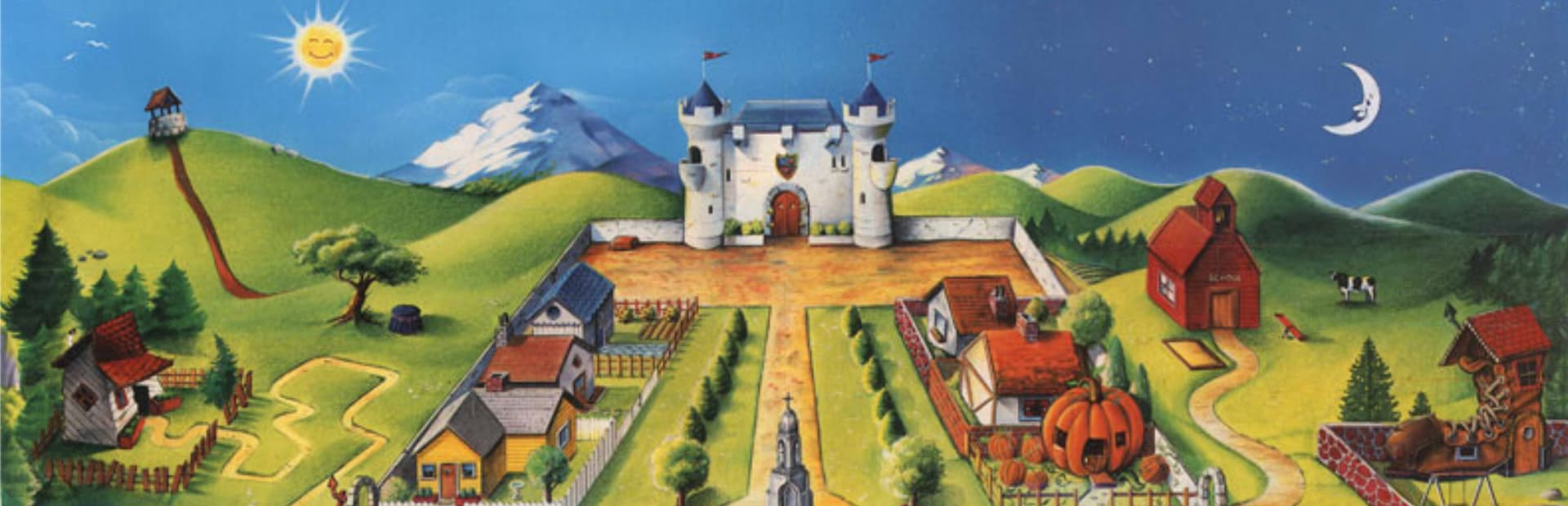
The entire structure resolves around eighteen nursery rhymes scattered across a shared countryside. At the start of every session, eighteen lost objects spawn randomly across the map screens. Your objective is simply to return every item to the proper character to repair their rhyme and complete the game.
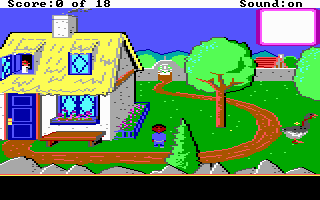
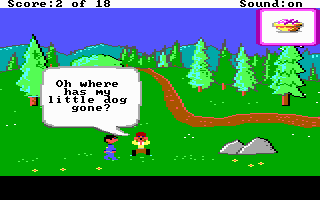
Identifying who needs what requires zero guesswork. When you walk up to a nursery rhyme character, a small thought bubble appears above their head displaying the exact object they are missing. The game features a wide variety of items tied directly to classic folklore:
Because item placement is randomized each time you start, you cannot memorize fixed paths. You must walk from screen to screen, taking note of where objects sit on the grass so you can return for them later.
While the design is forgiving, the actual traversal mechanics hit a distinct physical bottleneck. Your character can only hold one item at a time. If you are carrying Mary's lamb and stumble across Tommy Tucker's slice of bread and butter, you cannot store the bread for later. You have to leave it sitting on the screen, deliver the lamb to Mary, and then walk all the way back to retrieve the bread.
This single-slot restriction turns what should be a swift treasure hunt into a lengthy trek back and forth across flip-screen transitions. Early reviewers noted that while the visual presentation featured jagged edges and somewhat jerky character walking animations, the straightforward goals kept kids focused. Yet even young players quickly notice how much repetition stems from walking back and forth to swap items.
Despite the backtracking, the puzzle design is completely fair. You never run into lateral logic leaps or hidden triggers. You see a ladder, you see a character thinking about a ladder, and you bring the two together.
To avoid forcing young players to manage DOS file paths or type file names, the engine uses a custom "bookmark" system instead of a typical save menu. When children finished playing, the system displayed simple visual indicators representing their current progress. This made resuming a session painless for households without technical background knowledge.
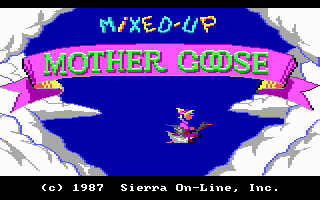
The game established a framework that Sierra On-Line would revisit later with Mixed-Up Fairy Tales in 1991. The concept proved so durable that Sierra used a reworked edition as their very first CD-ROM market release in 1991, adding full speech to replace text. But this original 16-color floppy disk version remains the pure baseline for early educational computer titles.
This release succeeded because it stripped away the frustration of parser-based adventure games without losing the satisfying feel of solving screen-based puzzles. It works as an accessible piece of design, built around quick visual feedback and short musical rewards instead of high-stakes failure.
You can play Mixed-Up Mother Goose online today right in your browser window. If you want to run the Mixed-Up Mother Goose MS-DOS game free in your browser, you can launch it instantly with nothing to install. Grab Humpty Dumpty's ladder, track down Old King Cole's fiddlers, and see how fast you can reunite Mother Goose Land without a single text prompt getting in your way.
By stripping away complex parser commands and fatal mistakes, Mixed-Up Mother Goose turned traditional computer interaction into a clean item-matching game built for young children.
Most graphic adventure releases from Sierra On-Line, Inc. in the late eighties were notorious for punishing player mistakes. One wrong step off a precipice or an improper verb typed into the prompt meant an immediate game over. Designer Roberta Williams took a radically different direction for this project. She removed the traditional text interface entirely, choosing direct character control so four-year-olds could navigate screens without typing a single word.
Programmed by David Slayback on Sierra's Adventure Game Interpreter (AGI) engine, the 1987 release relied on visual cues instead of command lines. Upon starting, you select from eight customizable child avatars before getting transported to Mother Goose Land. There are no combat encounters, no secret chambers, no health bars, and no game-over screens. Interaction happens automatically when your sprite bumps into objects or non-player characters.
Visual presentation relied on standard 16-color EGA graphics, featuring screen-by-screen flip-screen progression rather than smooth scrolling. Gerald Moore handled the art design, while Al Lowe and Amenda Lombardo arranged the musical score. Every time you return a missing item to its rightful owner, the PC speaker or add-on sound card plays a short, monophonic version of the corresponding nursery rhyme as a reward.
The entire structure resolves around eighteen nursery rhymes scattered across a shared countryside. At the start of every session, eighteen lost objects spawn randomly across the map screens. Your objective is simply to return every item to the proper character to repair their rhyme and complete the game.
Identifying who needs what requires zero guesswork. When you walk up to a nursery rhyme character, a small thought bubble appears above their head displaying the exact object they are missing. The game features a wide variety of items tied directly to classic folklore:
Because item placement is randomized each time you start, you cannot memorize fixed paths. You must walk from screen to screen, taking note of where objects sit on the grass so you can return for them later.
While the design is forgiving, the actual traversal mechanics hit a distinct physical bottleneck. Your character can only hold one item at a time. If you are carrying Mary's lamb and stumble across Tommy Tucker's slice of bread and butter, you cannot store the bread for later. You have to leave it sitting on the screen, deliver the lamb to Mary, and then walk all the way back to retrieve the bread.
This single-slot restriction turns what should be a swift treasure hunt into a lengthy trek back and forth across flip-screen transitions. Early reviewers noted that while the visual presentation featured jagged edges and somewhat jerky character walking animations, the straightforward goals kept kids focused. Yet even young players quickly notice how much repetition stems from walking back and forth to swap items.
Despite the backtracking, the puzzle design is completely fair. You never run into lateral logic leaps or hidden triggers. You see a ladder, you see a character thinking about a ladder, and you bring the two together.
To avoid forcing young players to manage DOS file paths or type file names, the engine uses a custom "bookmark" system instead of a typical save menu. When children finished playing, the system displayed simple visual indicators representing their current progress. This made resuming a session painless for households without technical background knowledge.
The game established a framework that Sierra On-Line would revisit later with Mixed-Up Fairy Tales in 1991. The concept proved so durable that Sierra used a reworked edition as their very first CD-ROM market release in 1991, adding full speech to replace text. But this original 16-color floppy disk version remains the pure baseline for early educational computer titles.
This release succeeded because it stripped away the frustration of parser-based adventure games without losing the satisfying feel of solving screen-based puzzles. It works as an accessible piece of design, built around quick visual feedback and short musical rewards instead of high-stakes failure.
You can play Mixed-Up Mother Goose online today right in your browser window. If you want to run the Mixed-Up Mother Goose MS-DOS game free in your browser, you can launch it instantly with nothing to install. Grab Humpty Dumpty's ladder, track down Old King Cole's fiddlers, and see how fast you can reunite Mother Goose Land without a single text prompt getting in your way.
How Mixed-Up Mother Goose is played — the keys the game listens to, grouped by what they do.
Highlighted keys are mapped — hover or tap one to see what it does.
Only four-way directional movement controls were retrieved from available documentation.
The on-screen keyboard and gamepad mapping the browser player uses on a phone, a tablet or a controller, as opposed to the real keys above. $PRO members make their own in the player and share them here; anyone can pick one to play with.
Cheat codes, console commands and memory pokes for Mixed-Up Mother Goose — each one verified and attributed.
Sign in to submitHow Mixed-Up Mother Goose is played — the keys the game listens to, grouped by what they do.
Highlighted keys are mapped — hover or tap one to see what it does.
Only four-way directional movement controls were retrieved from available documentation.
The on-screen keyboard and gamepad mapping the browser player uses on a phone, a tablet or a controller, as opposed to the real keys above. $PRO members make their own in the player and share them here; anyone can pick one to play with.
Cheat codes, console commands and memory pokes for Mixed-Up Mother Goose — each one verified and attributed.
Sign in to submit