
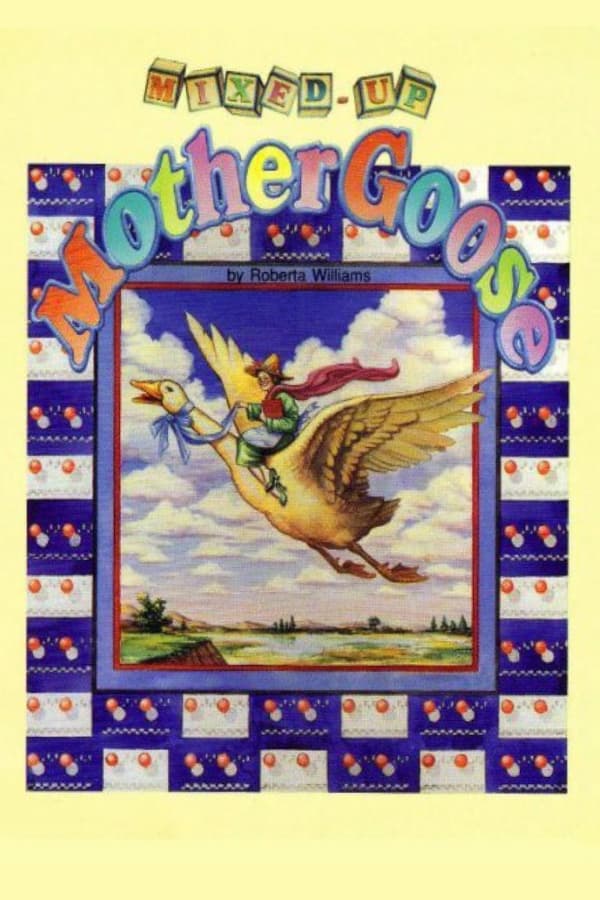

If you played Mixed-Up Mother Goose Enhanced in 1991, your first lesson in inventory management was not hauling pot-bellied stove parts across a unforgiving kingdom, but carrying a single brass candlestick back to Jack Be Nimble while a MIDI tune blared through a Sound Blaster card.
Roberta Williams swapped parser traps for pure nursery logic in Mixed-Up Mother Goose Enhanced
Before this title arrived, Sierra was famous for treating players with absolute malice. Typing the wrong command in a text parser meant your character died on a screen transition or spent three hours carrying an item they should have used four chapters earlier. Designer Roberta Williams took the exact opposite route when rebuilding her 1987 title on Sierra's upgraded SCI engine. She stripped out typing completely, replaced the text prompt with a simple point-and-click mouse interface, and built a world where you literally cannot die.
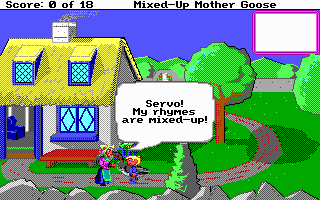
You start the session by picking a small childhood avatar from a selection screen, and from the moment you drop into Mother Goose Land, the whole project makes its intentions obvious. A sudden storm has scattered eighteen classic nursery rhymes all across the kingdom, and your job is to clean up the mess. There are no combat encounters, no secret death screens, and no cryptic text traps. Instead of punishing you for clicking the wrong shrub, the game rewards every correct delivery with a full screen animated sing-along.
Why wandering Mother Goose Land hits differently every single playthrough
The entire structure revolves around a clever trick that kept kids coming back to the family PC in 1991: dynamic item placement. Every time you start a new game, all eighteen lost objects and stray characters spawn in completely random locations across the map. You might find a ladder resting near a cottage on one run, only to find it sitting beside a riverbank on the next. That simple bit of randomness keeps the world feeling active, even when you already know every rhyme by heart.
The puzzle mechanics stick to a strict set of rules that anyone can pick up in seconds:
- Humpty Dumpty requires his sturdy wooden ladder to get back onto the wall.
- Jack and Jill need their water pail before they can walk up the hill.
- Little Bo Peep will only follow you once you track down her scattered sheep.
- Old King Cole will not sit down until you bring him his pipe, bowl, and three fiddlers.
- Hickory Dickory Dock needs you to find the runaway mouse for his clock.
The real restriction comes from your inventory limit. You can only carry one item or escort one character or animal at a time. If you stumble across the fiddle for Hey Diddle Diddle while dragging a sheep back to Little Bo Peep, you have to leave the instrument sitting on the grass, finish your current drop-off, and walk all the way back. Sierra kept this from becoming tedious by including an auto-save feature and a built-in map warp system, letting you jump directly to areas you have already discovered.
Where the interface shines and where the interior design gets confusing
Visually, this update was a major step forward for Sierra On-Line, Inc. over the original floppy disk release. Upgraded 256-color VGA art brought bright, storybook scenery to PC monitors, while full sound card support let players with a Roland MT-32 or IBM Music Feature Card hear rich musical arrangements instead of harsh PC speaker beeps. When published on CD-ROM, it held a special place in Sierra history as the company's very first CD-ROM release, bringing digitized voice acting directly to desktop speakers.
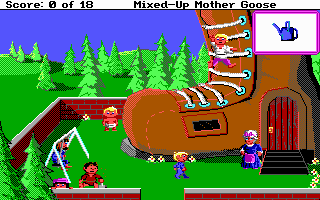
If you play this adventure game today as an adult, the main friction comes from architectural layout rather than logic puzzles. Items frequently spawn inside buildings, and a few of the doorways match the wall art so closely that you will walk right past them without realizing an entrance exists. Reviewers at the time rightfully praised the clean point-and-click interface as a welcome relief from Sierra's strict text parsers, even if modern players can speed through the whole map in about thirty minutes flat.
A gentle game that even Space Quest could not resist teasing
Because the game focused on accessibility over brutal difficulty, it became an easy target for good-natured ribbing inside Sierra's own offices. In Space Quest V, whenever player character Roger Wilco meets an untimely death, a cheeky game-over message suggests that the player try a less challenging game like Mixed Up Mother Goose. Yet the design philosophy held real value. The non-violent, exploration-focused layout inspired Lori Cole to design Mixed-Up Fairy Tales later that same year, using the same accessible point-and-click engine for young adventure gamers.
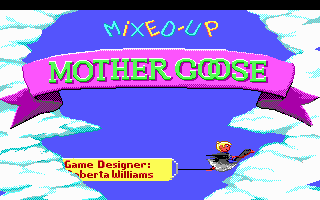
There is also great studio history tucked behind the scenes. On the original 1987 box art cover, Mother Goose herself was portrayed by designer Roberta Williams, who posed in costume alongside local neighborhood children. While the 1991 VGA upgrade replaced that physical photography with hand-drawn character art, the underlying intent remained untouched: build a warm, inviting entry point into computer gaming that anyone could enjoy without reading a two-hundred-page manual.
Play Mixed-Up Mother Goose Enhanced free in your browser right now
This entry works as a low-stress slice of Sierra history that proves adventure games do not need moon logic or sudden death screens to satisfy you. Whether you want to experience Sierra's very first CD-ROM project, show a younger family member how point-and-click games used to work, or simply spend thirty minutes on uncomplicated item trading, it is easy to enjoy a full run through.
You can play Mixed-Up Mother Goose Enhanced online for free right here in your web browser. There is no software to install and no setup required to launch this landmark MS-DOS game. Just load up the page, choose your small traveler, and start gathering up stray sheep and lost ladders in Mother Goose Land today.
How Mixed-Up Mother Goose Enhanced is played — the keys the game listens to, grouped by what they do.
- Movement
- Left click — Move on-screen character
Highlighted keys are mapped — hover or tap one to see what it does.
Players' controls
Touch and gamepad controls
The on-screen keyboard and gamepad mapping the browser player uses on a phone, a tablet or a controller, as opposed to the real keys above. $PRO members make their own in the player and share them here; anyone can pick one to play with.
Make your own touch controlsPRO
- 1Open the editorSign in below, then pick what to make. The game starts with the editor open over it.
- 2Place your keysAdd keys and drag them where your thumbs rest, or map a controller's buttons. Test plays the game with them; Save keeps them, and you play with them from then on.
- 3Share themShare them right after saving in the game, or name and share them here. Players vote, and the best become this game's controls for everyone.
Go PROSee how it worksSign in+20 XP for sharing · +50 XP if yours become the game's own
- The game's own controlsKeyboardGamepadWhat every player starts with.In use
3 screenshots
From the archive
No gameplay video yet
No gameplay video for Mixed-Up Mother Goose Enhanced yet. Sign in to add one.
No reviews yet
Tell the community what you think of Mixed-Up Mother Goose Enhanced. Reviews are public and tied to your username.
No archived manuals for Mixed-Up Mother Goose Enhanced yet
No manuals archived for this title yet. Sign in to upload the first scan.
Cheat codes, console commands and memory pokes for Mixed-Up Mother Goose Enhanced — each one verified and attributed.
Sign in to submitNo cheats yet for this title
Know a working cheat, poke or trainer? Add it with the button above. Moderators check every entry before it goes live.
No archived soundtrack for Mixed-Up Mother Goose Enhanced yet
No soundtrack archived for this title yet. Sign in to upload the first rip.
No save states for Mixed-Up Mother Goose Enhanced yet
No save states for this title yet. Sign in to share one.
Discussions
Sign in to post- Threads0
- Total posts0
- Online now6
Community · Mixed-Up Mother Goose Enhanced
Who's contributing, and what's new
- Reviews0
- Threads0
- Uploadsapproved0
- Contributors0
Recent activity
Nothing here yet
Reviews, discussion threads and approved uploads appear here as members add them.