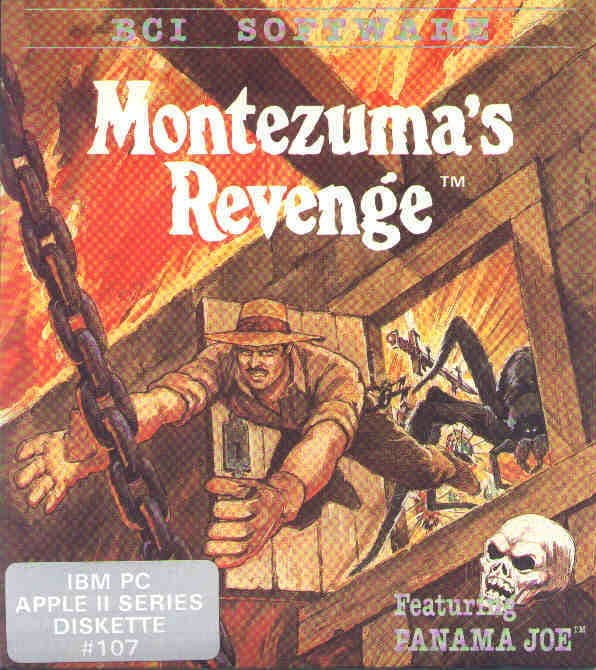
Montezuma's Revenge (1984)
In 1984, Montezuma's Revenge gave PC players a sprawling 99-room Aztec pyramid to explore long before flip-screen action games had a name for it. With lethal fall heights, precision jumps, and single-touch deaths, teenager Robert Jaeger's design turned floor navigation and movement timing into a stern, absorbing test.
How Robert Jaeger built a massive labyrinth on a floppy disk
When sixteen-year-old developer Robert Jaeger showed off his unfinished action title at the Consumer Electronics Show in 1983, he was aiming for something far larger than the single-screen arcade games of the period. Publisher Parker Brothers snapped up the project, tweaking and packaging it for home microcomputers the following year. The game took its title from the well-known slang phrase for digestive distress suffered by tourists in Mexico, a tongue-in-cheek label for a expedition defined by constant danger.
To run on early IBM PCs, the original release arrived on a standalone Booter disk. Bypassing the memory overhead of MS-DOS allowed the game to talk straight to the hardware, enabling support for 16-color PCjr display modes alongside standard systems. That technical directness gave the title smooth screen transitions, even if the sound hardware support remained strictly tethered to the clicks and bleeps of the internal PC speaker.
Putting the game alongside other 1984 release titles shows how much ground it covered in a single package. While most computer platform games were content to loop three or four static layouts, this design linked nearly one hundred rooms across nine distinct vertical floors into one giant, persistent structure.
Montezuma's Revenge converts platforming into a spatial puzzle
You control an adventurer named Panama Joe, who goes by Pedro in some regional manuals, entering a dark Aztec catacomb to locate a lost treasure chamber. Your goal is simple on paper, but navigating the 99 interconnected rooms requires strict inventory planning. You carry color-coded keys to unlock doors of matching hues, grab torches to light dark chambers, and hunt down swords to clear away patrolling hazards.
The mechanics take heavy inspiration from early screen-by-screen arcade games like Donkey Kong, but frame those jumping skills as a maze-solving exercise. Panama Joe can climb ladders, drop off ledges, and vault over low obstacles, yet his agility is strictly limited by weight and gravity. Jump off a platform that sits just a few pixels too high, and Joe dies instantly on impact with the stone floor.
Progress through the Montezuma's Revenge MS-DOS game comes down to memorizing routes and managing inventory items in the right order:
- Color-coded keys: Unlocking doors consumes your matching key, meaning a wrong door choice can leave you completely trapped deep within the pyramid.
- Torches: Entering pitch-black rooms blinds you to floor drops and hazards until you carry a lit torch into the frame.
- Swords: Equipping a blade lets you run directly through an enemy creature to clear a path, though the sword shatters after a single strike.
- Amulets: Picking up these glowing icons grants temporary invincibility, turning dangerous creatures harmless for a brief window.
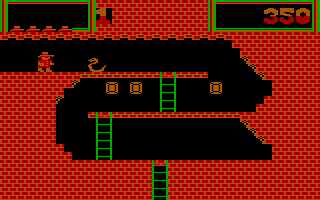
A strict hazard system with zero mid-pyramid checkpoints
The pyramid itself is packed with hostile life and environmental traps. Skulls bounce along floor corridors, spiders drop down climbing ropes, and snakes block tight crawls. Alongside the fauna, you must timing-jump across laser gates, ride moving conveyor belts, dodge fire pits, and step carefully over disappearing floor tiles that drop you into empty air.
What makes the experience notoriously punishing is the absolute lack of mid-game save functionality. You get a set pool of extra lives, but clearing the full depth of the structure must be accomplished in a single sitting. If you spend your final red key on the wrong door four floors down, you are stuck, forcing you to sacrifice lives or restart the run from the top entry room.
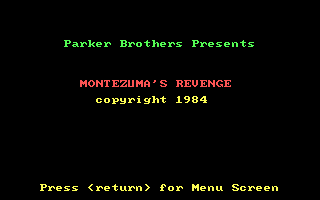
Unlike modern re-releases and later console remakes, this 1984 DOS original contains no final boss encounter with King Montezuma at the bottom. Reaching the final chamber yields the ultimate treasure reward directly, serving as a test of spatial navigation and raw survival rather than an exercise in pattern-memorizing combat.
The verdict on Panama Joe's brutal expedition
As a piece of dynamic screen-by-screen level design, the pyramid layout works well. Deciding whether to use a sword on a spider or save it for a snake in the next room creates genuine tension, and discovering an optimal path through the nine difficulty tiers is deeply satisfying. The movement physics, while unforgiving, follow consistent rules that reward patience and exact timing.
What plainly fails to satisfy modern standards is the complete lack of a save feature paired with single-touch lethal fall damage. A single missed jump late in a long run costs you twenty minutes of progress, and the PC speaker sound driver offers little audio feedback beyond harsh, rhythmic chirps. It is an exacting action puzzle game that expects complete mastery of its map and controls.
If you want to experience an early pioneer of non-linear action platformers, you can play Montezuma's Revenge online today. You can run Montezuma's Revenge free in your browser right now with no setup needed, so step into the pyramid, watch your step off those high ledges, and try to keep track of your red keys.