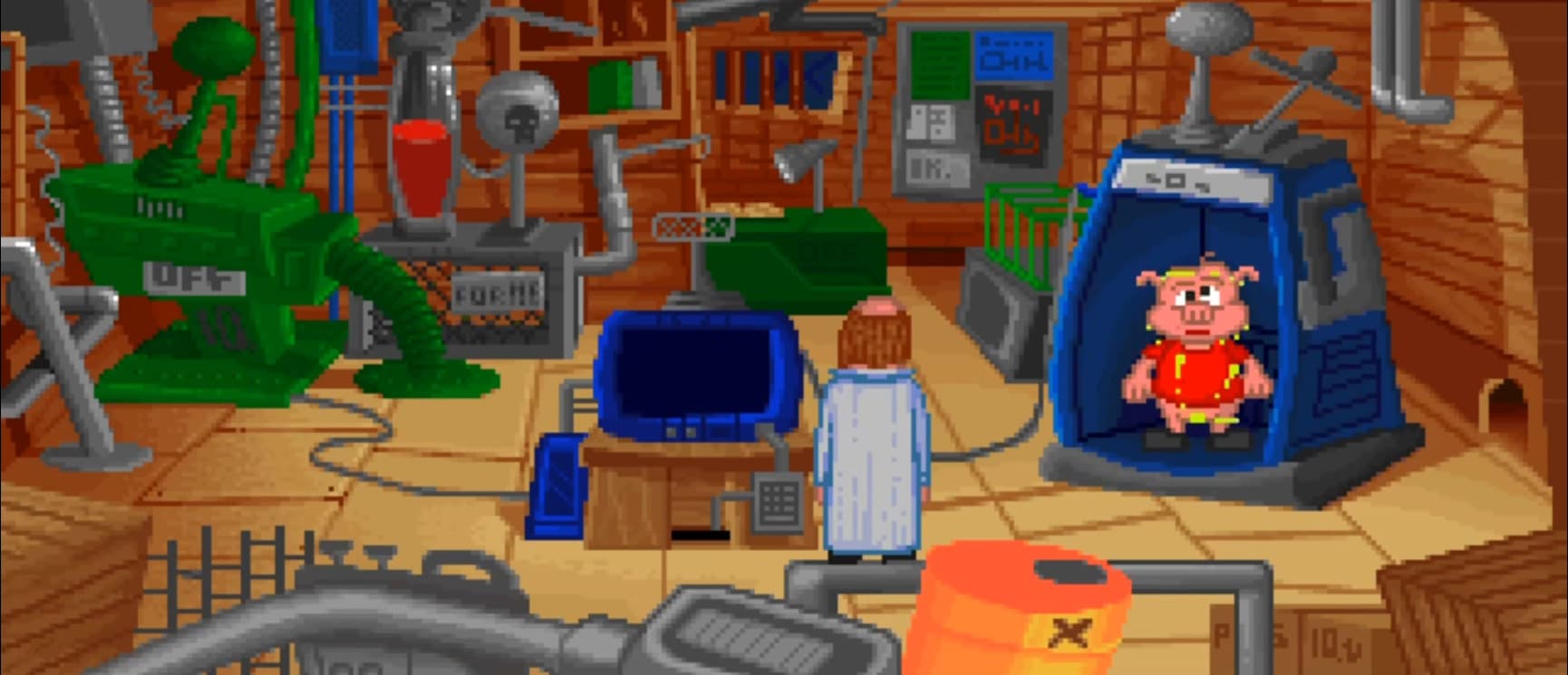
Screenshot×91d ago
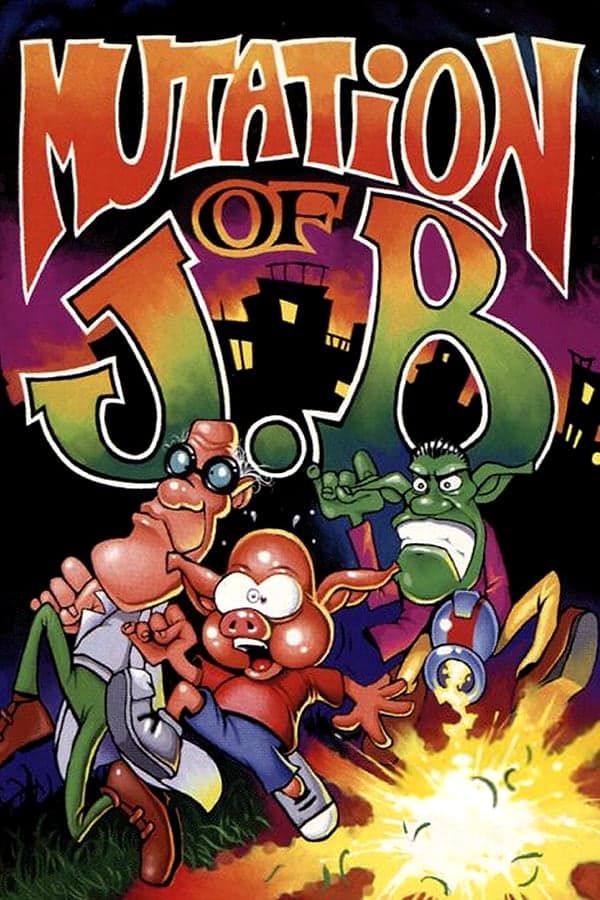
Mutation of J.B.
Before you even get a chance to search for your missing cousin in Mutation of J.B., a lab test goes completely sideways and transforms young Johny Burger into a human-pig hybrid. That initial catastrophe sends you on a bizarre trek across Earth and into deep space to chase down the scientist who can cure you.
Turning a schoolboy into a pig in Mutation of J.B.
The story kicks off with a simple trip to visit your cousin Emanuel for a two-week vacation. You arrive at his place only to find him missing, and your investigation quickly leads to Professor Fugel. The professor offers Johny 500 Deutsche Marks to participate in a quick laboratory experiment, an offer no broke kid in a point-and-click game is going to turn down. Naturally, the equipment malfunctions, leaving Johny walking around on two legs with a snout and pig ears before the professor gets snatched away to the alien world of Ladea.
Playing the DOS version of Mutation of J.B. feels instantly familiar if you grew up on classic mid-nineties graphic adventures. The lower portion of the screen holds your standard command interface: six direct verb buttons alongside a scrolling inventory bar. You spend your time clicking through the classic set of verbs to interact with the environment:
- Go to for moving Johny between screens and through doorways.
- Talk to for striking up conversations with locals and strange aliens.
- Look at for getting descriptive flavor text on items and backgrounds.
- Use for manipulating machinery and applying inventory objects to the scene.
- Take for hoarding every loose item that is not nailed down.
The third-person view gives you a wide field of vision across each painted screen, making it easier to scan for key items than in first-person titles. Navigating through the opening scenes requires testing every object against your command bar. If you miss a tiny item tucked into a corner during your initial sweep of the lab, your progress grinds to a halt until you backtrack and hover your cursor over every square inch.
Full voice acting without subtitles as anti-piracy protection
In 1996, developer Invention teamed up with Riki Computer Games to distribute the title on CD-ROM in Slovakia. It hit the market as the first commercial Slovak graphic adventure game, taking advantage of the expanded disc space to deliver complete localized speech. The cast pulled from local entertainment talent, bringing in comedians Jozef Pročko and Ladislav Kočan alongside Ivo Ninja, the chief editor of Slovakia's prominent Riki gaming magazine.
The production details behind the release reveal just how wild the PC market was at the time. To thwart rampant software piracy, the creators intentionally left text subtitles out of the original Slovak release. The idea was simple: bootleggers passing around floppy disks or text dumps could not easily strip the game, forcing players to own the full audio files on CD to understand what anyone was saying. When Austrian publisher NEO Software picked up the title for German-speaking territories, they added German dubbing and text subtitles, requiring the original audio tracks to be transmitted directly to their Vienna studio for localization.
That dependence on full speech gives the game a distinct audio identity. While CD-ROM audio was becoming standard across the industry, hearing full regional voice acting in a native point-and-click release was a massive event for local players who were used to reading English text with a dictionary on their lap.
Inventory hunting across Earth and planet Ladea
Once you get past the initial shock of Johny's porcine transformation, the objective shifts toward building a way off Earth. You need to recover Professor Fugel so he can reverse the gene experiment, which means tracking his kidnappers all the way to Ladea. Once you reach the foreign planet, the plot expands into a full liberation mission against the tyrannical General Xern.
The puzzle logic shifts back and forth between sensible inventory usage and classic adventure game absurdities. You might spend ten minutes trying to figure out how to bypass a guard, only to realize the game wants you to combine two completely unrelated items in your pocket that no sane person would put together. The lack of an inline hint system means that when you hit a wall, you hit it hard. Expect to revisit every unlocked room, re-read every dialogue branch, and try using every inventory item on every active hotspot on the screen.
The visual design leans heavily into cartoonish exaggerated character proportions, which fits the silly premise. Johny's mutated pig avatar moves with a clumsy walk cycle that never lets you forget the predicament you are in, while alien environments on Ladea introduce bright color palettes that contrast with the grounded urban locations back on Earth.
Where this DOS adventure succeeds and where it stumbles
Judged alongside the major CD-ROM hits of 1996, the game holds up well in terms of humor and ambition, even if its mechanical execution feels familiar. The puzzles rely heavily on lateral thinking, which will delight hardcore point-and-click purists while thoroughly frustrating anyone who expects modern objective markers or logical real-world physics. If you dislike brute-force inventory testing, a few of these mid-game bottlenecks will test your patience.
What works best is the underlying character writing and the absolute refusal to take its sci-fi stakes seriously. Johny treats his transformation into a mutant pig with the mild annoyance of a teenager who just missed the bus, and that dry reaction carries through his encounters with bizarre alien warlords. The voice delivery from the original cast adds a layer of genuine personality that text-only adventure titles from the same year lack.
I find that the standard six-verb command bar feels clunky compared to the context-sensitive cursors that were taking over the genre by the late nineties. Having to select "Use" or "Look at" before clicking an object adds extra steps to basic interactions, though anyone who grew up on LucasArts adventures will still navigate it in their sleep.
Preserving the history of Mutation of J.B.
This release holds a distinct place in regional development history as a pioneer for Slovak game production on CD-ROM. While it did not achieve the international household status of major Western adventure franchises, its combination of original voice casting, regional anti-piracy strategies, and absurd sci-fi storytelling makes it an fascinating study for DOS collectors.
Preserving these early CD-ROM binaries involves far more work than keeping raw code runnable under emulation. Cataloging efforts protect the specific voice tracks, manual context, and regional release variants that would otherwise fade away as old optical media degrades. If you enjoy hunting down mid-nineties point-and-click oddities with heavy doses of strange humor, seeking out a translation or playthrough of Johny Burger's mutated space voyage is time well spent.