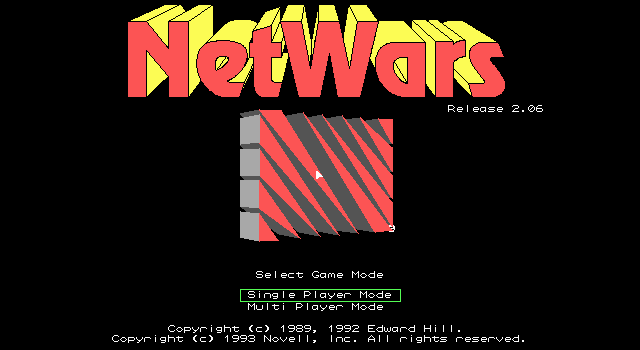
Novell created NetWars not as a retail space combat sim, but as a tech demo to prove what their local area network protocols could do over an office IPX connection.
Novell needed to prove its network software, so it built a space dogfight
Back in the early nineties, convincing an office manager that an IPX network was worth installing took more than technical documentation. System engineers needed something that immediately demonstrated low latency and quick packet delivery across multiple workstations. A text-based maze game called Snipes had previously served that purpose, but modern PCs with VGA displays demanded something faster.
Engineer Edward N. Hill, Jr. at Novell's European Development Centre in Hungerford had spent years working on a 3D vector flight engine called LiteYear. Novell took that standalone project, hooked it directly into their IPX networking stack, and packed the whole thing into an executable that sat under 77 KB. When Novell DOS 7 and Personal NetWare 1.0 arrived in late 1993, this lightweight 3D shooter replaced the aging text utilities as the ultimate network stress test.
How playing NetWars in single-player actually feels
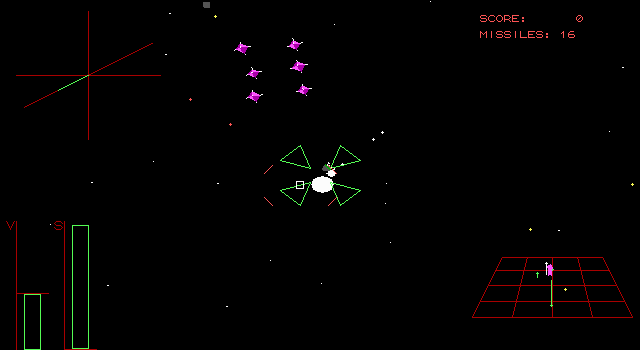
Launching this action game alone drops you straight into deep space with zero training. You sit in a first-person cockpit, staring into an almost totally pitch-black void populated by sparse geometric shapes. Your flight controls give you complete directional movement, roll authority, and full speed management using keyboard or mouse. A 3D radar grid sits in your heads-up display, showing targets as tiny blips relative to your hull orientation.
The single-player mode offers eight distinct difficulty settings. Your job is simple: defend stationary pods floating in space while hunting down a set target count of hostile alien craft. Enemies come in four distinct classes:
- Pirates: Fast, nimble light craft that circle you to chip away at your forward shields.
- Fighters: Aggressive mid-tier attackers that engage you directly in head-on dogfights.
- Guardians: Heavy defensive ships that orbit the pods and take serious fire to destroy.
- Commanders: Tough target vessels that fire persistent volleys while coordinating squad movements.
Dogfights turn into intense tracking matches where you balance engine speed against turn radius. Cut your throttle too low and you become a stationary target for a Commander; fly too fast and you will overshoot your targets into empty void. Destroyed targets drop satellites and power-ups that you sweep up to replenish your shield reserves or upgrade your weapon systems.
Where the single-player campaign falls flat
The flight physics and 3D positioning work surprisingly well, but single-player content suffers from severe visual repetition. Because space consists of pure black background with sparse star points, you quickly lose all sense of scale or location without constantly reading your radar grid. Enemy models are basic polyhedrals, making it hard to identify target classes by sight alone during chaotic fights.
The lack of dedicated mission variety also hurts longer sessions. Protecting pods against waves of identical craft across eight difficulty steps eventually turns into a mechanical drill rather than an evolving campaign. Audio does little to help, as version 2.06 relies entirely on the harsh squawks of the PC Speaker for laser fire and shield impacts. Sound Blaster card audio support did not show up until much later revisions, leaving early players with pure internal speaker noise.
Five-player LAN combat is where the design shines
Everything changes when you launch the multiplayer mode over an IPX network. Up to five players can drop into the same arena simultaneously, ditching the pod protection objectives for a pure deathmatch where every landed hit adds to your running score tally. The tight, uncompressed network code meant that dogfights ran surprisingly smooth even on modest 386 hardware without heavy packet loss.
Multiplayer introduces a cloaking device system that completely alters how players approach combat. Firing your weapons reveals your current position on everyone else's radar, forcing you to pick your shots carefully before vanishing back into the dark. Ambushing another player from behind, stripping their shields in one pass, and cloaking away before their wingman can lock onto your tail creates genuine tension that single-player simply cannot replicate.
The impact of Novell's tiny 3D combat engine
Novell never sold this title on store shelves as a standalone boxed product. Instead, distributing it bundled directly inside their operating systems meant almost every network administrator and lab technician in 1993 had a copy sitting on their server drives. It became an open secret in IT departments, running secretly on corporate networks after hours long before full commercial LAN shooters took over the PC market.
A few years later in 1997, Caldera included an updated version called Advanced NetWars inside their DR-DOS releases, adding Sound Blaster support and expanded features. Modern programmers even wrote dedicated OpenGL source ports like NetWarsGL decades later just to keep the original networking feel alive on modern graphics cards. Yet the original 1993 build published by Novell packs impressive early 3D engineering into minuscule file sizes.
How to jump into the dogfights today
If you want to experience this piece of network software history, you can play 1993 games like this directly without hunting down ancient IPX driver disks or vintage DOS networking setups. You can play NetWars online right now, running free in your browser with no installation needed. The flight controls translate neatly to modern keyboards, letting you test your vector targeting skills inside a lightweight classic space shooter within seconds.
Players' controls
Touch and gamepad controls
The on-screen keyboard and gamepad mapping the browser player uses on a phone, a tablet or a controller, as opposed to the real keys above. $PRO members make their own in the player and share them here; anyone can pick one to play with.
Make your own touch controlsPRO
- 1Open the editorSign in below, then pick what to make. The game starts with the editor open over it.
- 2Place your keysAdd keys and drag them where your thumbs rest, or map a controller's buttons. Test plays the game with them; Save keeps them, and you play with them from then on.
- 3Share themShare them right after saving in the game, or name and share them here. Players vote, and the best become this game's controls for everyone.
Go PROSee how it worksSign in+20 XP for sharing · +50 XP if yours become the game's own
- The game's own controlsNone yet: played with a real keyboard only.In use
2 screenshots
From the archive
No reviews yet
Tell the community what you think of NetWars. Reviews are public and tied to your username.
No archived manuals for NetWars yet
No manuals archived for this title yet. Sign in to upload the first scan.
Cheat codes, console commands and memory pokes for NetWars — each one verified and attributed.
Sign in to submitNo cheats yet for this title
Know a working cheat, poke or trainer? Add it with the button above. Moderators check every entry before it goes live.
No archived soundtrack for NetWars yet
No soundtrack archived for this title yet. Sign in to upload the first rip.
No save states for NetWars yet
No save states for this title yet. Sign in to share one.
Discussions
Sign in to post- Threads0
- Total posts0
- Online now6
Community · NetWars
Who's contributing, and what's new
- Reviews0
- Threads0
- Uploadsapproved0
- Contributors0
Recent activity
Nothing here yet
Reviews, discussion threads and approved uploads appear here as members add them.