
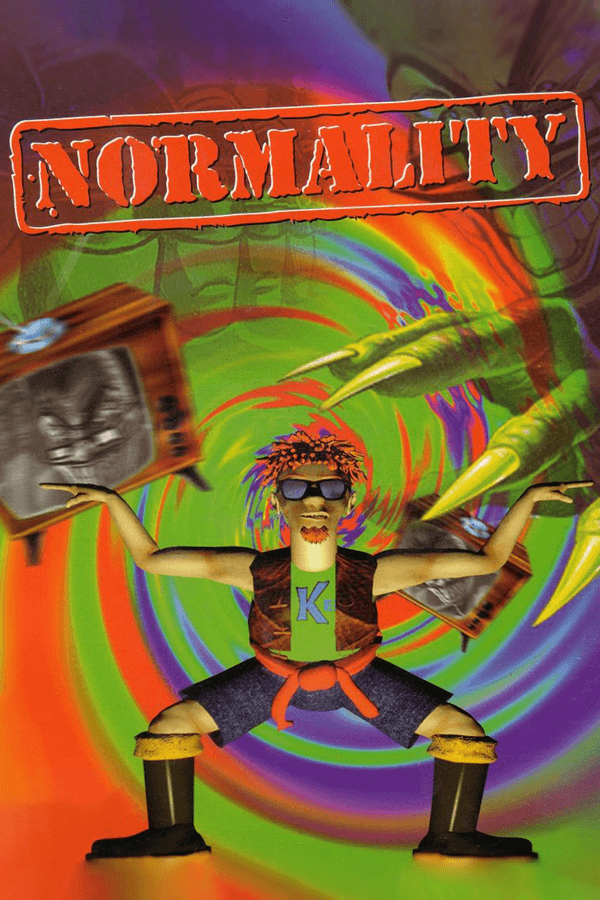

In Normality, you play as Kent Knutson, a slouching slacker locked in his apartment for the crime of whistling a happy tune in a grey, emotionless city. Escaping your room is only the start of a strange first-person adventure through a dystopian nightmare.
Neutropolis is ruled by a dictator named Paul and his oppressive One True Government regime. The authorities outlaw joy, sending police officers known as Norms to lock away anyone showing personality. After receiving a secret note about an underground rebel group called The Chumps, Kent sets out to break free and overthrow the regime.
Unlike the flat painted backdrops common to 1990s graphic adventures, this title gives you real-time first-person movement inside room spaces. Programmed by Antony Crowther using what Gremlin called their True3D engine, the game lets you look around freely and walk anywhere in Kent's cluttered room. Developer Gremlin Interactive later reused this same tech to build their horror shooter Realms of the Haunting.
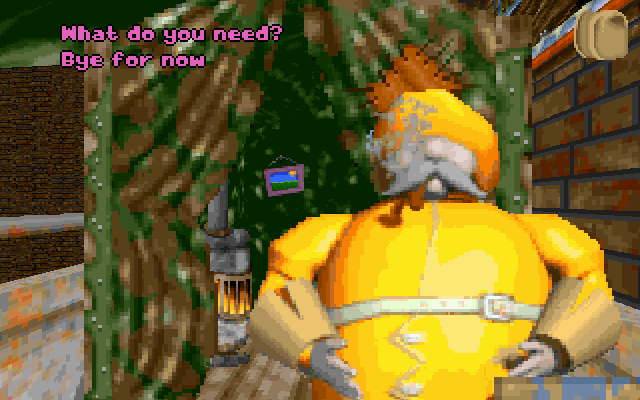
To interact with your surroundings, you bring up a visual verb selection menu known in the manual as the voodoo doll interface. Clicking the doll's eyes inspects objects, its mouth talks or chews, and its hands manipulate items in the world. It was a novel control scheme for the time, even if maneuvering around low-resolution furniture takes patience.
Bringing point-and-click mechanics into full 3D introduced navigation problems that 2D adventure games rarely faced. Retrospective reviewers often point out how easy it is to miss a vital clue because an item sits on a shelf above eye level or tucked behind a chair. You spend plenty of time repositioning Kent around narrow spaces just to line up your cursor with an interactive object.
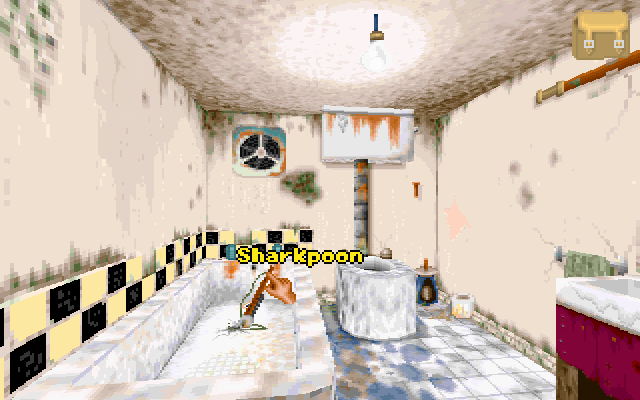
Once you locate the interactive spots, the inventory puzzles rely on traditional graphic adventure logic. You carry around a bizarre collection of items, including a sharkpoon, an oxy-acetylene torch, a slumber manual, a car battery, radio parts, and paint cans. Solutions rarely follow real-world physics, asking you to experiment with strange item combinations to make progress.
Your search for the underground rebellion sends you through several key locations across the city. You start in Kent's Apartment before sneaking through the Plush-Rest Factory and searching the M.I.N.T. Mall. Later stages take you deep into the Substation, across the local Stadium, and finally into the dangerous Pollutotron facility. Each environment adds fresh obstacles that demand careful exploration and exhaustive inventory testing.
The narrative written by producer Adrian Carless leans heavily into nineties slacker tropes and surreal comedy. For the North American release by Interplay, the team re-voiced Kent Knutson with actor Corey Feldman, giving the protagonist a distinctive laid-back drawl. Reviews at the time were split on whether the jokes actually landed.
In 1996, PC Gamer praised the fluid engine and clever interface while noting that much of the script fell flat. GameSpot gave the game a 7.7 out of 10 score, while French outlet PC Team awarded it 90%. Later retrospective reviews from sites like Adventure Gamers gave it a lower 2.5 out of 5 score, citing uneven comedy and frustrating pixel hunting. The French dubbed release was also criticized by regional players for ridiculous voice acting on secondary characters.
I remember trying to figure out which item went where back when PC gaming was transitioning into full 3D environments. The humor can feel hit or miss today, but the distinctive art style and oppressive urban setting give the world a memorable personality. Check out the official details on Wikipedia for more on its release history.
As an experimental release from Gremlin Interactive, the game occupies an interesting spot in PC gaming history. Moving a puzzle adventure into real-time 3D created genuine control headaches, but the creative world design makes it worth examining for fans of adventure games. The balance between weird inventory puzzles and slacker comedy defined a unique moment for European developers in the mid-nineties.
If you want to experience the original MS-DOS release, you can play Normality free in your browser right here. You can jump straight into Kent's room, open the voodoo doll menu, and start exploring Neutropolis with zero hassle.
In Normality, you play as Kent Knutson, a slouching slacker locked in his apartment for the crime of whistling a happy tune in a grey, emotionless city. Escaping your room is only the start of a strange first-person adventure through a dystopian nightmare.
Neutropolis is ruled by a dictator named Paul and his oppressive One True Government regime. The authorities outlaw joy, sending police officers known as Norms to lock away anyone showing personality. After receiving a secret note about an underground rebel group called The Chumps, Kent sets out to break free and overthrow the regime.
Unlike the flat painted backdrops common to 1990s graphic adventures, this title gives you real-time first-person movement inside room spaces. Programmed by Antony Crowther using what Gremlin called their True3D engine, the game lets you look around freely and walk anywhere in Kent's cluttered room. Developer Gremlin Interactive later reused this same tech to build their horror shooter Realms of the Haunting.
To interact with your surroundings, you bring up a visual verb selection menu known in the manual as the voodoo doll interface. Clicking the doll's eyes inspects objects, its mouth talks or chews, and its hands manipulate items in the world. It was a novel control scheme for the time, even if maneuvering around low-resolution furniture takes patience.
Bringing point-and-click mechanics into full 3D introduced navigation problems that 2D adventure games rarely faced. Retrospective reviewers often point out how easy it is to miss a vital clue because an item sits on a shelf above eye level or tucked behind a chair. You spend plenty of time repositioning Kent around narrow spaces just to line up your cursor with an interactive object.
Once you locate the interactive spots, the inventory puzzles rely on traditional graphic adventure logic. You carry around a bizarre collection of items, including a sharkpoon, an oxy-acetylene torch, a slumber manual, a car battery, radio parts, and paint cans. Solutions rarely follow real-world physics, asking you to experiment with strange item combinations to make progress.

Your search for the underground rebellion sends you through several key locations across the city. You start in Kent's Apartment before sneaking through the Plush-Rest Factory and searching the M.I.N.T. Mall. Later stages take you deep into the Substation, across the local Stadium, and finally into the dangerous Pollutotron facility. Each environment adds fresh obstacles that demand careful exploration and exhaustive inventory testing.
The narrative written by producer Adrian Carless leans heavily into nineties slacker tropes and surreal comedy. For the North American release by Interplay, the team re-voiced Kent Knutson with actor Corey Feldman, giving the protagonist a distinctive laid-back drawl. Reviews at the time were split on whether the jokes actually landed.
In 1996, PC Gamer praised the fluid engine and clever interface while noting that much of the script fell flat. GameSpot gave the game a 7.7 out of 10 score, while French outlet PC Team awarded it 90%. Later retrospective reviews from sites like Adventure Gamers gave it a lower 2.5 out of 5 score, citing uneven comedy and frustrating pixel hunting. The French dubbed release was also criticized by regional players for ridiculous voice acting on secondary characters.

I remember trying to figure out which item went where back when PC gaming was transitioning into full 3D environments. The humor can feel hit or miss today, but the distinctive art style and oppressive urban setting give the world a memorable personality. Check out the official details on Wikipedia for more on its release history.
As an experimental release from Gremlin Interactive, the game occupies an interesting spot in PC gaming history. Moving a puzzle adventure into real-time 3D created genuine control headaches, but the creative world design makes it worth examining for fans of adventure games. The balance between weird inventory puzzles and slacker comedy defined a unique moment for European developers in the mid-nineties.
If you want to experience the original MS-DOS release, you can play Normality free in your browser right here. You can jump straight into Kent's room, open the voodoo doll menu, and start exploring Neutropolis with zero hassle.
How Normality is played — the keys the game listens to, grouped by what they do.
Highlighted keys are mapped — hover or tap one to see what it does.
The on-screen keyboard and gamepad mapping the browser player uses on a phone, a tablet or a controller, as opposed to the real keys above. $PRO members make their own in the player and share them here; anyone can pick one to play with.
Cheat codes, console commands and memory pokes for Normality — each one verified and attributed.
Sign in to submitaka Normality Inc. · נורמליטי
How Normality is played — the keys the game listens to, grouped by what they do.
Highlighted keys are mapped — hover or tap one to see what it does.
The on-screen keyboard and gamepad mapping the browser player uses on a phone, a tablet or a controller, as opposed to the real keys above. $PRO members make their own in the player and share them here; anyone can pick one to play with.
Cheat codes, console commands and memory pokes for Normality — each one verified and attributed.
Sign in to submit