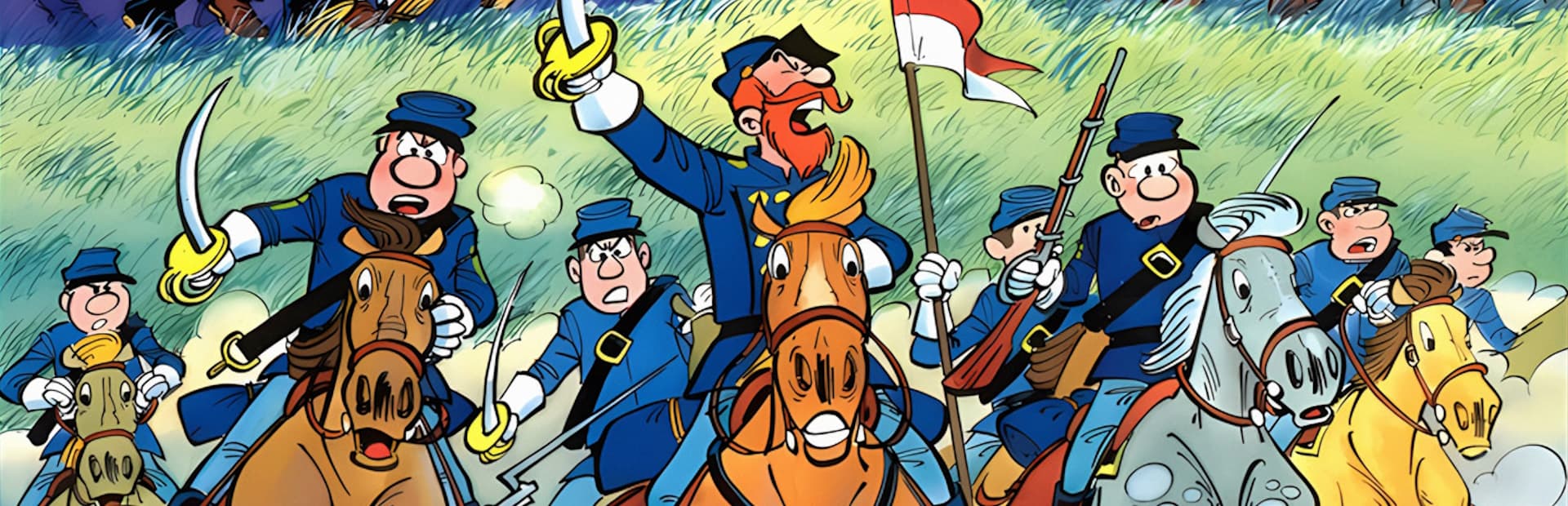
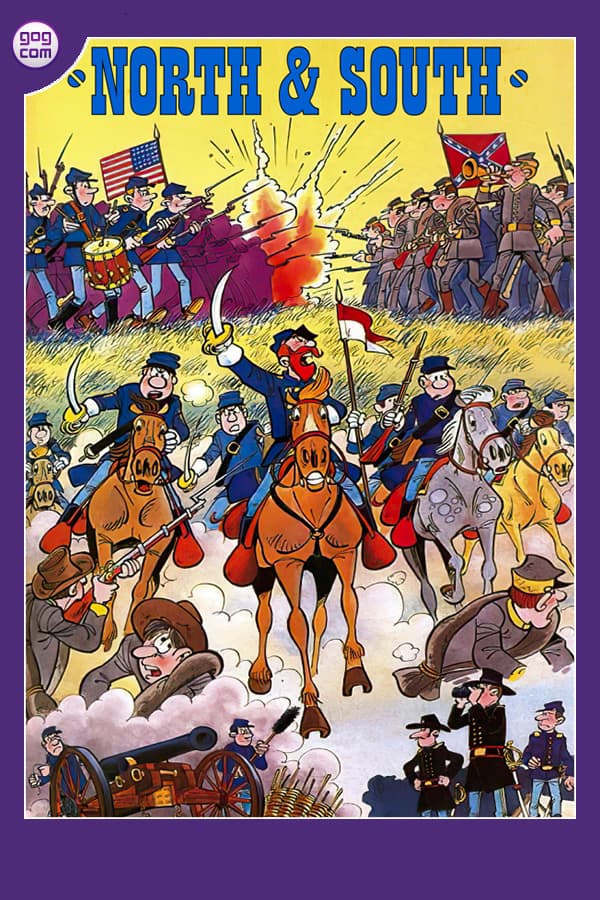

Adapted directly from the Belgian comic strip Les Tuniques Bleues, Infogrames created North & South as a hybrid of turn-based map control, real-time battlefield skirmishes, and tight platforming minigames.
When you start a campaign in 1990's North & South, the strategic map of the United States looks like a serious wargame. You choose a starting year from 1861 to 1864, pick your faction between the Union and the Confederacy, and prepare to shuffle cavalry icons across state borders. States with railway stations generate state income, which accumulates until it pays for entire army corps as reinforcements. Turn on optional settings, and you have to account for naval drops in North Carolina, storm clouds that freeze army movement, or border disruptions like Indian attacks and a sleepy Mexican border guard who occasionally toss explosives into Texas.
That high-level tactical planning evaporates the moment two armies meet in the same state. Strategy gives way to immediate tactical reflexes as the screen transitions into a side-view battleground featuring infantry, cavalry, and artillery. Instead of computing outcome percentages based on unit statistics, victory relies entirely on how fast you cycle through your units and aim your cannon shots. Hardcore strategy purists in 1990 complained that the board state mattered less than direct arcade skill, but that wild shift in tone is precisely why the game worked for casual players.
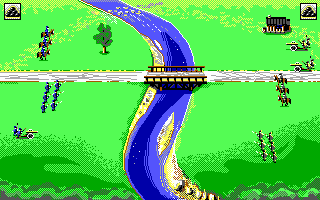
Real-time battlefield combat hinges on managing three distinct troop types on a single screen. Infantry line up and fire rifle volleys, cavalry charge ahead to shred foot soldiers, and artillery fire cannonballs across parabolic arcs to crush enemy ranks from a safe distance. Controlling them with a keyboard requires rapid switching, because leaving an artillery piece exposed to an incoming cavalry charge means losing your strongest long-range damage in seconds.
The system breaks down during the specialized side-scrolling platform segments. Attempting to capture an unfortified territory with a train station or raid an enemy supply line forces you into a timed run where you control a single soldier running left to right. You dodge obstacles, hit guards, avoid attack dogs, and race against an aggressive countdown clock to raise your flag or jump aboard the locomotive.
These platform sequences introduce the sharpest difficulty spikes in the game:
Computer Gaming World summed up the divide cleanly at release, offering low praise for wargamers looking for a deep simulation while recommending it as three out of five stars for arcade players. Retrospective reviews often highlighted the magazine's dry comment that the game was roughly what one expected from France, a country famous for treating Jerry Lewis as an icon. The critique was fair: depth was sacrificed for pace, visual humor, and immediate slapstick energy.
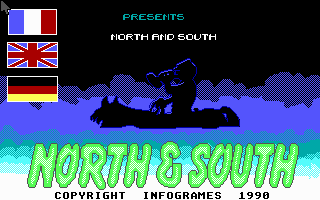
Developer Infogrames leaned heavily into the visual charm of the original comic artwork by Raoul Cauvin and Willy Lambil. Cartoonish animations soften the grim subject matter, giving every defeat and border raid a lighthearted feel. On the main menu, clicking on the photographer's rear end triggers an interactive joke that became a classic piece of early PC easter egg trivia among players.
The audio depended heavily on what sound hardware sat inside your machine in 1990. On the original Amiga, the music score by Charles Callet included rich voice samples and parodies of national anthems triggered by picking different language options at startup. Playing the Data East MS-DOS release meant listening to simplified PC speaker bleeps, which turned standard bugle calls into sharp chiptunes, though EGA and CGA graphics kept the visual presentation recognizable.
While the strategy depth is lightweight compared to serious historical simulations, the combination of tactical territorial control and frantic arcade combat makes it ideal for a quick match. The real-time battles reward quick positioning, and forcing your opponent off a bridge with cannon fire remains satisfying thirty years later.
You can play North & South MS-DOS game files directly in your web browser with no download required. Start a two-player campaign or select a single-player game starting in 1861 to learn the map, control the train routes, and get a feel for artillery aiming before tackling the timed fort raids.
Adapted directly from the Belgian comic strip Les Tuniques Bleues, Infogrames created North & South as a hybrid of turn-based map control, real-time battlefield skirmishes, and tight platforming minigames.
When you start a campaign in 1990's North & South, the strategic map of the United States looks like a serious wargame. You choose a starting year from 1861 to 1864, pick your faction between the Union and the Confederacy, and prepare to shuffle cavalry icons across state borders. States with railway stations generate state income, which accumulates until it pays for entire army corps as reinforcements. Turn on optional settings, and you have to account for naval drops in North Carolina, storm clouds that freeze army movement, or border disruptions like Indian attacks and a sleepy Mexican border guard who occasionally toss explosives into Texas.
That high-level tactical planning evaporates the moment two armies meet in the same state. Strategy gives way to immediate tactical reflexes as the screen transitions into a side-view battleground featuring infantry, cavalry, and artillery. Instead of computing outcome percentages based on unit statistics, victory relies entirely on how fast you cycle through your units and aim your cannon shots. Hardcore strategy purists in 1990 complained that the board state mattered less than direct arcade skill, but that wild shift in tone is precisely why the game worked for casual players.
Real-time battlefield combat hinges on managing three distinct troop types on a single screen. Infantry line up and fire rifle volleys, cavalry charge ahead to shred foot soldiers, and artillery fire cannonballs across parabolic arcs to crush enemy ranks from a safe distance. Controlling them with a keyboard requires rapid switching, because leaving an artillery piece exposed to an incoming cavalry charge means losing your strongest long-range damage in seconds.
The system breaks down during the specialized side-scrolling platform segments. Attempting to capture an unfortified territory with a train station or raid an enemy supply line forces you into a timed run where you control a single soldier running left to right. You dodge obstacles, hit guards, avoid attack dogs, and race against an aggressive countdown clock to raise your flag or jump aboard the locomotive.
These platform sequences introduce the sharpest difficulty spikes in the game:
Computer Gaming World summed up the divide cleanly at release, offering low praise for wargamers looking for a deep simulation while recommending it as three out of five stars for arcade players. Retrospective reviews often highlighted the magazine's dry comment that the game was roughly what one expected from France, a country famous for treating Jerry Lewis as an icon. The critique was fair: depth was sacrificed for pace, visual humor, and immediate slapstick energy.
Developer Infogrames leaned heavily into the visual charm of the original comic artwork by Raoul Cauvin and Willy Lambil. Cartoonish animations soften the grim subject matter, giving every defeat and border raid a lighthearted feel. On the main menu, clicking on the photographer's rear end triggers an interactive joke that became a classic piece of early PC easter egg trivia among players.
The audio depended heavily on what sound hardware sat inside your machine in 1990. On the original Amiga, the music score by Charles Callet included rich voice samples and parodies of national anthems triggered by picking different language options at startup. Playing the Data East MS-DOS release meant listening to simplified PC speaker bleeps, which turned standard bugle calls into sharp chiptunes, though EGA and CGA graphics kept the visual presentation recognizable.
While the strategy depth is lightweight compared to serious historical simulations, the combination of tactical territorial control and frantic arcade combat makes it ideal for a quick match. The real-time battles reward quick positioning, and forcing your opponent off a bridge with cannon fire remains satisfying thirty years later.
You can play North & South MS-DOS game files directly in your web browser with no download required. Start a two-player campaign or select a single-player game starting in 1861 to learn the map, control the train routes, and get a feel for artillery aiming before tackling the timed fort raids.
How North & South is played — the keys the game listens to, grouped by what they do.
Highlighted keys are mapped — hover or tap one to see what it does.
Player 1 Fire key is omitted as it was not specified in the sources. Controls can be reassigned or set to joystick/mouse via the configuration menu.
The on-screen keyboard and gamepad mapping the browser player uses on a phone, a tablet or a controller, as opposed to the real keys above. $PRO members make their own in the player and share them here; anyone can pick one to play with.
Cheat codes, console commands and memory pokes for North & South — each one verified and attributed.
Sign in to submitHow North & South is played — the keys the game listens to, grouped by what they do.
Highlighted keys are mapped — hover or tap one to see what it does.
Player 1 Fire key is omitted as it was not specified in the sources. Controls can be reassigned or set to joystick/mouse via the configuration menu.
The on-screen keyboard and gamepad mapping the browser player uses on a phone, a tablet or a controller, as opposed to the real keys above. $PRO members make their own in the player and share them here; anyone can pick one to play with.
Cheat codes, console commands and memory pokes for North & South — each one verified and attributed.
Sign in to submit