In 1994, One Must Fall 2097 turned what could have been a cheap mecha gimmick into the deepest fighting game on PC by decoupling the pilot from the machine.
Most fighters in 1994 handed you a locked roster and forced you straight into ladder matches. Diversions Entertainment took a different route by embedding a full RPG progression system inside an arcade brawler. You start in the local tournament as a broke pilot in a sluggish Jag metal chassis, earning prize money for every landed punch and round victory.
That cash buys stat upgrades for your robot's engine power, arm speed, and leg agility. You can also save up to purchase entirely new Human-Assisted Robots (H.A.R.s) or train your pilot's personal attributes. Matching a high-agility pilot like Crystal with a swift Pyros robot yields a completely different fight feel than pairing a heavy hitter with a slow Goliath.
This loop transforms a standard action game into a long-term campaign. A costly loss damages your mechanical repair budget, so every trade in the ring carries real financial weight.
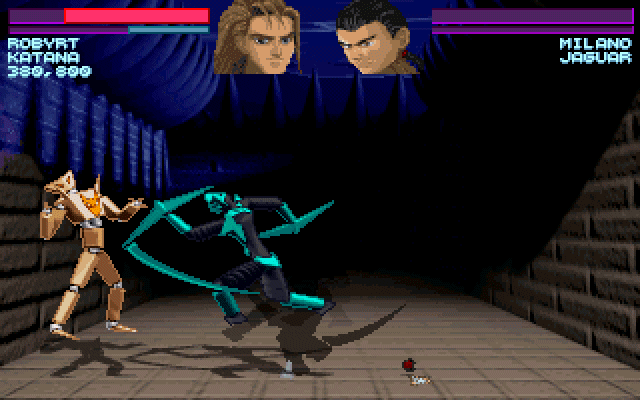
While 1994 saw glossy pseudo-3D disasters like Rise of the Robots rely on pre-rendered graphics, this game prioritized fast frame rates and precise controls. Ten distinct robots and ten unique pilots allow for dozens of functional combinations. Movement is immediate, aerial juggles land cleanly, and special moves execute without input lag.
The arenas themselves actively participate in every match. You cannot simply wall-trap an opponent without watching for local hazards:
Knocking an enemy into a hazard wall to extend an air combo is standard high-level play. The side-view action stays fluid even when dynamic hazards, metal debris, and particle sparks fill the fixed-screen stage.
Brothers Rob Elam and Ryan Elam handled the code, but composer Kenny Chow provided the sound that defined the PC gaming scene in 1994. Instead of standard MIDI files, Chow used the Cybersound Music System to produce module tracker music (MOD format). The digitized synth lines and heavy drum samples sounded brutal through a Sound Blaster 16.
If you owned a Gravis UltraSound card back then, the game natively utilized hardware wave-table synthesis. The industrial sound fit the dystopian lore, where the monolithic W.A.R. corporation forces pilots to fight for corporate governorship over Jupiter's moon, Ganymede. Contemporary press agreed; Computer Gaming World called it the best fighting game available on PC.
The original MS-DOS code suffered from a severe issue as hardware evolved. Because game loops tied directly to processor tick cycles, moving to faster CPUs like the Pentium II made the robots move in hyper-speed hyper-drive. Without speed throttles, matches ended in five chaotic seconds.
When Diversions Entertainment released the software as freeware in 1999, fans took over maintenance. Modern players created OpenOMF, an open-source engine recreation, to run the game natively on modern operating systems. Patching also introduced early modem and IPX network play, laying the ground for early online leagues.
The original release required careful AUTOEXEC.BAT tweaks to allocate conventional RAM for full digital audio. You do not need to wrestle with 1990s system memory tricks or download patches today. You can play this classic Epic MegaGames, Inc. release right here on this page.
Jump straight into the Tournament Mode rather than standard single matches. Pick a balanced pilot, buy engine upgrades for your base robot early, and learn how to bounce opponents off the hazard fence before buying heavier machinery. You can enjoy the full 1994 MS-DOS game experience directly in your web browser with zero installation.
In 1994, One Must Fall 2097 turned what could have been a cheap mecha gimmick into the deepest fighting game on PC by decoupling the pilot from the machine.
Most fighters in 1994 handed you a locked roster and forced you straight into ladder matches. Diversions Entertainment took a different route by embedding a full RPG progression system inside an arcade brawler. You start in the local tournament as a broke pilot in a sluggish Jag metal chassis, earning prize money for every landed punch and round victory.
That cash buys stat upgrades for your robot's engine power, arm speed, and leg agility. You can also save up to purchase entirely new Human-Assisted Robots (H.A.R.s) or train your pilot's personal attributes. Matching a high-agility pilot like Crystal with a swift Pyros robot yields a completely different fight feel than pairing a heavy hitter with a slow Goliath.
This loop transforms a standard action game into a long-term campaign. A costly loss damages your mechanical repair budget, so every trade in the ring carries real financial weight.

While 1994 saw glossy pseudo-3D disasters like Rise of the Robots rely on pre-rendered graphics, this game prioritized fast frame rates and precise controls. Ten distinct robots and ten unique pilots allow for dozens of functional combinations. Movement is immediate, aerial juggles land cleanly, and special moves execute without input lag.
The arenas themselves actively participate in every match. You cannot simply wall-trap an opponent without watching for local hazards:
Knocking an enemy into a hazard wall to extend an air combo is standard high-level play. The side-view action stays fluid even when dynamic hazards, metal debris, and particle sparks fill the fixed-screen stage.
Brothers Rob Elam and Ryan Elam handled the code, but composer Kenny Chow provided the sound that defined the PC gaming scene in 1994. Instead of standard MIDI files, Chow used the Cybersound Music System to produce module tracker music (MOD format). The digitized synth lines and heavy drum samples sounded brutal through a Sound Blaster 16.
If you owned a Gravis UltraSound card back then, the game natively utilized hardware wave-table synthesis. The industrial sound fit the dystopian lore, where the monolithic W.A.R. corporation forces pilots to fight for corporate governorship over Jupiter's moon, Ganymede. Contemporary press agreed; Computer Gaming World called it the best fighting game available on PC.

The original MS-DOS code suffered from a severe issue as hardware evolved. Because game loops tied directly to processor tick cycles, moving to faster CPUs like the Pentium II made the robots move in hyper-speed hyper-drive. Without speed throttles, matches ended in five chaotic seconds.
When Diversions Entertainment released the software as freeware in 1999, fans took over maintenance. Modern players created OpenOMF, an open-source engine recreation, to run the game natively on modern operating systems. Patching also introduced early modem and IPX network play, laying the ground for early online leagues.
The original release required careful AUTOEXEC.BAT tweaks to allocate conventional RAM for full digital audio. You do not need to wrestle with 1990s system memory tricks or download patches today. You can play this classic Epic MegaGames, Inc. release right here on this page.
Jump straight into the Tournament Mode rather than standard single matches. Pick a balanced pilot, buy engine upgrades for your base robot early, and learn how to bounce opponents off the hazard fence before buying heavier machinery. You can enjoy the full 1994 MS-DOS game experience directly in your web browser with zero installation.
How One Must Fall 2097 is played — the keys the game listens to, grouped by what they do.
Highlighted keys are mapped — hover or tap one to see what it does.
Controls can be remapped in setup. Joysticks must be calibrated inside game options.
The on-screen keyboard and gamepad mapping the browser player uses on a phone, a tablet or a controller, as opposed to the real keys above. $PRO members make their own in the player and share them here; anyone can pick one to play with.
Cheat codes, console commands and memory pokes for One Must Fall 2097 — each one verified and attributed.
Sign in to submitHow One Must Fall 2097 is played — the keys the game listens to, grouped by what they do.
Highlighted keys are mapped — hover or tap one to see what it does.
Controls can be remapped in setup. Joysticks must be calibrated inside game options.
The on-screen keyboard and gamepad mapping the browser player uses on a phone, a tablet or a controller, as opposed to the real keys above. $PRO members make their own in the player and share them here; anyone can pick one to play with.
Cheat codes, console commands and memory pokes for One Must Fall 2097 — each one verified and attributed.
Sign in to submit