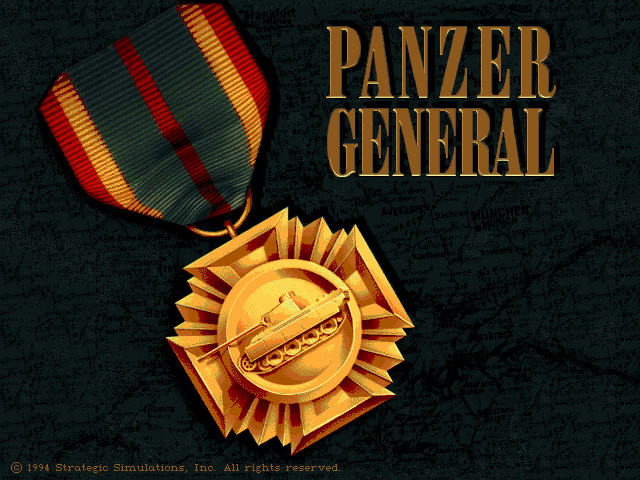
In Panzer General, you take command of operational forces on hex-based maps where managing fuel, ammo, and unit experience determines the outcome of World War II.
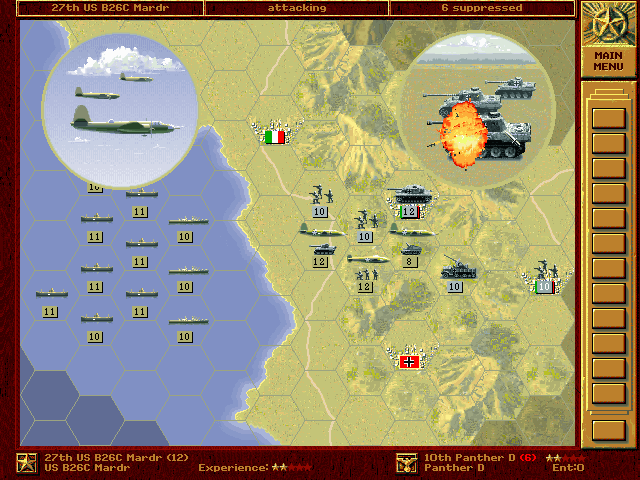
You start on a clean, detailed terrain map in high-resolution Super VGA. The operational menu sits on the right side of the screen, giving you full access to ground and air units. Selecting a unit highlights its movement range across hex tiles, showing clear terrain, forests, rivers, and fortified towns.
Combat depends heavily on unit types and support systems. Pushing a group of Panzers into a town full of enemy infantry without reconnaissance will destroy your armor quickly. You need artillery to suppress entrenched positions first, fighters to clear the skies, and bombers to soften targets before your ground troops move in.
Every attack consumes ammunition and fuel. If a unit runs out of supplies in enemy territory, it cannot fight or move efficiently. You constantly balance aggressive advances against the risk of leaving your spearhead exposed and unsupported.
Before this release, Strategic Simulations, Inc. was known for complex, text-heavy military simulations that appealed mainly to hardcore wargamers. For this project, the SSI Special Projects Group took direct inspiration from the Japanese series Daisenryaku. They wanted a system that was fast, visual, and easy to learn without losing operational depth.
Programmer Paul Murray built a flexible engine, complemented by David Jensen's detailed unit graphics and Doug Brandon's score. The game made exceptional use of PC audio hardware for its era. Players with a Gravis UltraSound, Roland Sound Canvas, or General MIDI board enjoyed rich musical tracks alongside crispy combat sound effects on standard Sound Blaster cards.
The design paid off massively. It became the best-selling title in the history of the company, selling 250,000 copies at full retail price. It proved that turn-based strategy games could achieve mainstream commercial success on desktop computers.
The campaign mode puts you in the role of a German Generalissimus across historical operations. You fight through famous engagements including Poland, France, Norway, North Africa, Kiev, Sevastopol, and D-Day. What made the system special was how it handled unit persistence across these battles.
Units gain experience from surviving combat, making veteran divisions far more effective than fresh replacements. Between scenarios, you spend prestige points to repair damaged units, upgrade older hardware to Tiger tanks or Focke-Wulf fighters, or purchase entirely new formations.
The campaign branching relies entirely on your speed. Finishing a scenario with five or more turns remaining grants a Major Victory. Securing continuous major victories opens up alternate history branches, allowing you to launch Operation Sealion to invade Britain or execute an amphibious landing on Washington, D.C..
The biggest point of frustration comes from the ruthless turn limits placed on every map. To achieve the top victory condition, you cannot play a slow, cautious battle of attrition. You must rush forward, taking risks that often lead to heavy unit casualties.
Modern players also notice a complete lack of character narrative or story cutscenes. You are managing military tokens on a board rather than guiding individual heroes or officers through a dramatic storyline. The emphasis remains strictly on positioning, logistics, and counter-play.
The battle mechanics themselves are solid, but a single bad tactical misstep can ruin a core unit you spent ten scenarios upgrading. Losing an elite division to a hidden air defense unit in the fog of war can make late-game scenarios brutally difficult.
Even with tight turn counters, it is still among the most accessible wargames on PC. It kicked off an entire engine lineage for SSI, spawning sequels like Allied General and Fantasy General. The core loop of upgrading experienced units and hunting for alternate historical timelines holds up exceptionally well.
If you enjoy tactical planning and unit management, this 1994 release is well worth your time. You can play Panzer General online directly in your browser without setting up complex configuration files or retro hardware. Jump straight into the invasion of France or Poland, test your tactical maneuvers, and see if you can earn a Major Victory before your turn counter runs out.
In Panzer General, you take command of operational forces on hex-based maps where managing fuel, ammo, and unit experience determines the outcome of World War II.
You start on a clean, detailed terrain map in high-resolution Super VGA. The operational menu sits on the right side of the screen, giving you full access to ground and air units. Selecting a unit highlights its movement range across hex tiles, showing clear terrain, forests, rivers, and fortified towns.
Combat depends heavily on unit types and support systems. Pushing a group of Panzers into a town full of enemy infantry without reconnaissance will destroy your armor quickly. You need artillery to suppress entrenched positions first, fighters to clear the skies, and bombers to soften targets before your ground troops move in.
Every attack consumes ammunition and fuel. If a unit runs out of supplies in enemy territory, it cannot fight or move efficiently. You constantly balance aggressive advances against the risk of leaving your spearhead exposed and unsupported.
Before this release, Strategic Simulations, Inc. was known for complex, text-heavy military simulations that appealed mainly to hardcore wargamers. For this project, the SSI Special Projects Group took direct inspiration from the Japanese series Daisenryaku. They wanted a system that was fast, visual, and easy to learn without losing operational depth.
Programmer Paul Murray built a flexible engine, complemented by David Jensen's detailed unit graphics and Doug Brandon's score. The game made exceptional use of PC audio hardware for its era. Players with a Gravis UltraSound, Roland Sound Canvas, or General MIDI board enjoyed rich musical tracks alongside crispy combat sound effects on standard Sound Blaster cards.
The design paid off massively. It became the best-selling title in the history of the company, selling 250,000 copies at full retail price. It proved that turn-based strategy games could achieve mainstream commercial success on desktop computers.
The campaign mode puts you in the role of a German Generalissimus across historical operations. You fight through famous engagements including Poland, France, Norway, North Africa, Kiev, Sevastopol, and D-Day. What made the system special was how it handled unit persistence across these battles.
Units gain experience from surviving combat, making veteran divisions far more effective than fresh replacements. Between scenarios, you spend prestige points to repair damaged units, upgrade older hardware to Tiger tanks or Focke-Wulf fighters, or purchase entirely new formations.
The campaign branching relies entirely on your speed. Finishing a scenario with five or more turns remaining grants a Major Victory. Securing continuous major victories opens up alternate history branches, allowing you to launch Operation Sealion to invade Britain or execute an amphibious landing on Washington, D.C..
The biggest point of frustration comes from the ruthless turn limits placed on every map. To achieve the top victory condition, you cannot play a slow, cautious battle of attrition. You must rush forward, taking risks that often lead to heavy unit casualties.
Modern players also notice a complete lack of character narrative or story cutscenes. You are managing military tokens on a board rather than guiding individual heroes or officers through a dramatic storyline. The emphasis remains strictly on positioning, logistics, and counter-play.
The battle mechanics themselves are solid, but a single bad tactical misstep can ruin a core unit you spent ten scenarios upgrading. Losing an elite division to a hidden air defense unit in the fog of war can make late-game scenarios brutally difficult.
Even with tight turn counters, it is still among the most accessible wargames on PC. It kicked off an entire engine lineage for SSI, spawning sequels like Allied General and Fantasy General. The core loop of upgrading experienced units and hunting for alternate historical timelines holds up exceptionally well.
If you enjoy tactical planning and unit management, this 1994 release is well worth your time. You can play Panzer General online directly in your browser without setting up complex configuration files or retro hardware. Jump straight into the invasion of France or Poland, test your tactical maneuvers, and see if you can earn a Major Victory before your turn counter runs out.
How Panzer General is played — the keys the game listens to, grouped by what they do.
Highlighted keys are mapped — hover or tap one to see what it does.
The game relies primarily on the mouse point-and-select interface for controls.
The on-screen keyboard and gamepad mapping the browser player uses on a phone, a tablet or a controller, as opposed to the real keys above. $PRO members make their own in the player and share them here; anyone can pick one to play with.
Cheat codes, console commands and memory pokes for Panzer General — each one verified and attributed.
Sign in to submitHow Panzer General is played — the keys the game listens to, grouped by what they do.
Highlighted keys are mapped — hover or tap one to see what it does.
The game relies primarily on the mouse point-and-select interface for controls.
The on-screen keyboard and gamepad mapping the browser player uses on a phone, a tablet or a controller, as opposed to the real keys above. $PRO members make their own in the player and share them here; anyone can pick one to play with.
Cheat codes, console commands and memory pokes for Panzer General — each one verified and attributed.
Sign in to submit