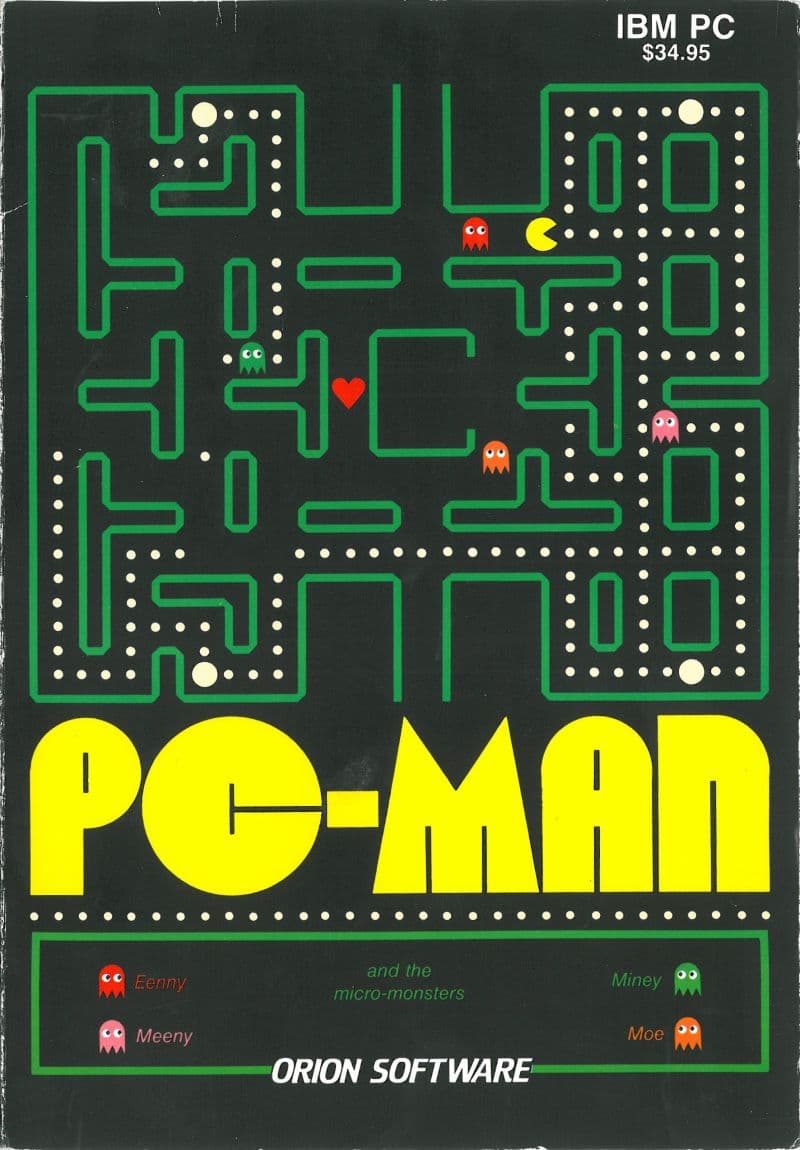
By rotating the entire arcade layout ninety degrees to fit widescreen IBM monitors, PC-Man turned a quick bootleg conversion into one of the most natural-feeling arcade experiences on early PC hardware.
Greg Kuperberg flipped the maze to make PC-Man work on standard monitors
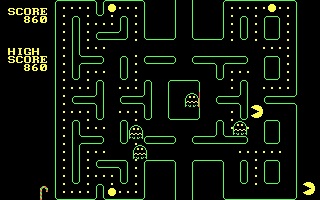
When Greg Kuperberg set out to build an unlicensed action game clone of Namco's arcade hit for Orion Software, Inc., he faced a glaring structural problem. Standard IBM PC monitors from 1982 were wider than they were tall, while arcade cabinets used vertical screens to display long, tall mazes. Rather than crushing the playfield into a tiny box with huge black borders, Kuperberg made the practical choice to rotate the whole maze sideways, putting the famous warp escape passages at the top and bottom of the display instead of the left and right edges.
It sounds like a minor tweak on paper, but in practice it completely alters how you scan the board. Because your eyes naturally track horizontal space on a PC screen, seeing four Micro Monsters give chase from the vertical extremities gives you a split-second longer to plan your path toward the four power pills sitting in the corners. The screen layout feels deliberate rather than cramped, turning a hardware constraint into a genuine mechanical strength.
The visual cleverness did not stop with the playfield orientation. Working within the harsh limits of early CGA displays, the game employs detailed pixel dithering techniques to fake a broader palette than the standard system hardware actually supported. The result is a clean, readable maze where your yellow dot-eater remains distinct against the wall patterns and fleeing blue monsters, sparing early IBM PC owners the blinding visual clash common to rival ports of the era.
The keypad controls demand precision and a locked Num Lock key
Controlling this yellow mouth means dealing with an old PC keyboard quirk. The game relies entirely on the numeric keypad for directional control, which means if you forget to engage Num Lock before booting, your character simply sits stationary while the Micro Monsters corner you in seconds. There is no custom key remapping or secondary arrow key setup, forcing you into a strict four-way hand position that feels closer to holding an arcade stick than typing.
Movement itself is sharp, but the corridor alignment takes some getting used to. Because the maze is rotated, navigating tight turns requires hitting your direction key a fraction of a second before PC-Man reaches an intersection. If you miss the window, you glide straight past the opening into an oncoming ghost, losing one of your three starting lives before you can react.
The audio relies on the standard internal PC Speaker to deliver feedback, pushing primitive hardware to its limits. You get chirping bleeps for eating dots, a short rhythmic intro tune when a round begins, and a descending pitch sequence whenever a Micro Monster catches you. It lacks the rich synthesizer sound of later arcade cards, but the sound effects give clear cues for when power pills are about to wear off.
Micro Monsters accelerate fast enough to crush early runs
The core loop of this PC-Man MS-DOS game stays faithful to arcade rules while ramping up the difficulty much faster than expected. You clear the fixed screen by eating every white dot in the corridors, grabbing bonus fruit items that pop up briefly near the center enclosure for extra points. Turning the tables on your pursuers requires eating one of the power pills, which turns all four Micro Monsters blue and vulnerable to being eaten for scaling point values.
The true test comes after the first couple of rounds, where the ghosts shed their predictability:
- Micro Monsters gain noticeable movement speed, quickly catching up to you in straight corridors.
- Blue vulnerability windows shrink dramatically, leaving almost no time to chase down monsters on the far side of the screen.
- Warp tunnels become mandatory escape valves rather than optional shortcuts as pursuers start cut-offs at intersections.
- Bonus fruit items disappear almost instantly, forcing risky dashes into the center of the maze.
Without named bosses or varied mission layouts, the challenge rests entirely on mastering your pathing through the maze. The lack of a save feature or password system means every attempt is a fresh sprint for a new personal high score, exactly as an arcade title should be.
Hardware speed bugs make modern cycle throttling essential
For years, playing this title on original gear was as easy as inserting the self-booting 5.25" floppy disk straight into an IBM PC drive and powering on the system. Because it was coded directly against the baseline clock rate of 4.77 MHz 8088 processors, the game logic is tied directly to CPU speed. Run this executable on faster vintage machines or default DOSBox settings without tweaking, and the entire simulation explodes into an unplayable warp speed where the ghosts destroy you in less than a single second.
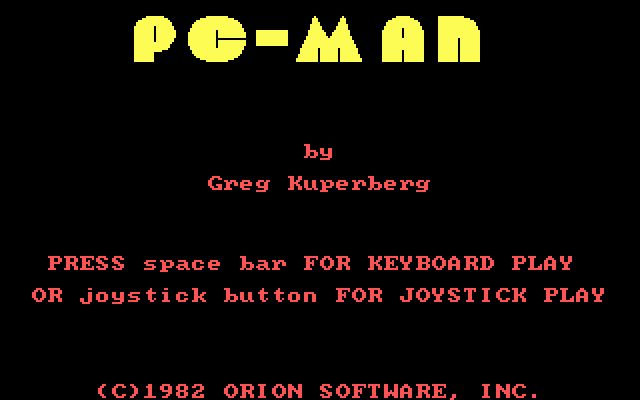
To get an authentic feel today, modern emulators need their cycles throttled down drastically, usually around 200 cycles. When tuned correctly, the original weight of character movement and enemy pathfinder logic returns immediately. It reveals an arcade conversion that actually aged far better than many officially licensed ports released later in the decade.
How this classic bootleg holds up today
As a straight clone, the game does not attempt to reinvent the maze runner formula, but its mechanical polish makes it far more than a cheap knockoff. The tight corridor layout, readable CGA visual choices, and steep difficulty curve make it satisfying to master once you adjust to the horizontal perspective shift. It shows how clever developers adapted arcade game design around PC hardware limitations.
If you want to try it out right now, you can play PC-Man online, running PC-Man free in your browser without needing to mess with floppy disk images or manual CPU cycle throttle settings. When the maze loads up, hit Num Lock, use the numeric keypad to navigate the rotated corridors, and see how many rounds you can survive before the Micro Monsters box you in.