
In Pick 'n Pile, designer Nicolas Choukroun turned simple gravity physics and tile swapping into an exercise in high-speed panic. You manipulate falling spheres and geometric shapes across a packed grid, trying to clear every object before a furious ticking clock drives your nerves over the edge.
By 1991, action puzzle games were everywhere on home PCs, but most stuck to rigid grids where items stayed exactly where you placed them. Pick 'n Pile disrupted that formula by letting you swap any two objects anywhere on the board while gravity continuously pulled everything downward.
When you move an object out from under a stack, the pieces above drop into the newly created gap. If an object lands on top of a single sphere, it slides diagonally into any empty space beside it. That rolling physics model means a single tile swap can trigger a cascading slide across half the screen.
Your goal sounds simple enough: match identical symbols into vertical columns to make them vanish entirely. Once all standard symbols disappear from the grid, you clear the stage and move on. You can choose EASY mode to begin on level 1, or start immediately on level 50 in HARD mode for a stiffer challenge.
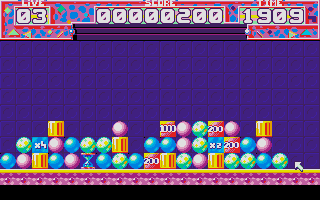
The core struggle in this Ubi Soft Entertainment Software release lies in managing your mistakes. A single careless swap can trap a single red ball at the bottom of a deep stack, leaving you with no obvious matches nearby.
When you get stuck, you can call for new random symbols to drop from above. Doing this buys you options, but it also crowds an already messy screen with unpredictable objects you might not need. A board that looked manageable two moves ago suddenly degenerates into total chaos.
Special items complicate your tactical choices. Bombs destroy adjacent items when activated, helping you clear stubborn obstacles like fixed wall blocks or immovable flower pots. On the other hand, skull items act as a penalty, draining your remaining time even faster if you leave them unchecked.
The audio presentation in the Pick 'n Pile MS-DOS game turns time pressure into a physical sensation. As the clock ticks down, the sound effect speeds up and grows louder, hammering away through your PC speaker or Sound Blaster card.
Reviewer responses at the time were split sharply on this tension. Magazine writers for Info called it pixel Zen for relaxing after work, while others noted that the frantic timer brought on actual heart palpitations. If the constant noise gets on your nerves, pressing the F5 key turns the ticking clock audio completely off.
Visually, the DOS build supports CGA, EGA, Tandy, and VGA graphic displays. VGA mode keeps symbols distinct, which is essential when you are trying to spot color matches in a split second. Controls are equally flexible, letting you use a mouse, keyboard, or joystick to drive the cursor.

Comparisons were inevitable upon release, with contemporary reviewers comparing the game directly to Puzznic. Computer Gaming World noted its original flavor, though correctly observed it lacked the deep addictive hold of titles like Tetris. Meanwhile, Crash! gave it a modest 56% score amid a crowded market of arcade brainteasers.
What sets this puzzle title apart is how fast a session can flip from easy to overwhelming. Unlike block-falling games where you control incoming pieces, here you operate directly on a full board of elements that react instantly to gravity. The satisfaction comes from engineering a clean chain reaction that wipes out half a column in one stroke.
I find that the fast pace still holds appeal for players who prefer quick thinking over deep, quiet planning. It lacks a long campaign or hidden bonus levels, but the central mechanic retains its bite. If you enjoy testing your reflexes under tight deadlines, the tension remains genuine.
You can play Pick 'n Pile online free in your browser right here, with no extra setup required. It offers a fast, sharp puzzle challenge that reveals its core loop within thirty seconds of launching.
Once you start playing, watch how the diagonal sliding mechanic shifts pieces sideways into open spaces. That tumbling motion is hard to gauge from still pictures, but it completely changes how you set up matches. Launch a game, hit F5 if the ticking clock drives you crazy, and see how many screens you can clear before time runs out.
In Pick 'n Pile, designer Nicolas Choukroun turned simple gravity physics and tile swapping into an exercise in high-speed panic. You manipulate falling spheres and geometric shapes across a packed grid, trying to clear every object before a furious ticking clock drives your nerves over the edge.
By 1991, action puzzle games were everywhere on home PCs, but most stuck to rigid grids where items stayed exactly where you placed them. Pick 'n Pile disrupted that formula by letting you swap any two objects anywhere on the board while gravity continuously pulled everything downward.
When you move an object out from under a stack, the pieces above drop into the newly created gap. If an object lands on top of a single sphere, it slides diagonally into any empty space beside it. That rolling physics model means a single tile swap can trigger a cascading slide across half the screen.
Your goal sounds simple enough: match identical symbols into vertical columns to make them vanish entirely. Once all standard symbols disappear from the grid, you clear the stage and move on. You can choose EASY mode to begin on level 1, or start immediately on level 50 in HARD mode for a stiffer challenge.
The core struggle in this Ubi Soft Entertainment Software release lies in managing your mistakes. A single careless swap can trap a single red ball at the bottom of a deep stack, leaving you with no obvious matches nearby.
When you get stuck, you can call for new random symbols to drop from above. Doing this buys you options, but it also crowds an already messy screen with unpredictable objects you might not need. A board that looked manageable two moves ago suddenly degenerates into total chaos.
Special items complicate your tactical choices. Bombs destroy adjacent items when activated, helping you clear stubborn obstacles like fixed wall blocks or immovable flower pots. On the other hand, skull items act as a penalty, draining your remaining time even faster if you leave them unchecked.
The audio presentation in the Pick 'n Pile MS-DOS game turns time pressure into a physical sensation. As the clock ticks down, the sound effect speeds up and grows louder, hammering away through your PC speaker or Sound Blaster card.
Reviewer responses at the time were split sharply on this tension. Magazine writers for Info called it pixel Zen for relaxing after work, while others noted that the frantic timer brought on actual heart palpitations. If the constant noise gets on your nerves, pressing the F5 key turns the ticking clock audio completely off.
Visually, the DOS build supports CGA, EGA, Tandy, and VGA graphic displays. VGA mode keeps symbols distinct, which is essential when you are trying to spot color matches in a split second. Controls are equally flexible, letting you use a mouse, keyboard, or joystick to drive the cursor.
Comparisons were inevitable upon release, with contemporary reviewers comparing the game directly to Puzznic. Computer Gaming World noted its original flavor, though correctly observed it lacked the deep addictive hold of titles like Tetris. Meanwhile, Crash! gave it a modest 56% score amid a crowded market of arcade brainteasers.
What sets this puzzle title apart is how fast a session can flip from easy to overwhelming. Unlike block-falling games where you control incoming pieces, here you operate directly on a full board of elements that react instantly to gravity. The satisfaction comes from engineering a clean chain reaction that wipes out half a column in one stroke.
I find that the fast pace still holds appeal for players who prefer quick thinking over deep, quiet planning. It lacks a long campaign or hidden bonus levels, but the central mechanic retains its bite. If you enjoy testing your reflexes under tight deadlines, the tension remains genuine.
You can play Pick 'n Pile online free in your browser right here, with no extra setup required. It offers a fast, sharp puzzle challenge that reveals its core loop within thirty seconds of launching.
Once you start playing, watch how the diagonal sliding mechanic shifts pieces sideways into open spaces. That tumbling motion is hard to gauge from still pictures, but it completely changes how you set up matches. Launch a game, hit F5 if the ticking clock drives you crazy, and see how many screens you can clear before time runs out.
How Pick 'n Pile is played — the keys the game listens to, grouped by what they do.
Highlighted keys are mapped — hover or tap one to see what it does.
Control method is selected in the menu using F3. Cursor speed can be adjusted with F6 when keyboard or joystick control is selected.
The on-screen keyboard and gamepad mapping the browser player uses on a phone, a tablet or a controller, as opposed to the real keys above. $PRO members make their own in the player and share them here; anyone can pick one to play with.
Cheat codes, console commands and memory pokes for Pick 'n Pile — each one verified and attributed.
Sign in to submitHow Pick 'n Pile is played — the keys the game listens to, grouped by what they do.
Highlighted keys are mapped — hover or tap one to see what it does.
Control method is selected in the menu using F3. Cursor speed can be adjusted with F6 when keyboard or joystick control is selected.
The on-screen keyboard and gamepad mapping the browser player uses on a phone, a tablet or a controller, as opposed to the real keys above. $PRO members make their own in the player and share them here; anyone can pick one to play with.
Cheat codes, console commands and memory pokes for Pick 'n Pile — each one verified and attributed.
Sign in to submit