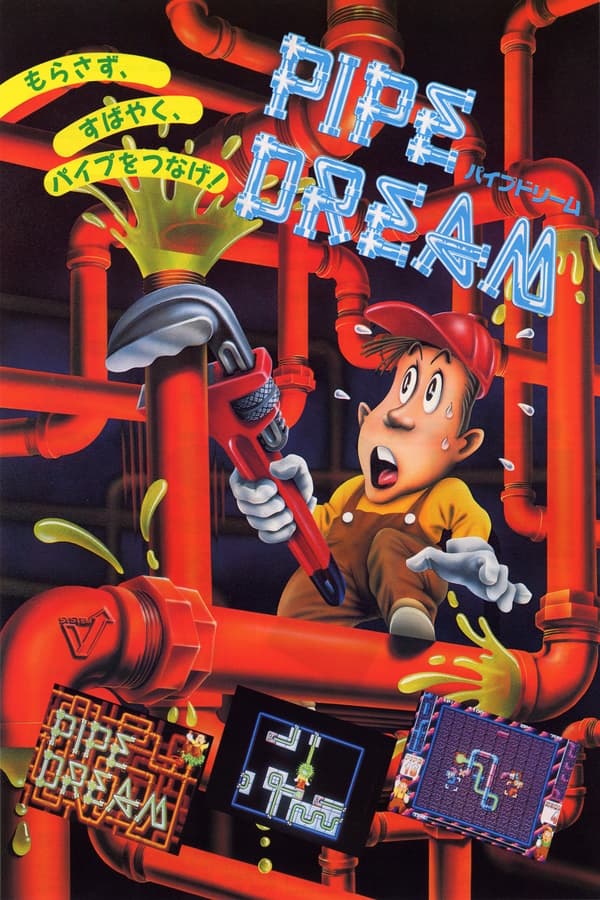

In Pipe Dream, you are handed a queue of random plumbing segments and given only a few frantic seconds before a slimy liquid starts oozing across the grid.
Laying track under pressure makes every second count
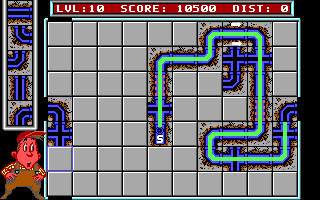
The core tension hits you the moment you drop your first segment on the single-screen board. You do not control a character or drive a vehicle in this puzzle game. Instead, you stare at a queue displaying five upcoming pipe tiles while a timer silently ticks down toward disaster.
Seven basic shapes populate the queue: horizontal straights, vertical straights, four distinct ninety-degree corners, and a four-way cross-over. A designated starting square determines where the liquid, known as flooz, will originate. Once the countdown reaches zero, the flooz crawls out and fills one pipe section every few moments.
Your goal sounds simple: build a path long enough to meet the level threshold before the fluid spills into an empty square. If the flooz hits a dead end or an open pipe mouth, your run ends on the spot. You can overwrite an existing piece to change direction, but doing so costs valuable points and eats precious seconds.
Cross-over loops turn basic plumbing into spatial geometry
Scoring high takes far more effort than laying a straight line to the minimum quota. Designed by Akila Redmer and Stephan L. Butler, the game mechanics actively push you toward dangerous, sprawling layouts. Sending the liquid through both channels of at least five cross-over tiles earns massive bonus points, as does filling every single tile on the grid.
The developers at The Assembly Line introduced clever grid hazards in later stages to disrupt simple pathfinding. Blocked tiles force you around narrow corners, while gaps in the outer side-walls wrap your pipeline around to the opposite edge of the display. Managing a double wrap-around while trying to clear a high score requirement tests your foresight under extreme time constraints.
Early reviews recognized how well these mechanics worked under pressure. In May 1990, MacUser praised it as
"a great arcade-style game"that consistently rewards strategic planning, placing it among the sharpest puzzlers of its day. The sheer speed required to divert flooz away from an open end creates a distinct brand of chaos.
Austere visuals hide a brutal difficulty curve
Nobody ever booted up the 1989 Empire Software release for its graphic presentation. Retrospective critics at French outlet Retro Archives accurately described the visuals as effroyablement spartiate, or frightfully austere. The background stays dark, the interface looks like standard workstation software, and audio support relies on basic PC speaker chirps.
That minimalist visual language keeps your eyes focused entirely on tile placement. Every square on the grid remains clear, letting you read the entire board at a single glance. Here is what you encounter across a typical run:
- Randomized starting points that dictate the opening direction of flow.
- Increasing liquid speeds that turn mid-game levels into panic management.
- Fixed obstacle tiles that lock off central portions of the screen.
- Side-wall wrap points that let pipelines cross edge boundaries.
The late-game difficulty curve ramps up sharply as the liquid velocity accelerates. By the time you reach the higher stages, the flooz surges forward so quickly that replacing a misplaced tile becomes nearly impossible. One wrong click creates an unfixable bottleneck, bringing your high score attempt to a sudden end.
The Connect 4 bonus levels break up the frantic pace
After completing every four standard stages, the pace shifts entirely with a special scoring stage. These bonus rounds alter the tile placement rules, forcing pieces to drop down to the lowest open position in a chosen column, matching the board mechanics of Connect 4.
This structural pause lets you gather bonus points without the constant threat of a fluid spill ending your game. It also forces a completely different tactical mindset, as you stack pieces from the bottom up rather than routing anywhere on the board. When the regular levels resume, the contrast makes the sudden return to fast real-time routing feel even more immediate.
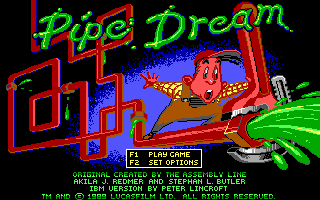
When published in North America by LucasArts, the original Pipe Mania title became Pipe Dream. The game eventually reached over fifteen platforms and was bundled into the Microsoft Windows Entertainment Pack. Its core concept proved so influential that developers copied the pipe-linking puzzle directly into action titles, most famously as the hacking mini-game in BioShock.
You can play Pipe Dream online right now
The appeal of this 1989 release lies in its pure, uncluttered design. The presentation is bare, but the frantic loop of tile placement, path extension, and emergency corrections works as well today as it ever did. If you enjoy spatial puzzles that demand quick decisions under pressure, fire it up tonight.
Modern players often assume they can easily outsmart the tile queue, but panic sets in fast once the flooz speeds up. You can play Pipe Dream online right now in your web browser. Jump into the original Pipe Dream MS-DOS game free in your browser with nothing to install, select your first tile, and see how many cross-overs you can fill before the green liquid overflows your board.