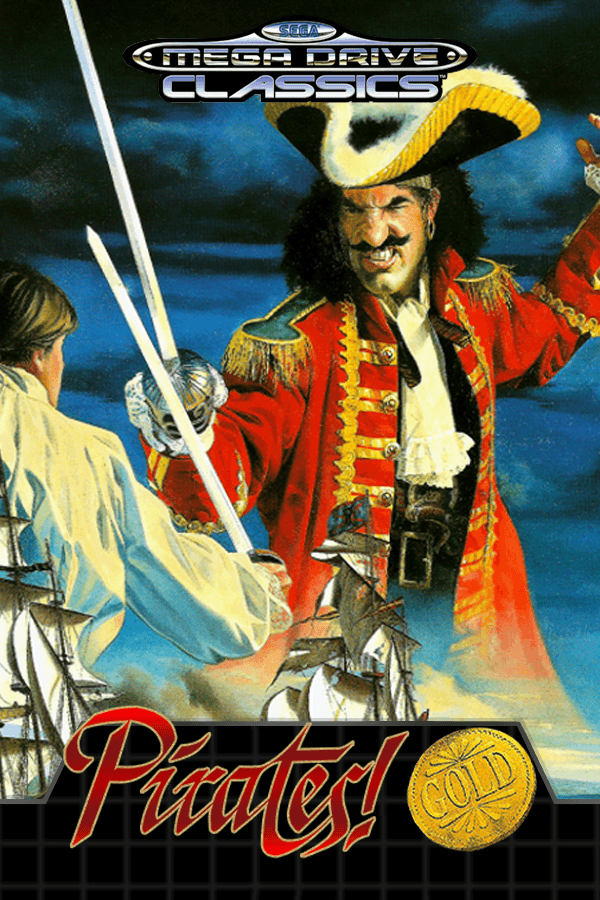

Pirates! Gold
aka Sid Meier's Pirates! Gold
If you loaded up Pirates! Gold hoping for a fresh strategy engine, you were in for a surprise: MicroProse took Sid Meier's 1987 Caribbean sandbox, wrapped it in 256-color SVGA art, and left the core gameplay untouched.
SVGA paint over an existing legend
When the remake landed on MS-DOS in 1993, players who had spent years squinting at sixteen-color EGA graphics suddenly got detailed hand-painted portraits, digitized sea spray, and 3D modeled ship sprites. Computer Gaming World famously described the package as adding three disks of graphical gold to an already great game engine, while recommending it whole-heartedly to anyone who had missed the original. Yet for veterans who already knew every trade route by heart, the actual game beneath the coat of paint was almost identical to the classic they had played six years earlier.
The team at MPS Labs led project management under Paul Murphy, with code by Randall Don Masteller and art direction by Michael Haire. They stripped out a few small mechanics from the 1987 build, including the original sun sighting mini-game and some of the original special items, focusing their energy on high-resolution menus and mouse support. The result felt polished on a VGA monitor, but it did not try to reinvent how a privateer made his living.
Choosing your era and making your fortune on the high seas
Every campaign starts by choosing your entry point between 1560 and 1680, selecting historical periods like The Silver Empire or the Early Buccaneers. You pick a home nation among the English, French, Dutch, or Spanish, pick a starting political alignment, and receive a single ship with a skeleton crew. Beyond career mode, you can also jump into fixed historic scenarios to command famous expeditions, taking on the actual voyages of Henry Morgan or other real-world privateers.
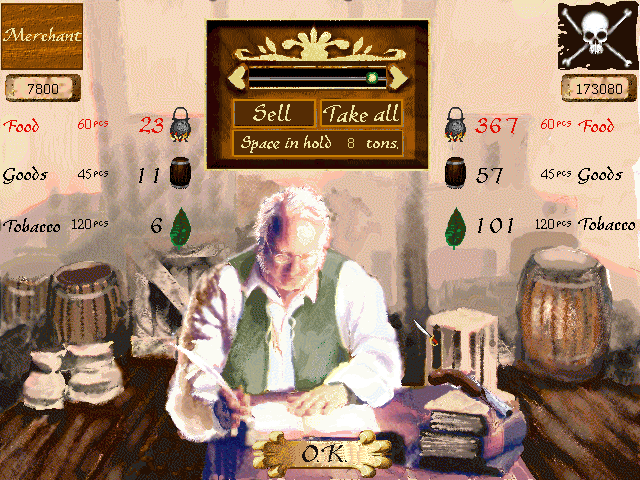
What makes the campaign loop so durable is how quickly it opens up into complete freedom. You drop anchor in local ports to visit the pub, buy supplies, buy rumors, and hire crew members who expect a share of the eventual plunder. If you keep your men happy with gold, you can court local governors' daughters, accept missions from politicos, hunt down notorious pirates like Blackbeard or Calico Jack, and search for lost family members using scraps of treasure maps.
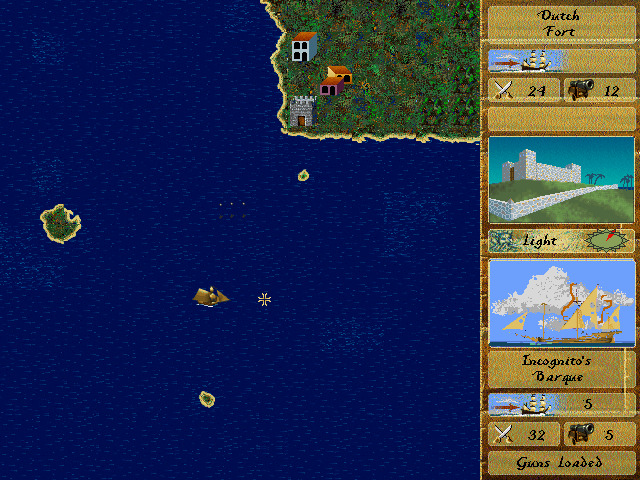
- Sailing: Real-time top-down navigation where wind speed and hull weight dictate your tactical choices.
- Ship Combat: Turning your vessel to line up broadside cannon fire before deciding to sink your target or close in for a boarding action.
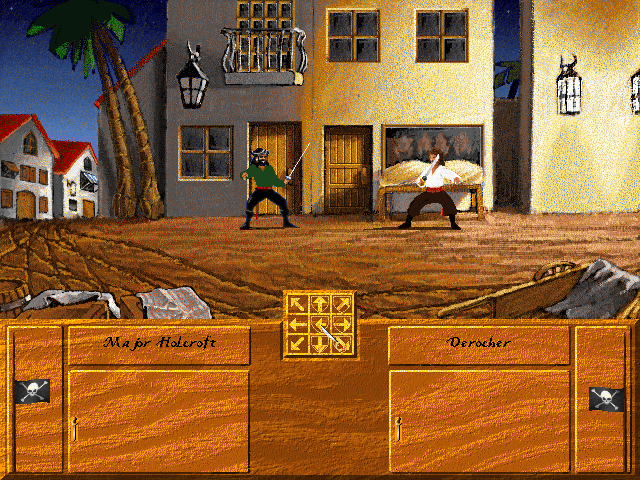
- Fencing: Side-view sword duels against enemy captains where timing your thrust, parry, and slash determines the outcome.
- Land Assaults: Turn-based tactical battles against heavily fortified towns and coastal forts when direct sea attacks are too risky.
Broadsides, fencing, and the copy protection wall
The combat strikes a careful balance between broadside maneuvering and personal dueling. In top-down ship combat, steering a heavy galleon against the wind while a fast sloop runs circles around you is a quick lesson in naval physics. If you board, the view shifts to a side-profile duel where sword swings feel snappy, though low crew morale will handicap your stamina from the very first strike.
Not everything in the package earned warm praise, however. The game included an aggressive physical copy protection check: every so often, an enemy pirate captain's flag appears on the horizon, forcing you to identify it by flipping through pages 48 to 67 of the paper manual. If you mistype the flag identity, your ship is stripped of all its cannons on the spot, turning a winning campaign into a miserable retreat. Modern players frequently cite this system and occasional control quirks as the main points of friction during long sessions.
Sound cards, period reviews, and technical upgrades
Audio was one area where the MS-DOS release made massive strides over the early PC speaker days. Published by MicroProse, the game provided full driver support for everything from basic AdLib and Sound Blaster cards to the Sound Blaster Pro, Pro Audio Spectrum, Covox, and the high-end Roland MT-32 synthesizer. Composers Jeffery L. Briggs and Roland J. Rizzo supplied a MIDI soundtrack filled with period-appropriate sea shanties that sounded rich through a proper Roland module.
Gaming magazines of the day gave the update strong scores across the board. Compute! praised the hand-painted screens for having the feel of Caribbean watercolors, while PC Master awarded an 89% rating and Australia's Hyper issue #1 gave it 90%. PC Zone took a slightly more reserved stance at 75%, pointing out that behind the SVGA graphics lay a familiar loop that long-time fans had already played to death.
You can play Pirates! Gold online right now
If you want a classic Caribbean privateer simulation that gets out of your way and lets you sail, trade, or plunder on your own terms, this 1993 edition is about as clean as it gets. The fencing is quick, the top-down ship battles require real spatial planning, and the graphics hold up far better than the 8-bit art that preceded them.
You can play Pirates! Gold online free in your browser right here. There is nothing to install, so you can jump straight onto the high seas, test your fencing timing against an enemy captain, and see how much plunder you can haul back to port before your crew mutinies.