


Before Disney turned the historic figure into an animated blockbuster, Pocahontas arrived on PC displays as a punishing side-scrolling action game where players alternate between dodging wild animals and aiming a musket with the mouse cursor.
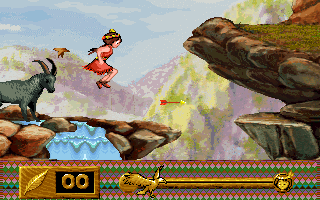
The campaign splits seven distinct levels between two historical figures, beginning with control of the title heroine. Your earliest tasks involve gathering feathers scattered across the wilderness for a local Shaman woman, who rewards your footwork with magic cards. You use four primary keys to walk, run, climb, jump, and swing across branches, while an on-screen mouse cursor highlights interactive points in the environment. Clicking the left or right mouse button selects different contextual actions, while an inventory bar along the bottom of the screen holds items required for light puzzle solving.
Early stages sound straightforward on paper, but navigating the terrain quickly turns into an exercise in frustration. Level two forces you to outmaneuver a spirit bear wandering the woods, while level four tasks you with shaking off a pursuing boy before you reach the English encampment. The problem lies in how the character handles. Movements feel heavy and delayed, making precise leaps across high tree branches far harder than they ought to be. A progress bar at the bottom of your display tracks how close you are to completing stage goals, but watching that meter fill feels like a relief rather than a victory.
When the perspective shifts to John Smith, the core loop changes completely. In level three, the explorer must hunt passing animals across separate depth planes using mouse-driven crosshairs to feed his hungry crew before sunset. Level five swaps the musket for a paddle, placing Smith in a canoe to catch fish under the same strict time limit. These shifts in play style keep the stage structures varied, even if the sudden move from precision platforming to target shooting feels abrupt.
Designed by Diana Hartmann at UK studio Teeny Weeny Games and published by GT Interactive Software in 1995, the project was one of the developer's final releases before merging with Perfect 10 Productions to form Perfect Entertainment. The production team put real effort into PC sound hardware integration, including dedicated support for Roland AWE synthesizer cards. Hearing rich environmental audio and atmospheric effects come through high-end MIDI setups was a genuine highlight for PC owners at the time, even if the visuals stayed strictly within standard two-dimensional boundaries.
By level six, the two playable leads finally meet up. Smith begins the stage leaping across wide ravines and rushing rivers on his own before meeting Pocahontas at the edge of a large lake. From there, both characters must assist each other to cross the water safely, combining their unique movement abilities to clear obstacles that neither could bypass alone.
The finale pushes this cooperative design to an absurd extreme. Level seven requires you to direct both characters simultaneously to trap a bear in the woods. Managing two sets of awkward movement keys while keeping track of two sprites on one screen leads to frequent deaths. Contemporary reviewers at Home of the Underdogs rightly called out this extreme difficulty spike, noting that while the narrative integration across stages was clever, the stiff controls and steep challenge made the later levels fit only for expert platformer fans.
Compared to mainstream mid-nineties DOS action titles like Jazz Jackrabbit or Rayman, this release lacks the smooth momentum and forgiving hitboxes that make long sessions enjoyable. Miss a single jump over a river in level six and you lose all momentum, often sending you straight into a hazard. The inventory system at the bottom of the screen adds an interesting adventure touch, but toggling items while dodging hostile wildlife feels needlessly clunky during high-stress encounters.
What keeps the experience interesting is its willingness to mix up goals rather than sticking to simple left-to-right running. One level asks for stealthy evasion, the next demands fast mouse aim, and the finale demands complex micro-management. It is a odd mix of action mechanics that rarely gelled together cleanly, but it certainly avoided the copy-paste design of lesser movie-adjacent tie-ins from the era.
If you enjoy tackling brutal DOS platformers or want to see how developers handled licensed material right before Disney's own adaptation dominated store shelves, this releases is worth a look. The high difficulty wall and stiff walking animations mean only dedicated retro enthusiasts will see the final screen, but experiencing the strange shift to mouse-aim hunting in level three makes for a memorable quick session.
You can play Pocahontas online, free in your browser, with nothing to install and no setup required. Load into the Pocahontas MS-DOS game, test your timing against the spirit bear in the early levels, and see if you have the patience to wrangle dual-character controls in the endgame.
Before Disney turned the historic figure into an animated blockbuster, Pocahontas arrived on PC displays as a punishing side-scrolling action game where players alternate between dodging wild animals and aiming a musket with the mouse cursor.
The campaign splits seven distinct levels between two historical figures, beginning with control of the title heroine. Your earliest tasks involve gathering feathers scattered across the wilderness for a local Shaman woman, who rewards your footwork with magic cards. You use four primary keys to walk, run, climb, jump, and swing across branches, while an on-screen mouse cursor highlights interactive points in the environment. Clicking the left or right mouse button selects different contextual actions, while an inventory bar along the bottom of the screen holds items required for light puzzle solving.
Early stages sound straightforward on paper, but navigating the terrain quickly turns into an exercise in frustration. Level two forces you to outmaneuver a spirit bear wandering the woods, while level four tasks you with shaking off a pursuing boy before you reach the English encampment. The problem lies in how the character handles. Movements feel heavy and delayed, making precise leaps across high tree branches far harder than they ought to be. A progress bar at the bottom of your display tracks how close you are to completing stage goals, but watching that meter fill feels like a relief rather than a victory.
When the perspective shifts to John Smith, the core loop changes completely. In level three, the explorer must hunt passing animals across separate depth planes using mouse-driven crosshairs to feed his hungry crew before sunset. Level five swaps the musket for a paddle, placing Smith in a canoe to catch fish under the same strict time limit. These shifts in play style keep the stage structures varied, even if the sudden move from precision platforming to target shooting feels abrupt.
Designed by Diana Hartmann at UK studio Teeny Weeny Games and published by GT Interactive Software in 1995, the project was one of the developer's final releases before merging with Perfect 10 Productions to form Perfect Entertainment. The production team put real effort into PC sound hardware integration, including dedicated support for Roland AWE synthesizer cards. Hearing rich environmental audio and atmospheric effects come through high-end MIDI setups was a genuine highlight for PC owners at the time, even if the visuals stayed strictly within standard two-dimensional boundaries.
By level six, the two playable leads finally meet up. Smith begins the stage leaping across wide ravines and rushing rivers on his own before meeting Pocahontas at the edge of a large lake. From there, both characters must assist each other to cross the water safely, combining their unique movement abilities to clear obstacles that neither could bypass alone.
The finale pushes this cooperative design to an absurd extreme. Level seven requires you to direct both characters simultaneously to trap a bear in the woods. Managing two sets of awkward movement keys while keeping track of two sprites on one screen leads to frequent deaths. Contemporary reviewers at Home of the Underdogs rightly called out this extreme difficulty spike, noting that while the narrative integration across stages was clever, the stiff controls and steep challenge made the later levels fit only for expert platformer fans.
Compared to mainstream mid-nineties DOS action titles like Jazz Jackrabbit or Rayman, this release lacks the smooth momentum and forgiving hitboxes that make long sessions enjoyable. Miss a single jump over a river in level six and you lose all momentum, often sending you straight into a hazard. The inventory system at the bottom of the screen adds an interesting adventure touch, but toggling items while dodging hostile wildlife feels needlessly clunky during high-stress encounters.
What keeps the experience interesting is its willingness to mix up goals rather than sticking to simple left-to-right running. One level asks for stealthy evasion, the next demands fast mouse aim, and the finale demands complex micro-management. It is a odd mix of action mechanics that rarely gelled together cleanly, but it certainly avoided the copy-paste design of lesser movie-adjacent tie-ins from the era.
If you enjoy tackling brutal DOS platformers or want to see how developers handled licensed material right before Disney's own adaptation dominated store shelves, this releases is worth a look. The high difficulty wall and stiff walking animations mean only dedicated retro enthusiasts will see the final screen, but experiencing the strange shift to mouse-aim hunting in level three makes for a memorable quick session.
You can play Pocahontas online, free in your browser, with nothing to install and no setup required. Load into the Pocahontas MS-DOS game, test your timing against the spirit bear in the early levels, and see if you have the patience to wrangle dual-character controls in the endgame.
How Pocahontas is played — the keys the game listens to, grouped by what they do.
Highlighted keys are mapped — hover or tap one to see what it does.
Specific keyboard controls were not fully documented in available sources, though four movement keys and context-sensitive mouse controls are used.
The on-screen keyboard and gamepad mapping the browser player uses on a phone, a tablet or a controller, as opposed to the real keys above. $PRO members make their own in the player and share them here; anyone can pick one to play with.
Cheat codes, console commands and memory pokes for Pocahontas — each one verified and attributed.
Sign in to submitHow Pocahontas is played — the keys the game listens to, grouped by what they do.
Highlighted keys are mapped — hover or tap one to see what it does.
Specific keyboard controls were not fully documented in available sources, though four movement keys and context-sensitive mouse controls are used.
The on-screen keyboard and gamepad mapping the browser player uses on a phone, a tablet or a controller, as opposed to the real keys above. $PRO members make their own in the player and share them here; anyone can pick one to play with.
Cheat codes, console commands and memory pokes for Pocahontas — each one verified and attributed.
Sign in to submit