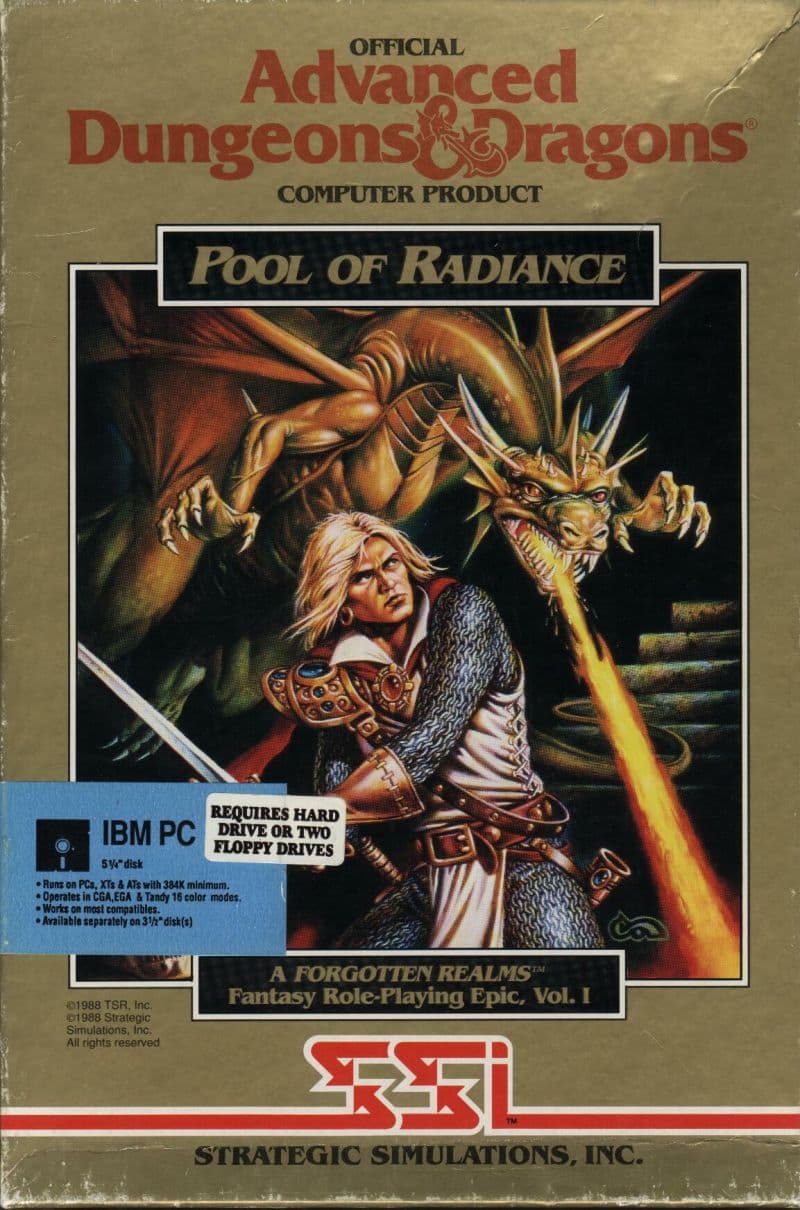
Pool of Radiance
When Strategic Simulations brought Pool of Radiance to MS-DOS in 1988, it gave computer role-playing players something tabletop gamers had enjoyed for years: a faithful translation of Advanced Dungeons & Dragons mechanics coupled with brutal tactical combat.
Rebuilding Phlan through tactical grid warfare
Before this game came along, computer RPGs usually asked you to choose between smooth wireframe dungeon crawling and deep tactical combat. Strategic Simulations, Inc. solved that trade-off by splitting the perspective into two distinct modes. You explore the ruined city of Phlan through a small first-person window in pseudo-3D, then drop directly into an overhead turn-based grid the moment a band of kobolds ambushes your front line.
That top-down view is where the engine built by programmers Keith Brors and Brad Myers really shines. Combat relies heavily on positioning, spell timing, and line of sight. If your wizard drops a Sleep spell on a cluster of enemies, your fighters can step up and finish them in a single blow, but misplace your spell caster and a single flank attack from a bugbear will wipe out your primary area-of-effect damage in one turn.
How Pool of Radiance handles party balance and brutal encounters
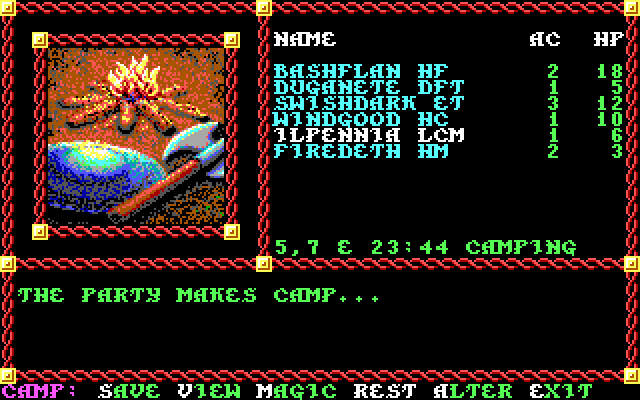
Building a party requires serious planning in the city hall before you step into the slums. You pick up to six adventurers, balancing raw martial strength against utility and divine magic. Your options for building a crew draw straight from the tabletop rulebooks:
- Six playable races: Human, Elf, Half-Elf, Dwarf, Gnome, and Halfling.
- Four core character classes: Fighter, Cleric, Magic-User, and Thief.
- Multi-classing options for non-human characters to mix combat prowess with spellcasting.
- Space for up to two hired non-player characters recruited at the local New Phlan hiring hall.
The early hours in the slums of New Phlan do not offer a gentle learning curve. A bad initiative roll against a large group of goblins or kobolds can wipe out an entire party of level-one characters in seconds. Success comes down to managing resources, buying sensible gear in city shops, and using narrow doorways to deny enemy swarms their numerical advantage.
The Adventurer's Journal and the pain of Wizard's Isle
Narrative delivery in the 1988 DOS release relied heavily on physical media. Rather than cluttering precious floppy disk space with hundreds of lines of text, the game told you to open the physical Adventurer's Journal and read specific paragraph numbers. To foil copycats and players trying to skim ahead, TSR writers Jim Ward, David Cook, Steve Winter, and Mike Breault stuffed the journal with fake entries describing false quests and bogus plot twists alongside the real ones.
While the tactical combat earns high praise, the dungeon design takes a sharp drop in quality near the end. The worst offender is Kokol Tower on Wizard's Isle, home to the mutated wizard Yarash. The area relies on an annoying labyrinth of invisible teleporters that scramble your party across the map, turning exploration into a tedious chore of trial-and-error mapping. Modern players running the original files often rely on fan utilities like the Gold Box Companion just to map that section without throwing a keyboard across the room.
The engine that launched an era for SSI
The creation of this project was a huge gamble for Strategic Simulations. The company secured the official AD&D video game license from TSR in 1987 after beating out rival bidder Electronic Arts. Director Chuck Kroegel and designer George MacDonald were tasked with creating an engine that could serve as the foundation for a massive series of official campaign adaptations.
Artists Tom Wahl, Fred Butts, Darla Marasco, and Susan Halbleib established a distinct visual format for character portraits and monster sprites that endured across multiple sequels. Despite the frustrating late-game teleporters and strict inventory weight limits, the core gameplay loop remains incredibly satisfying. Clearing out zones like the Graveyard or the Barren River and returning to the city council for a reward gives you a real sense of reclaiming a fallen realm brick by brick.
Play Pool of Radiance online right now
If you want to experience where computer AD&D adaptations hit their stride, you can launch this classic role-playing game right in your web browser. The combat mechanics still work well, provided you keep a notepad handy for spell descriptions or look up the original journal entries online when prompted.
You can play Pool of Radiance free in your browser without downloading extra software. To get started with this classic Pool of Radiance MS-DOS game experience, roll a balanced party with at least two strong fighters up front, keep your cleric in the middle row, and make sure your magic-user memorizes Sleep before you head into the slums for your very first contract. When you are ready to test your tactical skills, simply play Pool of Radiance online right here and start reclaiming the city of Phlan.