

From the moment you step through the central hub portal in Quake, the weapon in your hands feels tied to an actual physical space rather than a flat, clever optical illusion.
The moment you step into Quake, the shift from older raycasting shooters becomes immediate. Your camera tilts up toward medieval rafters, grenades arc downward off inclined stone walls, and enemies flinch back into real shadows cast by dynamic lightmaps. You control a soldier deployed through slipgate portals into hostile dimensions to stop an alien army, and the initial military base quickly gives way to dark, gothic castles built by id Software, Inc.
Instead of scaling flat wall textures and flat enemy sprites, John Carmack's engine rendered every monster, pillar, and hallway out of actual polygons. That mechanical pivot fundamentally altered combat pacing. Enemies do not simply hit a sightline and shoot, they leap down from ledges, circle around stone pillars, and flush you out of cover with bounced explosives. Aiming vertically with a mouse transformed from a minor secondary option into a core survival skill, especially when tracking aggressive foes overhead.
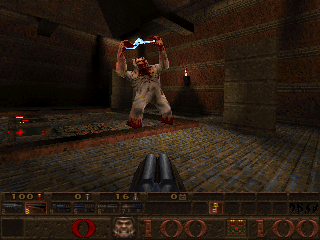
Combat relies on rapid positioning and choosing the right weapon for aggressive target priority. Your standard shotgun and super shotgun handle low-level possessed soldiers and knights, but larger threats demand heavier ordnance. The double-barreled Nailgun and Super Nailgun punch through heavily armored foes with heavy metal rivets, while explosive grenade and rocket launchers clear out clusters of monsters before they close the distance. In tight water filled spaces, firing the high damage Thunderbolt lightning gun is lethal to everything nearby, including yourself if you pull the trigger underwater.
The game engine physics introduced unintended movement quirks that players immediately converted into advanced tactics. Direct explosive splash damage against a floor allowed players to perform a rocket jump, blasting themselves high into the air to skip entire floor puzzles or reach hidden ledges. Continuous strafe jumping, known as bunny hopping, allowed continuous acceleration far past normal running caps. That mechanical depth is reinforced by Trent Reznor's haunting industrial ambient sound effects and score, complemented by Nine Inch Nails branding stamped directly onto the game's heavy nailgun ammo crates.
The technical triumph of full 3D rendering came with a distinct aesthetic trade-off. To fit lightmaps and real-time textures within strict 1996 memory budgets, the art direction leaned heavily into murky shades of brown, gray, and deep rust. Across all four campaign episodes, the environmental palette can feel monochromatic, making dark corridors blur together despite detailed level architecture. Reviewers at launch celebrated the technological leap, but modern eyes will easily spot how blocky those low-polygon character models look outside the shadows.
The encounter design also features brutal difficulty spikes that frustrate unprepared players. High-tier monsters like the lumbering, fur-covered Shambler soak up massive explosive damage while firing instant-hit lightning, while jumping Fiends and homing projectile Vores rapidly punish slight movement errors. That pressure is compounded by tight platforming sequences over instant-death lava and slime pits, such as the low-gravity secret level E1M8: Ziggurat Vertigo. A single mistimed jump across an open pit sends you back to your last manual save, making precise air control just as important as shot placement.
When the original 1996 launch arrived on PC displays under publisher GT Interactive Software Corp., running the original Quake MS-DOS game required serious processing horsepower. Standard Pentium CPUs struggled at higher resolutions, prompting special hardware-accelerated releases like VQuake for Rendition Verite chips and GLQuake for OpenGL cards to achieve smooth frame rates. Players unable to secure expensive accelerator cards routinely dropped their view windows or resolution settings just to stay competitive.
For those stuck in difficult ambushes, entering the developer console offered direct relief. Typing god granted complete invincibility, noclip allowed ghosting straight through solid level geometry, and typing impulse 9 instantly loaded your inventory with all weapons and maximum ammunition. Beyond the single-player campaign, deathmatch multiplayer took off rapidly across early networks, offering fast, twitch-based arena competition that established standard tropes for online action games for years to follow.
While the visual design leans heavily on dark grays and earth tones, the underlying combat design stays sharp. The raw running speed, heavy weapon feedback, and spatial level design hold up far better than many later shooters that sacrificed movement fluidity for slower, cinematic scripting. If you enjoy pure mechanical skill, tight secrets, and aggressive monster encounters, this foundational release in the action genre still deserves an evening of your time.
If you want to play Quake online or jump into a quick solo run right now, you can play Quake free in your browser without downloading config files or setting up ancient system drivers. Everything runs directly inside your current tab, letting you drop into Episode 1, grab a super shotgun, and start rocket jumping across lava pits within seconds.
From the moment you step through the central hub portal in Quake, the weapon in your hands feels tied to an actual physical space rather than a flat, clever optical illusion.
The moment you step into Quake, the shift from older raycasting shooters becomes immediate. Your camera tilts up toward medieval rafters, grenades arc downward off inclined stone walls, and enemies flinch back into real shadows cast by dynamic lightmaps. You control a soldier deployed through slipgate portals into hostile dimensions to stop an alien army, and the initial military base quickly gives way to dark, gothic castles built by id Software, Inc.
Instead of scaling flat wall textures and flat enemy sprites, John Carmack's engine rendered every monster, pillar, and hallway out of actual polygons. That mechanical pivot fundamentally altered combat pacing. Enemies do not simply hit a sightline and shoot, they leap down from ledges, circle around stone pillars, and flush you out of cover with bounced explosives. Aiming vertically with a mouse transformed from a minor secondary option into a core survival skill, especially when tracking aggressive foes overhead.
Combat relies on rapid positioning and choosing the right weapon for aggressive target priority. Your standard shotgun and super shotgun handle low-level possessed soldiers and knights, but larger threats demand heavier ordnance. The double-barreled Nailgun and Super Nailgun punch through heavily armored foes with heavy metal rivets, while explosive grenade and rocket launchers clear out clusters of monsters before they close the distance. In tight water filled spaces, firing the high damage Thunderbolt lightning gun is lethal to everything nearby, including yourself if you pull the trigger underwater.
The game engine physics introduced unintended movement quirks that players immediately converted into advanced tactics. Direct explosive splash damage against a floor allowed players to perform a rocket jump, blasting themselves high into the air to skip entire floor puzzles or reach hidden ledges. Continuous strafe jumping, known as bunny hopping, allowed continuous acceleration far past normal running caps. That mechanical depth is reinforced by Trent Reznor's haunting industrial ambient sound effects and score, complemented by Nine Inch Nails branding stamped directly onto the game's heavy nailgun ammo crates.
The technical triumph of full 3D rendering came with a distinct aesthetic trade-off. To fit lightmaps and real-time textures within strict 1996 memory budgets, the art direction leaned heavily into murky shades of brown, gray, and deep rust. Across all four campaign episodes, the environmental palette can feel monochromatic, making dark corridors blur together despite detailed level architecture. Reviewers at launch celebrated the technological leap, but modern eyes will easily spot how blocky those low-polygon character models look outside the shadows.
The encounter design also features brutal difficulty spikes that frustrate unprepared players. High-tier monsters like the lumbering, fur-covered Shambler soak up massive explosive damage while firing instant-hit lightning, while jumping Fiends and homing projectile Vores rapidly punish slight movement errors. That pressure is compounded by tight platforming sequences over instant-death lava and slime pits, such as the low-gravity secret level E1M8: Ziggurat Vertigo. A single mistimed jump across an open pit sends you back to your last manual save, making precise air control just as important as shot placement.
When the original 1996 launch arrived on PC displays under publisher GT Interactive Software Corp., running the original Quake MS-DOS game required serious processing horsepower. Standard Pentium CPUs struggled at higher resolutions, prompting special hardware-accelerated releases like VQuake for Rendition Verite chips and GLQuake for OpenGL cards to achieve smooth frame rates. Players unable to secure expensive accelerator cards routinely dropped their view windows or resolution settings just to stay competitive.
For those stuck in difficult ambushes, entering the developer console offered direct relief. Typing god granted complete invincibility, noclip allowed ghosting straight through solid level geometry, and typing impulse 9 instantly loaded your inventory with all weapons and maximum ammunition. Beyond the single-player campaign, deathmatch multiplayer took off rapidly across early networks, offering fast, twitch-based arena competition that established standard tropes for online action games for years to follow.
While the visual design leans heavily on dark grays and earth tones, the underlying combat design stays sharp. The raw running speed, heavy weapon feedback, and spatial level design hold up far better than many later shooters that sacrificed movement fluidity for slower, cinematic scripting. If you enjoy pure mechanical skill, tight secrets, and aggressive monster encounters, this foundational release in the action genre still deserves an evening of your time.
If you want to play Quake online or jump into a quick solo run right now, you can play Quake free in your browser without downloading config files or setting up ancient system drivers. Everything runs directly inside your current tab, letting you drop into Episode 1, grab a super shotgun, and start rocket jumping across lava pits within seconds.
How Quake is played — the keys the game listens to, grouped by what they do.
Highlighted keys are mapped — hover or tap one to see what it does.
Set up for modern play: W A S D move, the mouse turns and aims, left click fires. The arrow keys still turn. Ctrl and Alt are left free because the browser uses them (Ctrl + W closes the tab).
The on-screen keyboard and gamepad mapping the browser player uses on a phone, a tablet or a controller, as opposed to the real keys above. $PRO members make their own in the player and share them here; anyone can pick one to play with.
Cheat codes, console commands and memory pokes for Quake — each one verified and attributed.
Sign in to submitHow Quake is played — the keys the game listens to, grouped by what they do.
Highlighted keys are mapped — hover or tap one to see what it does.
Set up for modern play: W A S D move, the mouse turns and aims, left click fires. The arrow keys still turn. Ctrl and Alt are left free because the browser uses them (Ctrl + W closes the tab).
The on-screen keyboard and gamepad mapping the browser player uses on a phone, a tablet or a controller, as opposed to the real keys above. $PRO members make their own in the player and share them here; anyone can pick one to play with.
Cheat codes, console commands and memory pokes for Quake — each one verified and attributed.
Sign in to submit