


In Quarantine, you play Drake Edgewater, a cab driver stuck in a walled prison city who has to mount machine guns on his hovercab to earn passage out.
Driving fares through the dystopia of KEMO City
You start behind the wheel of a yellow hovercab with nothing but a basic windshield and a dream of escaping KEMO City. The city is a giant containment zone, sealed off from the rest of the world and filled with armed lunatics, street gangs, and citizens driven mad by a chemical named Hydergine 344. Your job is simple: pick up pedestrians, check their destination, and slam the accelerator before the fare gets bored or killed by crossfire.
The core loop pairs aggressive driving with financial survival. Every drop-off pays cash, which you immediately spend at the local repair shop on cab armor, buzzsaws, side-mounted machine guns, or roof cannons. Between standard cab runs, underground contacts give you story missions that open gates into higher-security districts like The Wharf, The Projects, The Park, and Old Kemo. If you run out of money to pay for fuel and repairs, your run ends in a graveyard of scrap metal.
How Quarantine trades control for pure speed
The first thing you notice on the road is that the steering feels slippery. Your cab floats on air cushions rather than gripping asphalt, meaning sharp turns require braking long before the intersection or throwing the cab sideways into a drift. In fact, most players quickly learn that the fastest way to stop at a fare's drop-off marker is to intentionally crash into the nearest concrete wall.
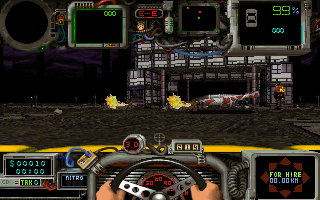
That lack of precise handling becomes dangerous when combined with strict delivery timers. Passengers give you a handful of seconds to reach destinations across town, forcing you to blow through red lights and ram through crowds. Aggressive enemy drivers in armored rigs shoot on sight, turning a simple passenger delivery into a running firefight across 320x200 pixel blockwork.
Building a combat cab on cabbie money
The original idea for this racing driving game came from designer Evan Taylor, who cooked up the concept while driving a real taxi on frustrating late-night shifts. Developer Imagexcel built a custom real-time 3D engine to render the textured city blocks, giving programmer Ed Zolnieryk the speed needed to move software-rendered streets fast on 486 computers. When publisher GameTek, Inc. shipped the CD-ROM version in 1994, they packed it with FMV cutscenes and an 11-track soundtrack featuring Australian alternative rock bands that thumped through Sound Blaster and Gravis UltraSound cards.
Upgrades change how you tackle each city sector. You might equip these tools to keep the meters running:
- Buzzsaws: Side-mounted blades that slice nearby infantry and rival cabs when you scrape against them.
- Roof cannons and missiles: Heavy artillery for clearing barricades and taking down heavily armored gunships.
- Landmines: Explosive drops that stop chasing gang vehicles from hugging your rear bumper.
- Vehicle shielding: Reinforced plating that absorbs hitscan bullet fire and heavy wall collisions.
Identical walls and strict delivery timers
The design hits a harsh wall when you try to navigate without getting lost. Because the graphics engine relies on repeating textures, every block in a district looks almost identical to the last. The overhead map offers basic directional assistance, but when you are under severe time pressure, taking one wrong turn down an alleyway usually means failing the delivery.

German magazine PC Games noted in late 1994 that while the arcade shooting was fast, the constant time pressure stopped players from utilizing all the open-ended city design. UK PC Review gave it 68%, echoing the frustration over severe difficulty spikes when enemy fire shred your cab before you can earn enough for repairs. Yet for players who loved raw speed, typing console cheat codes like OMNICORP IS ALL KNOWING or KEEP THE OPRESSOR OPRESSING opened up instant weapon access to tear through the grid.
Take a spin in KEMO City right now
Quarantine shows you where open-ended vehicular combat started before full 3D acceleration existed. The slippery steering and brutal timers take some getting used to, but the mix of grunge-era industrial rock and heavy cab weaponry feels entirely different from modern racers. If you want to sample this 1994 DOS action game without digging out old boot disks, you can play Quarantine online right here.
You can run this full Quarantine MS-DOS game free in your browser with no installation needed. New players usually make the mistake of buying expensive missiles early on, but smart cabbies spend their first earnings on vehicle repair and basic hull plating to survive the early district crossfire. Jump in, pick up your first passenger, and see if you have what it takes to drive your way out of KEMO City.