
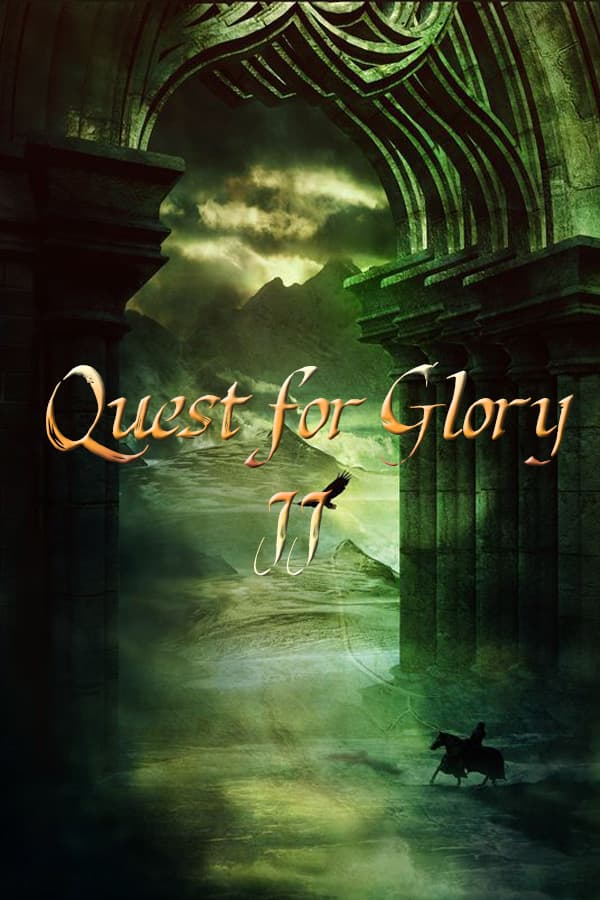

In Quest For Glory II: Trial By Fire, Sierra imported your saved character directly from the cold forests of the original game into an Arabian-style desert city of elementals, alleyway mazes, and a strict 30-day clock.
When Sierra mixed RPG stat-grinding with a text parser
Designing an adventure game around persistent RPG statistics was a gamble, but designers Corey and Lori Ann Cole made it work by tying your hero's physical abilities directly to puzzle design. If your character lacked the strength to lift a rock or the stealth to sneak past a guard, you had to spend game hours practicing those exact skills in the desert or at the local guild hall. Building off Sierra's SCI1 engine, this 1990 release retained the classic text parser where you typed out actions while moving your character around 2D scrolling and fixed-screen environments.
The transition from 16-color EGA graphics to full mountain and desert soundscapes was particularly noticeable if you owned a Roland MT-32 sound module. While standard PC speakers offered rudimentary beeps, high-end audio hardware produced rich oriental motifs and clear combat sound effects that made the land of Shapeir feel wide and lively. Originally planned under the title Hero's Quest II, Sierra renamed the project after Milton Bradley trademarked their board game HeroQuest, forcing a franchise title change that stayed with the series forever.
Navigating Shapeir and surviving the desert clock
Your journey begins in the winding streets of Shapeir, where you quickly learn that getting lost is a core mechanic. The city streets are laid out in a repetitive grid of nameless corridors, forcing you to purchase a magic map from a vendor almost immediately if you want to find the money changer, the magic shop, or the guild halls without wandering aimlessly for hours. Outside the city walls lies an unforgiving desert inhabited by scorpions, aggressive terrace saurs, and vast empty dunes where running out of water or losing your orientation means death.
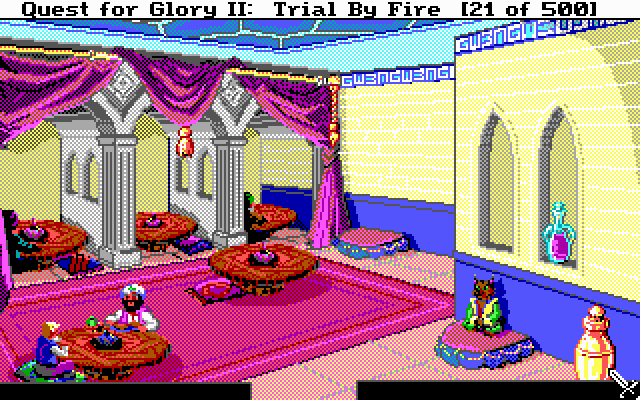
Unlike standard Sierra titles where you can explore at your leisure, this story runs on a fixed calendar of 30 in-game days. Specific events trigger on fixed dates: elementals attack the city one by one, caravans depart on schedule, and failing to prepare before day 30 locks you out of the final confrontation. This calendar structure keeps the narrative moving, but it also creates severe tension. If you spend too many days resting to restore health or mana, you might reach the final act without the stats or items needed to survive.
Classes, elementals, and the Quest For Glory II: Trial By Fire puzzle logic
The core structure revolves around protecting Shapeir from four elementals: Earth, Water, Fire, and Air. Defeating these forces requires distinct approach strategies rather than simple sword swings. The Water Elemental must be trapped inside an empty flask, the Earth Elemental succumbs to magic or brute force, the Fire Elemental requires a bellows or magical cooling, and the Air Elemental needs to be captured using a magic mirror. These encounters test whether you have been paying attention to local merchants and gathering obscure inventory supplies early on.
Class division is where the puzzle design shines. Fighters can join the Eternal Order of Fighters and test their raw combat skills, Wizards face spellcasting tests at the Wizards' Institute of Technocery, and Thieves can break into local homes and pull off daring nighttime burglaries like stealing the Maltese Falcon. If you play a Fighter or Magic-User with high honor and perform selfless acts throughout the story, the liontaur paladin Rakeesh awards you the sword Soulforge, granting you the hidden Paladin class for the final act and future sequels.
The game also hides funny easter eggs and strict traps for dishonest players. Typing the famous cheat code suck blue frog brings up a warning screen, permanently lowers your stats, and disqualifies you from becoming a Paladin. Entering the cheat code from the previous game, razzle dazzle root beer, reduces every single stat on your character sheet down to single digits. If you try to drop your lantern by typing put down lamp instead of using the proper verb, your character hurls a humorous verbal insult at the object before setting it on the ground.
Where this MS-DOS game succeeds and where it stumbles
When gaming magazines evaluated the release in 1990, opinions highlighted both its narrative strength and its strict pacing. Dragon Magazine awarded it a full 5 out of 5 stars, while Computer Gaming World noted that the game felt somewhat more linear than its predecessor while praising its dramatic final act. Modern retrospectives on PopMatters frequently rank it as a high point for the franchise due to its distinct setting and balanced class-specific quest design.
Yet, several structural choices frustrate players today:
- The street network of Shapeir is brutally confusing without the magic map item, leading to tedious trial-and-error navigation.
- The strict 30-day timeline can trap unprepared players who spend too much time sleeping or wandering without advancing key quests.
- Key consumable items, especially throwing daggers for combat-focused characters, can be lost permanently in battle, leaving you defenseless during late-game boss fights.
- Deadly desert navigation leaves almost no room for error if you forget to buy extra rations or flasks before traveling.
The endgame sequence taking place in the oppressed city of Raseir and the Forbidden City raises the difficulty sharply. Fighting through Ad Avis's minion Khaveen and interrupting the ritual to summon the genie Iblis requires precise inventory usage and quick reflexes. If you reach this climax without sufficient daggers, healing potions, or spell points, completing the game becomes virtually impossible, forcing you to reload a save from days prior.
How to play Quest For Glory II: Trial By Fire online today
Despite the punishing time limits and maze-like streets, it is easily one of the most rewarding hybrid RPGs published by Sierra On-Line, Inc. The depth of character progression, the payoff for honorable play, and the desert atmosphere make it well worth mastering its steep learning curve.
You can play Quest For Glory II: Trial By Fire free in your browser right now, with full keyboard parser support ready to go. You can jump straight into this classic Quest For Glory II: Trial By Fire MS-DOS game without downloading any extra software, so select your character class, pack your water flasks, and see if you can protect Shapeir from evil tonight.