Risk
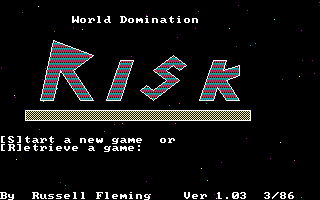
Russell Fleming's 1986 MS-DOS conversion of Risk makes one drastic change to the board game classic: it throws away the plastic dice entirely and leaves conquest strictly to cold math.
Numeric math replaces the luck of the dice
Most digital adaptations of board games attempt to replicate the physical components down to the random roll of a six-sided die. Panther Programs took a different path when adapting Risk for the IBM PC. Instead of relying on random chance, battles are resolved through player choices, troop deployment, and sheer numerical superiority. If you march a larger stack into a neighboring territory, you are not praying to an algorithm for favorable rolls; you are making a calculated trade of military force.
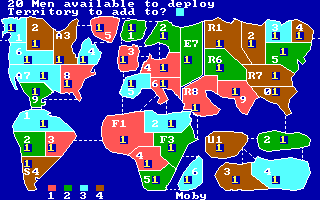
This single design choice alters the entire pacing of global conquest. From the top-down map view, victory depends strictly on long-term strategy, territorial drafting, and careful army management across all 42 regions. Without the chaotic safety net of a lucky defense roll, overextending your lines guarantees swift punishment from surrounding opponents.
Four rule sets and a strict parser test your patience
The game accommodates different play styles by offering four distinct setup options:
- UK full game (standard total map conquest)
- US full game (standard total map conquest)
- UK short game (victory via completing a secret mission)
- US short game (victory via capturing an opponent's headquarters)
While the tactical flexibility is welcome, wrestling with the user interface is where most campaigns grind to a halt. The game requires text inputs that are very case sensitive. Typing a region name or command without exact capitalization leads to rejected orders, turning simple troop moves into a chore of careful typing. Built originally on a PCjr before landing on mainstream DOS machines, the interface shows its age immediately, asking you to perform administrative work just to fortify a border.
High-resolution EGA graphics for 1986 hardware
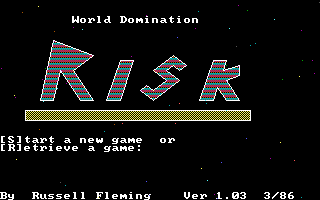
Visually, the game was quite ambitious for a 1986 release. It targets a 16-color Enhanced Graphics Adapter (EGA) setup at a sharp 640x350 resolution, with a standard CGA mode available for older setups. Running it required anywhere from 196K to 384K of RAM, pushing early PC clones to display a crisp, full-screen map of the world. A polite in-game disclaimer from the developer even reminds players that the software makes no attempt to replace the physical Parker Brothers original.
Because the dice are gone, the difficulty stems entirely from managing your front lines against computer rivals. If you leave a border thin, the engine will move in. A bad turn in this version is rarely a surprise twist of fate; it is the direct result of miscalculating your troop draft three turns prior.
Play Risk online directly in your browser
If you want to experience an early slice of PC gaming history without tracking down a vintage IBM XT, you can play Risk online right now. The game runs directly in your browser with zero setup, letting you test Fleming's deterministic ruleset without installing anything.
For your first match, try a US short game to target an enemy headquarters quickly. You will instantly notice how much quieter a war feels without dice bouncing across the table, leaving you alone with the keyboard and the map.