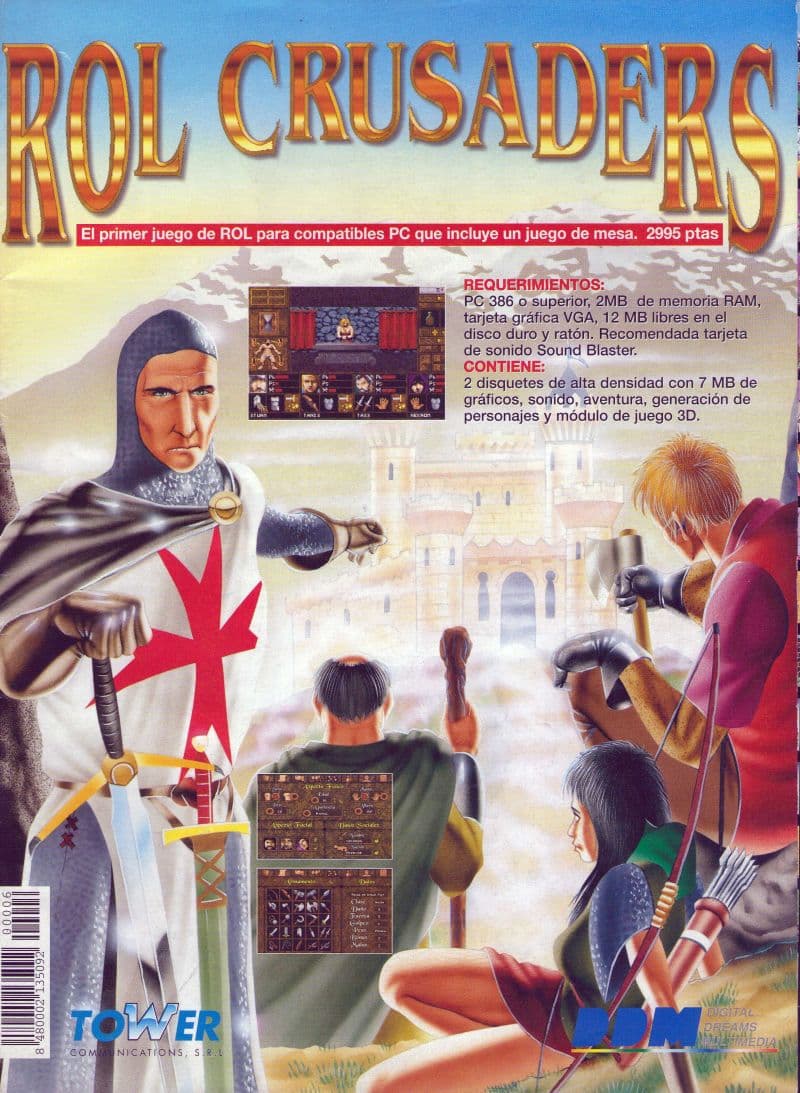
If you ever wanted to command four Templars through real-time corridors in Rol Crusaders, get ready for history, dark magic, and flat-out chaos hitting you all at once.
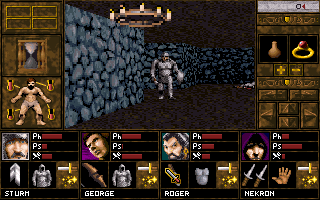
Most first-person dungeon crawlers from 1995 were moving toward complex height variation or gridless motion. Instead, Spanish developer NoriaWorks Entertainment built a engine that feels surprisingly close to Wolfenstein 3-D. You move through flat-walled corridors from a top-down awareness or direct eye-level perspective, clearing rooms in real time.
The control scheme sets its own bizarre rules immediately. You use the directional arrow keys to steer your whole party around corners. The mouse handles UI menus and character management, while hitting the space bar launches your attacks. Running through drops automatically collects items off the floor just like picking up ammo clips in early nineties shooters.
This hybrid setup means you do not step carefully through turn-based squares like older fantasy games. You charge directly into enemy swarms and mash the attack key while keeping an eye on four health bars. It creates an frantic rhythm that feels unlike almost any other role-playing (RPG) game from the same period.
Managing a four-person squad in real time inside tight corridors is where the experience gets hectic. Because movement happens in real time, enemies close distance instantly. You rarely have time to organize tactical formations or carefully cycle through individual spell lists when a fight breaks out.
The space bar handles your general attack command, which sounds simple until multiple monsters pin your party against a wall. Combat often devolves into raw button pressing and hopeful positioning. If you get turned around in a narrow hallway, taking damage from behind while wrestling with the viewport happens constantly.
This layout is precisely why early player reaction split into total opposite camps. Some players bounced off the mechanics instantly and dubbed the title virtually unplayable. Others appreciated the ambitious effort required to weld real-time action onto a multi-character squad crawler on standard DOS hardware.
The narrative framing gives the adventure a distinct historical flavor. The story follows the Knights Templar, eight noble cavaliers who built the Order of the Temple during the Crusades. After acquiring great fame and searching for secrets behind the Ark of the Covenant, envy from rival factions boiled over.
The Holy Inquisition launched false heresy charges to break the Templars completely. An inquisitor named Belasco struck a dark deal with Satan to steal the Ark and plunge the realm into dark chaos. Your party acts as the final holy resistance, fighting back against demonic forces and inquisitorial soldiers alike.
When publisher Digital Dreams Multimedia shipped the physical release, they included a full physical board game inside the box. That inclusion made the package a curious piece of Spanish software history. It offered tangible tabletop play alongside the digital floppy disks.
Looking back at the titles filling standard PC displays in 1995 reveals a fascinating contrast. While major studios chased textured floors and complex three-dimensional elevation, NoriaWorks stuck to simple geometric rendering with fast movement. That choice kept hardware requirements accessible, even if the visual style felt dated beside high-budget peers.
What holds up today is the sheer ambition behind the atmosphere and historical setting. The game does not feel like standard high-fantasy template work. What fails to impress is the mechanical friction, since steering four characters simultaneously via basic keyboard commands always feels somewhat clumsy.
If you enjoy tracking down rare European MS-DOS releases or studying experimental dungeon design, this title delivers a genuine novelty. Just prepare yourself for a steep learning curve while mastering the movement controls.
You do not need to hunt down rare diskettes or configure vintage sound hardware to sample this piece of history. You can play Rol Crusaders free in your browser right here without installing extra software. The emulation handles all the memory configuration instantly, letting you dive directly into the opening levels.
When you start your adventure, take a moment to get comfortable with the arrow keys and space bar before charging down your first corridor. Stepping into this DOS release today offers a direct window into an unusual real-time experiment that time mostly forgot.
If you ever wanted to command four Templars through real-time corridors in Rol Crusaders, get ready for history, dark magic, and flat-out chaos hitting you all at once.
Most first-person dungeon crawlers from 1995 were moving toward complex height variation or gridless motion. Instead, Spanish developer NoriaWorks Entertainment built a engine that feels surprisingly close to Wolfenstein 3-D. You move through flat-walled corridors from a top-down awareness or direct eye-level perspective, clearing rooms in real time.
The control scheme sets its own bizarre rules immediately. You use the directional arrow keys to steer your whole party around corners. The mouse handles UI menus and character management, while hitting the space bar launches your attacks. Running through drops automatically collects items off the floor just like picking up ammo clips in early nineties shooters.
This hybrid setup means you do not step carefully through turn-based squares like older fantasy games. You charge directly into enemy swarms and mash the attack key while keeping an eye on four health bars. It creates an frantic rhythm that feels unlike almost any other role-playing (RPG) game from the same period.
Managing a four-person squad in real time inside tight corridors is where the experience gets hectic. Because movement happens in real time, enemies close distance instantly. You rarely have time to organize tactical formations or carefully cycle through individual spell lists when a fight breaks out.
The space bar handles your general attack command, which sounds simple until multiple monsters pin your party against a wall. Combat often devolves into raw button pressing and hopeful positioning. If you get turned around in a narrow hallway, taking damage from behind while wrestling with the viewport happens constantly.
This layout is precisely why early player reaction split into total opposite camps. Some players bounced off the mechanics instantly and dubbed the title virtually unplayable. Others appreciated the ambitious effort required to weld real-time action onto a multi-character squad crawler on standard DOS hardware.
The narrative framing gives the adventure a distinct historical flavor. The story follows the Knights Templar, eight noble cavaliers who built the Order of the Temple during the Crusades. After acquiring great fame and searching for secrets behind the Ark of the Covenant, envy from rival factions boiled over.
The Holy Inquisition launched false heresy charges to break the Templars completely. An inquisitor named Belasco struck a dark deal with Satan to steal the Ark and plunge the realm into dark chaos. Your party acts as the final holy resistance, fighting back against demonic forces and inquisitorial soldiers alike.
When publisher Digital Dreams Multimedia shipped the physical release, they included a full physical board game inside the box. That inclusion made the package a curious piece of Spanish software history. It offered tangible tabletop play alongside the digital floppy disks.
Looking back at the titles filling standard PC displays in 1995 reveals a fascinating contrast. While major studios chased textured floors and complex three-dimensional elevation, NoriaWorks stuck to simple geometric rendering with fast movement. That choice kept hardware requirements accessible, even if the visual style felt dated beside high-budget peers.
What holds up today is the sheer ambition behind the atmosphere and historical setting. The game does not feel like standard high-fantasy template work. What fails to impress is the mechanical friction, since steering four characters simultaneously via basic keyboard commands always feels somewhat clumsy.
If you enjoy tracking down rare European MS-DOS releases or studying experimental dungeon design, this title delivers a genuine novelty. Just prepare yourself for a steep learning curve while mastering the movement controls.
You do not need to hunt down rare diskettes or configure vintage sound hardware to sample this piece of history. You can play Rol Crusaders free in your browser right here without installing extra software. The emulation handles all the memory configuration instantly, letting you dive directly into the opening levels.
When you start your adventure, take a moment to get comfortable with the arrow keys and space bar before charging down your first corridor. Stepping into this DOS release today offers a direct window into an unusual real-time experiment that time mostly forgot.
How Rol Crusaders is played — the keys the game listens to, grouped by what they do.
Highlighted keys are mapped — hover or tap one to see what it does.
Control map is incomplete due to limited available documentation. Mouse is used only for menus.
The on-screen keyboard and gamepad mapping the browser player uses on a phone, a tablet or a controller, as opposed to the real keys above. $PRO members make their own in the player and share them here; anyone can pick one to play with.
Cheat codes, console commands and memory pokes for Rol Crusaders — each one verified and attributed.
Sign in to submitHow Rol Crusaders is played — the keys the game listens to, grouped by what they do.
Highlighted keys are mapped — hover or tap one to see what it does.
Control map is incomplete due to limited available documentation. Mouse is used only for menus.
The on-screen keyboard and gamepad mapping the browser player uses on a phone, a tablet or a controller, as opposed to the real keys above. $PRO members make their own in the player and share them here; anyone can pick one to play with.
Cheat codes, console commands and memory pokes for Rol Crusaders — each one verified and attributed.
Sign in to submit