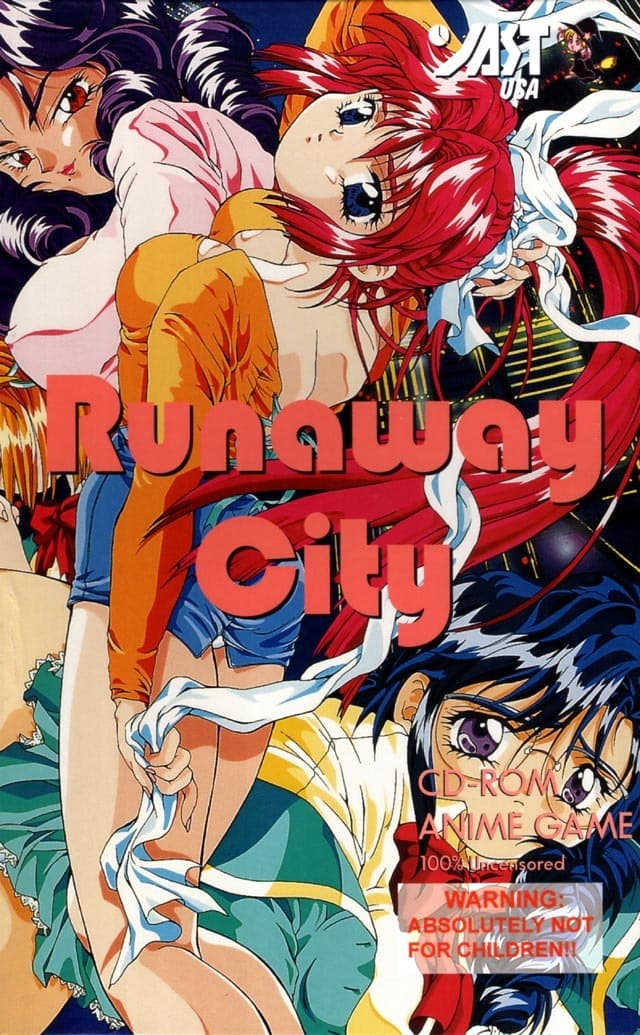
Runaway City
Playing Runaway City requires clicking through endless static menus while navigating the absurd life of a college student whose supernatural luck drives women wild and threatens to trigger total chaos.
What happens when high concept writing meets brute force trial and error in Runaway City
You start as Hiroaki Hanya, a college student living with his father Katsuhiko following his mother's suicide. Katsuhiko happens to run a video game publishing firm responsible for an in-universe hit titled Virtual Ninja, but Hiroaki spends less time worrying about family business and more time coping with a bizarre aura. He possesses a supernatural Good Luck power that acts like a irresistible magnet on every woman he meets. What begins as an outrageous fantasy quickly pivots into a conspiracy hunt across Tokyo to figure out where this power came from before it triggers widespread ruin.
Originally developed by JAST Co., Ltd. as Meisou Toshi on the Japanese PC-98 and FM Towns platforms in 1995, the game was translated and released state-side as a JAST USA adventure game in 1998. The setup sounds like a fast-paced thriller on paper, but in practice, you spend your time sitting in front of static anime stills selecting options from an old-school command box. You navigate scenes using basic choices like Look, Talk, Think, and Go. Everything relies on logic that feels equal parts clever and exhausting.
I played through the initial chapters expecting the supernatural mystery to take center stage early on, but the game insists on taking its time. Instead of fighting monsters or solving mechanical puzzles, your main objective is talking your way through romantic encounters and explicit adult scenarios while keeping track of where key characters disappear to.
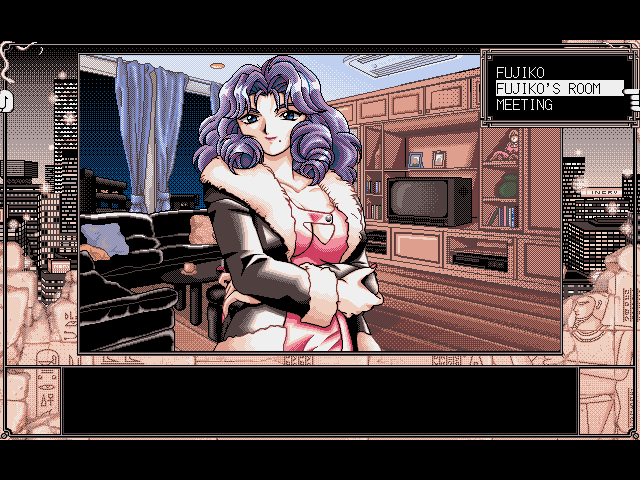
Endless menu cycling across Tokyo locations tested every player's patience
Progression in this 1998 Runaway City MS-DOS game relies almost entirely on exhaustive checking. You move between fixed map destinations such as the train station at Station Kaisatsuguchi, a local coffee shop or Kissaten, a underground drainage site called Chikasuiro, a sacred tree site known as Goshinboku, and a neighborhood Sunaku bar. The problem is that the story refuses to move forward until you have exhausted every interaction command in a location, sometimes two or three times in a row.
To trigger a simple plot event, you might have to complete a whole series of repetitive chores:
- Select Look on the background art until the text box repeats itself verbatim.
- Choose Talk with an NPC like Megumi Fujisawa or Sayaka Suga until no new dialogue lines appear.
- Use the Think action to trigger Hiroaki's inner monologue, which often acts as an invisible flag check.
- Travel to a secondary location like the Kissaten just to order a drink, then immediately head back.
- Re-examine the same room once more to finally trigger the next character's appearance.
This design creates long stretches where you are not really solving a mystery so much as clearing a checklist. If you miss a single Look command on an uninteresting object in the background, Hiroaki will refuse to leave the room or talk to the next person. That brute-force design wall is precisely where most players ended up stuck back in the late nineties.
Crossovers, game company satire, and sudden bad endings
Despite the rigid structure, the narrative team, written by a group including Sanagi Ōshima, Isshiki Ryotaro, Usa Usagi, Professor Asshuku, and Dai Kuro, slipped in some fun details for studio fans. The character Rin Watanabe, known to fans as "Akihabara no Hondala," makes a direct crossover appearance here from JAST's earlier title Season of the Sakura. Finding her sitting in a city spot feels like a secret handshakes for anyone who followed Japanese PC imports during that era.
The audio side relies entirely on AdLib and OPL2 FM synthesis to output Takanori Nakaigawa's synth soundtrack. Through a Sound Blaster card, the music delivers that bright, metallic PC audio texture typical of mid-nineties Japanese computer ports. Programmer Hakaishi Taizou kept the interface clean, but the game design hides a ruthless penalty toward the climax.
Near the final act, the story suddenly drops its relaxed pacing and demands pinpoint accuracy. You are hit with a sequence of strict dialogue and movement choices involving key figures like Choko and Hiroaki's father. Make one wrong pick out of curiosity, and the game abruptly kicks you directly into an immediate bad ending screen, forcing a complete reload.
Where Runaway City fails to hold up today
Retrospective assessments have not been particularly gentle to Hiroaki's adventure. A prominent reviewer on GameFAQs rated it a 2 out of 5, dismissing the overall experience as completely average, noting that the graphics and audio were merely passable while remarking that Hiroaki possessed "the charm of shower scum." When the game later reappeared in the JAST USA Memorial Collection, French critics on SensCritique openly questioned why the publisher selected this particular title to archive over stronger entries in their back catalog.
The critique holds weight. Hiroaki is a difficult protagonist to root for because his magical luck framing makes his interactions feel unearned, and his personal commentary rarely makes him likable. The background art and character illustrations are decent examples of mid-nineties anime visual style, but static images with minimal animation mean there is little visual payoff for all your menu hunting.
What keeps it somewhat interesting is its historical context as a bridge between standard visual novels and old-school point-and-click command interfaces. I find that its mix of corporate satire, supernatural oddities, and strict menu logic gives it a specific flavor, even if the actual play loop feels bloated by repetitive errands.
You can play Runaway City free in your browser right now
If you want to experience this piece of late-nineties localized PC history without hunting down obscure floor disks, you can play Runaway City online directly on this page. It runs smoothly right inside your web browser with no setup required, giving you direct access to the full English translation as JAST USA published it in 1998.
Whether you want to hunt down the Season of the Sakura crossover cameos or simply see how nineties command menus handled supernatural detective stories, you can jump straight into Hiroaki's world with a single click. Keep a notepad handy for those late-game choices so you do not get caught off guard by the sudden bad endings.