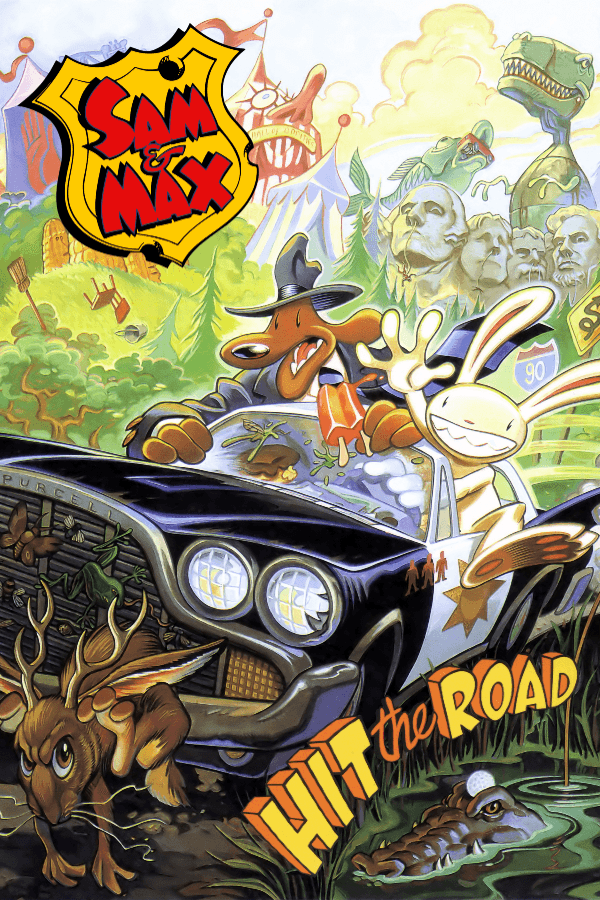
In Sam & Max Hit the Road, playing a detective means using a hyperkinetic rabbit as a bolt cutter, stuffing a cat with inventory items, and dragging a missing carnival bigfoot across America's strangest tourist traps.
LucasArts abandoned verb commands, and chaos immediately took over
When you launch Sam & Max Hit the Road, the first thing you notice is that the classic LucasArts verb bar is gone. Previous titles built on the SCUMM engine kept a grid of commands like "Push", "Pull", and "Use" locked to the bottom third of the monitor, but design directors Steve Purcell, Sean Clark, Collette Michaud, and Michael Stemmle swept all of that away for this ninth iteration of the technology. Right-clicking cycles your mouse cursor through simple icons representing look, talk, walk, and use, leaving the full screen open for high-resolution cartoon animation.
The streamlined interface looks cleaner, but it immediately forces you into a completely different rhythm. Your entry point into the story involves hiring out the titular freelance police, Sam (a suit-wearing canine detective voiced by Bill Farmer) and Max (a hyperkinetic rabbit voiced by Nick Jameson), to locate a runaway bigfoot named Bruno. Bruno fled the Kushman Brothers' Carnival, apparently abducting Trixie, the Giraffe-Necked Girl, on his way out. Investigating their disappearance means wandering around scene frames looking for context clues, but without explicit verb text, figuring out what an object responds to requires cycling through every cursor state while watching how Sam reacts.
The inventory puzzles in Sam & Max Hit the Road will test your sanity
The central mechanic driving this detective case relies on absurd lateral thinking. Standard adventure tropes dictate that finding a lock requires finding a key, but Purcell's cartoon logic bends those expectations until they snap. In an early sequence, getting inside a locked shed means picking up Max from your inventory screen and applying the rabbit directly to the door so he can gnaw through the chain links. Later on, reaching a vital clue requires manipulating a cat's stomach to extract a set of paper orders.
Because the logic relies on surreal sight gags, the progression frequently grinds to a halt. When reasonable deductions fail, players routinely resort to inventory dumping, trying every collected object on every interactive hot spot in the room. This process gets compounded by occasional pixel hunting, where a critical item consists of a tiny cluster of dark pixels tucked behind a background asset. I spent nearly forty minutes clicking across a single screen before realising a minor visual detail was actually a pickupable item.
Roadside attractions, minigames, and the brilliance of iMUSE audio
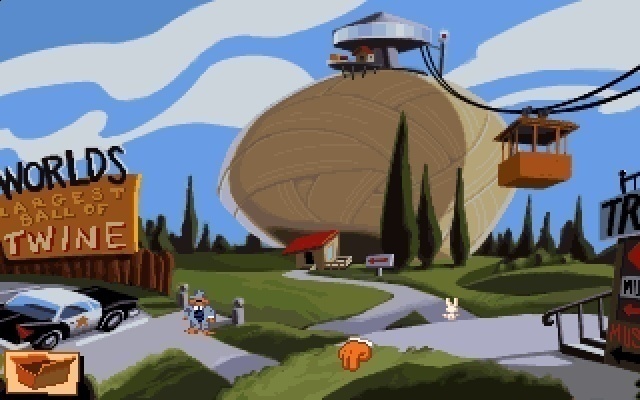
The journey takes the duo through a surreal tour of American tourist traps. You will investigate locations including The World's Largest Ball of Twine, the gravity-defying Mystery Vortex, and a Mount Rushmore Dinosaur Tarpit. To break up the narrative, the designers sprinkled interactive diversions throughout the journey, accessible directly or through the inventory screen.
- Wak-a-Rat: A carnival arcade game where you slam emerging rodents with a mallet to earn novelty prizes.
- Car Bomb: A grid-based tactical guessing game played on the highway, functioning like a scaled-down version of Battleship.
- Highway Surfing: A reflex test requiring Max to balance on top of the duo's moving vehicle while dodging low bridges.
While these distractions vary in quality, the presentation never falters due to its audio implementation. The game relies on the iMUSE sound system crafted by Clint Bajakian, Peter McConnell, and Michael Z. Land, which dynamically transitions the musical score based on player actions. Whether outputting to a basic AdLib card, a Sound Blaster board, or a high-end Roland MT-32 synthesizer, the jazz soundtrack adapts without missing a beat between screen transitions. The full CD-ROM release added recorded dialogue for every line, giving the deadpan banter perfect comedic timing that basic text boxes could not match.
Even the copy protection on the original floppy disk version possessed personality. Players were forced to solve a dress-up minigame, matching specific costuming combinations for Sam or Max by flipping through manual pages before starting the program. Furthermore, players who poked around obscure corners found small secrets, such as asking to play the bar knife game with Emmett roughly twenty times until he finally relented and let you try it.
Where the adventure drags and why critics were divided
Despite its visual charm, the campaign suffers from noticeable pacing issues as it approaches its conclusion. As you gather ingredients to help Doug the Mole Man, track down the mystic Shuv-Oohl, and stop country music villain Conroy Bumpus, the puzzle chains grow increasingly convoluted. Solving the late-game sequences demands backing tracking across earlier tourist spots, turning what started as a fast-paced road trip into a tedious scavenger hunt.
At the time of its 1993 release, contemporary press reflected these exact mixed feelings. Writing in PC Gamer UK, Gary Whitta awarded the game a 93% score, writing that "nobody, but nobody, does it quite like these guys". Conversely, Computer Gaming World argued the tone was slightly overdone, taking issue with its heavy reliance on sneering remarks, self-referential jokes, and non-stop deadpan derision. Later retrospectives echoed those sentiments; Steve Honeywell writing for Allgame commended the voice work while pointing out that the minigames felt dismal and the puzzle difficulty ranged from trivial to extreme, whereas Joonas Linkola at Adventure Gamers highlighted the dialogue as impressive verbal acrobatics.
The game left an impression on its original development studio that lasted for years. LucasArts animators frequently hid Max's silhouette inside other projects; typing reveal cheats in adventure games and shooters of the era often exposed his image. In Star Wars: Dark Forces, Max appears drawn onto the automap, while in Star Wars: Jedi Knight, he exists as a hidden, completely invincible cheat character.
How to play Sam & Max Hit the Road free in your browser today
If you want a mid-nineties LucasArts project that trades pure logic for dark humor and sharp cartoon satire, this case is worth opening. The trial-and-error puzzle spikes can frustrate modern sensibilities, but the voice performances and surreal environments make the journey worthwhile for anyone studying classic MS-DOS point-and-click design. You can play Sam & Max Hit the Road online, free right here in your browser, with nothing to install and no setup required. When you launch into the opening office scene, keep in mind that clicking on objects with standard logic will get you nowhere: treat Max as a multi-purpose pocket knife for every violent situation, and you will survive the first hour without consulting a guide.