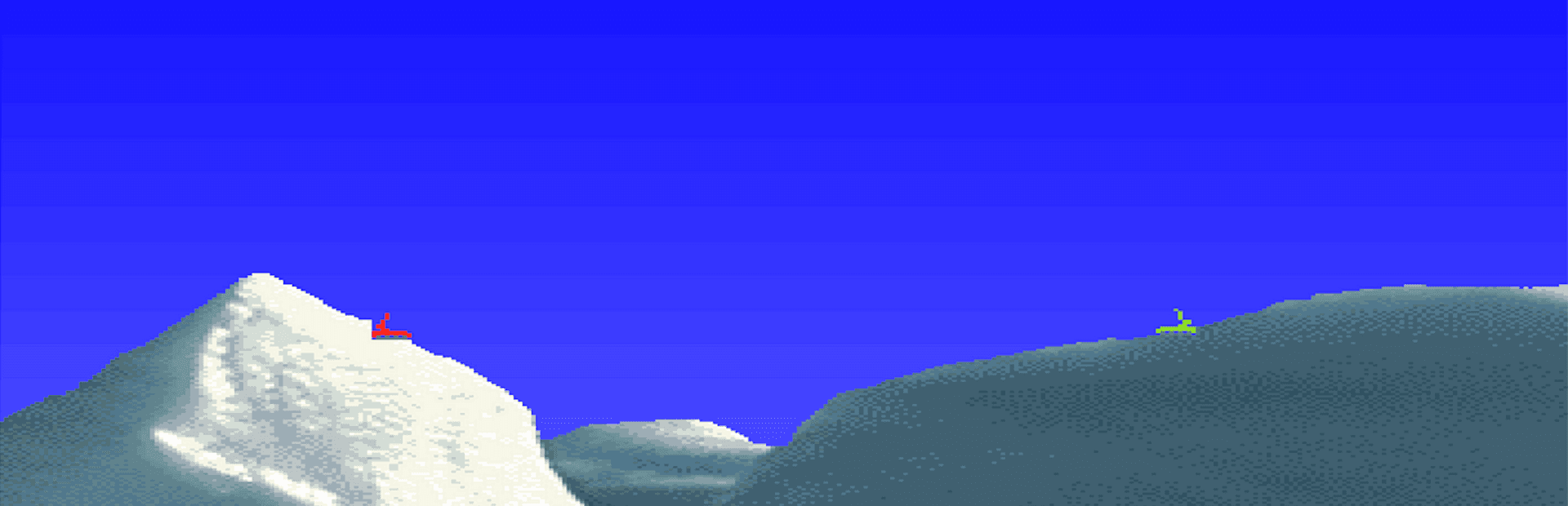

Scorched Earth turns simple vector ballistics into total battlefield chaos, where adjusting your tank cannon angle by two degrees is the difference between vaporising an opponent and nuking your own treads.
You start every match staring at a jagged horizon rendered in chunky VGA graphics, waiting for your turn while wind speed ticks unpredictably in the corner of the screen. Controlling a single tank on destructible 2D terrain, your job is simple enough on paper: calculate your angle, set your power output, select a warhead, and wipe up to nine enemy tanks off the map. In practice, missing a target by a fraction of an inch often triggers a chain reaction that reshapes the entire mountain range beneath your treads.
Between rounds, the game transforms from a pure aiming contest into an intense spending spree. Earnings from kills and surviving rounds go straight into a loaded shop menu. You are constantly weighing immediate offensive firepower against defensive hardware:
That balance makes every buying phase a tactical gamble. Skimping on a parachute to afford a Death's Head missile feels brilliant until an opponent hits the cliff below you, leaving your tank to plunge into the pit for an embarrassing self-destruction.
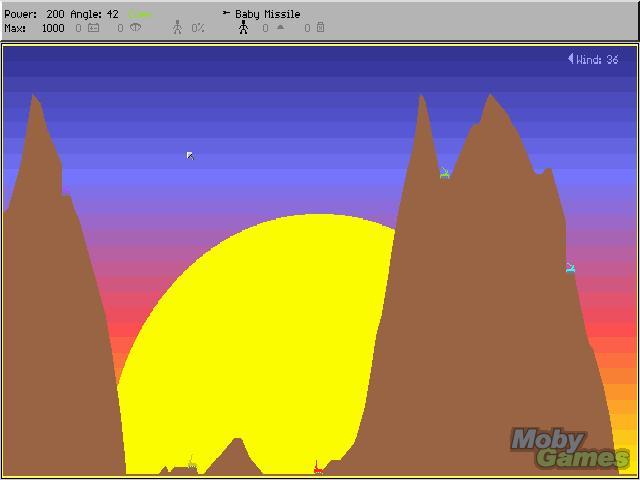
The visual presentation of this 1991 classic was distinctly primitive even when it first hit bulletin board systems. The tanks themselves are tiny, blocky sprites that look closer to late-1970s console graphics than top-tier PC releases of the era. Sound design relies entirely on the harsh squawking of the native internal PC speaker, producing piercing bleeps for explosions that wear on your ears after twenty minutes of heavy bombardment.
Yet the mechanical depth beneath those simple visuals keeps matches lively and unpredictable. Developed in Borland C++ and Turbo Assembler using Fastgraph routines, creator Wendell Hicken packed the underlying engine with flexible environmental variables. You can toggle gravity shifts, trigger sudden meteorite showers, or set the wind to drift wildly between turns, forcing every player to recalculate their firing math continuously.
Computer-controlled opponents offer a surprisingly sharp range of personalities and skill levels. Fighting a roster of basic "Moron" bots is pure shooting gallery practice, but higher-tier AI routines track wind trajectory and terrain contours with uncanny precision. Watching an AI opponent bounce a precision roller down three distinct slopes to detonate right against your hull is equal parts infuriating and impressive.
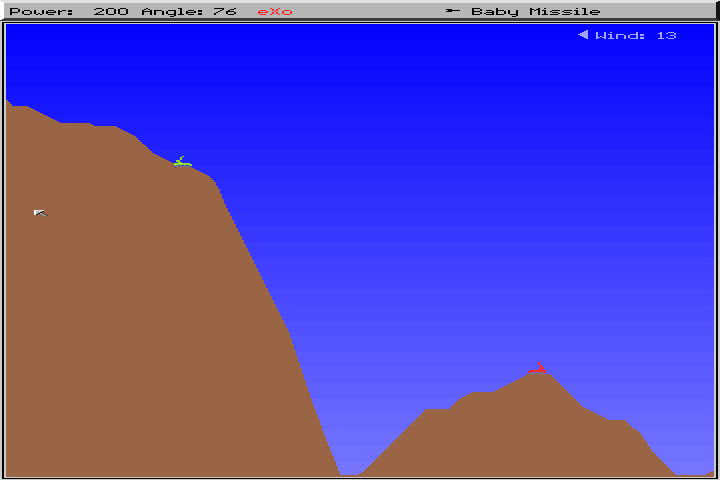
Part of what made this classic strategy tactics title stick in the minds of early PC gamers was its dry sense of humor. Tanks fire off customizable text quips right before unleashing a round, taunting rivals with lines like "I shall smash your ugly tank!" when aiming a shot. When hit with fatal damage, dying tanks broadcast final laments such as "Join the army, see the world they said" before exploding into dirt and scrap.
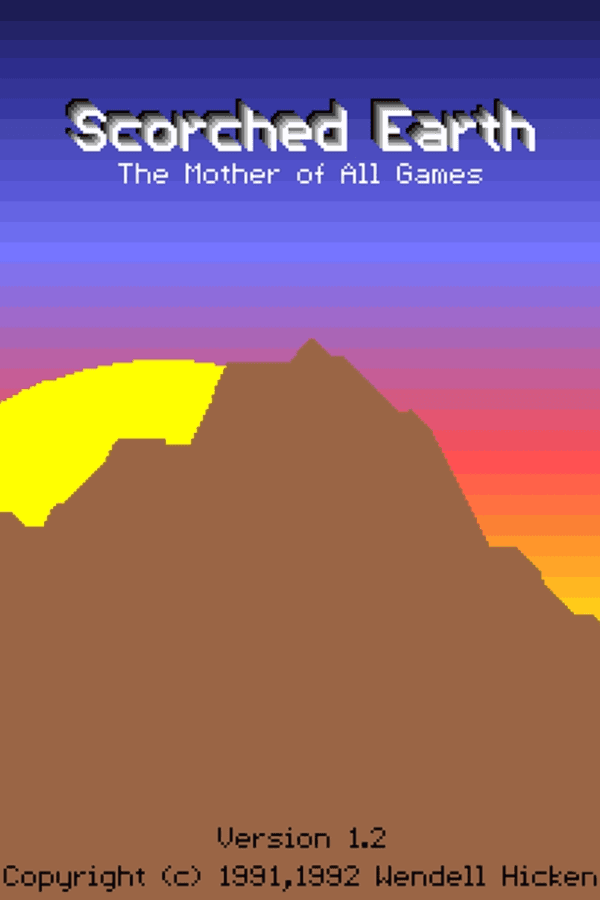
Hicken, writing under the handle "Sprig," tagged the game with the tongue-in-cheek subtitle "The Mother of All Games." The slogan was coined in 1991 as a direct parody of political rhetoric during the Gulf War. Distributed freely as shareware on floppy disks and local BBS networks, players were encouraged to share the initial build while paying Hicken directly to unlock extra registered features and weapons.
That shareware formula allowed the game to spread across thousands of home PCs without commercial retail back-up. While later games like Worms refined the artillery concept with animated characters and polished audio, Hicken's original formula built the exact blueprint those titles built upon. Through updates culminating in version 1.5 in 1995, the pure MS-DOS version remained the definitive release.
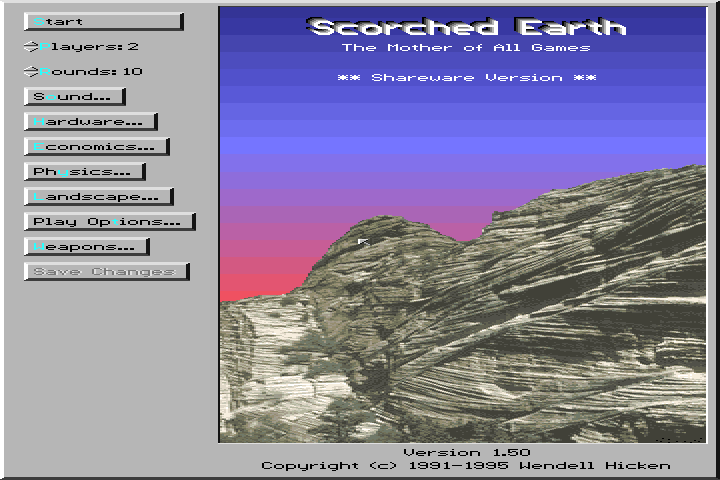
If you want to experience pure turn-based artillery math without modern fluff, the tactical loop gets straight to the point. The graphics are rough and the audio is shrill, but dropping a Death's Head directly into a pocket of four clustered enemy tanks never gets old. Deep mechanical customization easily outshines basic visual assets.
You can play the Wendell Hicken original Scorched Earth MS-DOS game free in your browser today, with zero installation required. Set up a match with five AI opponents, pump up the wind variance, buy a batch of dirt-moving Diggers in the round one shop, and see how fast you can turn a pristine green mountain range into a crater-pocked wasteland.
Scorched Earth turns simple vector ballistics into total battlefield chaos, where adjusting your tank cannon angle by two degrees is the difference between vaporising an opponent and nuking your own treads.
You start every match staring at a jagged horizon rendered in chunky VGA graphics, waiting for your turn while wind speed ticks unpredictably in the corner of the screen. Controlling a single tank on destructible 2D terrain, your job is simple enough on paper: calculate your angle, set your power output, select a warhead, and wipe up to nine enemy tanks off the map. In practice, missing a target by a fraction of an inch often triggers a chain reaction that reshapes the entire mountain range beneath your treads.
Between rounds, the game transforms from a pure aiming contest into an intense spending spree. Earnings from kills and surviving rounds go straight into a loaded shop menu. You are constantly weighing immediate offensive firepower against defensive hardware:
That balance makes every buying phase a tactical gamble. Skimping on a parachute to afford a Death's Head missile feels brilliant until an opponent hits the cliff below you, leaving your tank to plunge into the pit for an embarrassing self-destruction.
The visual presentation of this 1991 classic was distinctly primitive even when it first hit bulletin board systems. The tanks themselves are tiny, blocky sprites that look closer to late-1970s console graphics than top-tier PC releases of the era. Sound design relies entirely on the harsh squawking of the native internal PC speaker, producing piercing bleeps for explosions that wear on your ears after twenty minutes of heavy bombardment.
Yet the mechanical depth beneath those simple visuals keeps matches lively and unpredictable. Developed in Borland C++ and Turbo Assembler using Fastgraph routines, creator Wendell Hicken packed the underlying engine with flexible environmental variables. You can toggle gravity shifts, trigger sudden meteorite showers, or set the wind to drift wildly between turns, forcing every player to recalculate their firing math continuously.
Computer-controlled opponents offer a surprisingly sharp range of personalities and skill levels. Fighting a roster of basic "Moron" bots is pure shooting gallery practice, but higher-tier AI routines track wind trajectory and terrain contours with uncanny precision. Watching an AI opponent bounce a precision roller down three distinct slopes to detonate right against your hull is equal parts infuriating and impressive.
Part of what made this classic strategy tactics title stick in the minds of early PC gamers was its dry sense of humor. Tanks fire off customizable text quips right before unleashing a round, taunting rivals with lines like "I shall smash your ugly tank!" when aiming a shot. When hit with fatal damage, dying tanks broadcast final laments such as "Join the army, see the world they said" before exploding into dirt and scrap.
Hicken, writing under the handle "Sprig," tagged the game with the tongue-in-cheek subtitle "The Mother of All Games." The slogan was coined in 1991 as a direct parody of political rhetoric during the Gulf War. Distributed freely as shareware on floppy disks and local BBS networks, players were encouraged to share the initial build while paying Hicken directly to unlock extra registered features and weapons.
That shareware formula allowed the game to spread across thousands of home PCs without commercial retail back-up. While later games like Worms refined the artillery concept with animated characters and polished audio, Hicken's original formula built the exact blueprint those titles built upon. Through updates culminating in version 1.5 in 1995, the pure MS-DOS version remained the definitive release.
If you want to experience pure turn-based artillery math without modern fluff, the tactical loop gets straight to the point. The graphics are rough and the audio is shrill, but dropping a Death's Head directly into a pocket of four clustered enemy tanks never gets old. Deep mechanical customization easily outshines basic visual assets.
You can play the Wendell Hicken original Scorched Earth MS-DOS game free in your browser today, with zero installation required. Set up a match with five AI opponents, pump up the wind variance, buy a batch of dirt-moving Diggers in the round one shop, and see how fast you can turn a pristine green mountain range into a crater-pocked wasteland.
How Scorched Earth is played — the keys the game listens to, grouped by what they do.
Highlighted keys are mapped — hover or tap one to see what it does.
The keyboard control map is incomplete due to missing entries for item/weapon fast-keys and explicit inventory toggles in available documentation.
The on-screen keyboard and gamepad mapping the browser player uses on a phone, a tablet or a controller, as opposed to the real keys above. $PRO members make their own in the player and share them here; anyone can pick one to play with.
Cheat codes, console commands and memory pokes for Scorched Earth — each one verified and attributed.
Sign in to submitHow Scorched Earth is played — the keys the game listens to, grouped by what they do.
Highlighted keys are mapped — hover or tap one to see what it does.
The keyboard control map is incomplete due to missing entries for item/weapon fast-keys and explicit inventory toggles in available documentation.
The on-screen keyboard and gamepad mapping the browser player uses on a phone, a tablet or a controller, as opposed to the real keys above. $PRO members make their own in the player and share them here; anyone can pick one to play with.
Cheat codes, console commands and memory pokes for Scorched Earth — each one verified and attributed.
Sign in to submit