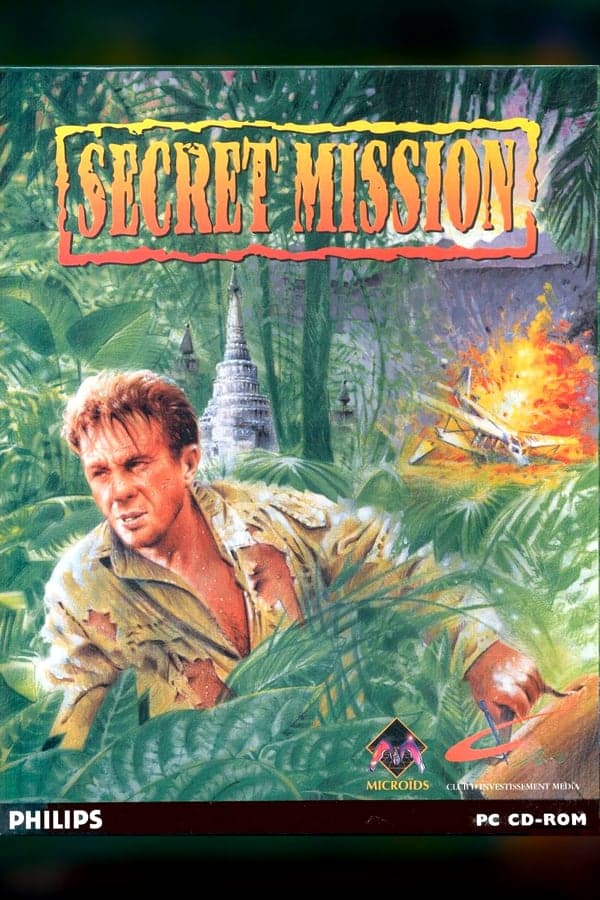
In Secret Mission, you play Jeff, a 1950s double agent who wakes up in a Southeast Asian hotel room with full amnesia just as an international crisis erupts around him.
You begin in the Black Lotus Hotel with a blank memory and a tight deadline. The fictional kingdom of Opalia has turned into a flashpoint between the United States and the Soviet Union, both attempting to sway the region while Prime Minister Vishaka quietly orchestrates a plot to murder the king. Your job is to piecemeal your identity back together, figure out which side you actually work for, and collect enough physical evidence to stop the assassination before the palace falls.
The campaign takes you across a wide range of backdrop locations, moving from urban modern spaces to dense jungle settings. You will search Doctor Stone's office, tail contacts into the local Dragon Club, sneak into the Palace, and eventually navigate through Thugnot Village, river paths, and remote hermit caves. The narrative leans heavily into classic espionage tropes: you decode encrypted messages, crack safes, snap photos, and manipulate microfilms to build your case against Vishaka.
Microïds originally designed the game for the Philips CD-i before porting it over as a Secret Mission MS-DOS game in 1996. That origin story explains almost every frustrating design choice in the game's interface. Instead of using point-and-click mouse movement standard for adventure games of the era, the developers bound movement to changing arrow-key perspectives. You move Jeff screen by screen using keyboard directional prompts that alter relative to the camera angle, making simple room navigation far more confusing than it ever needed to be.
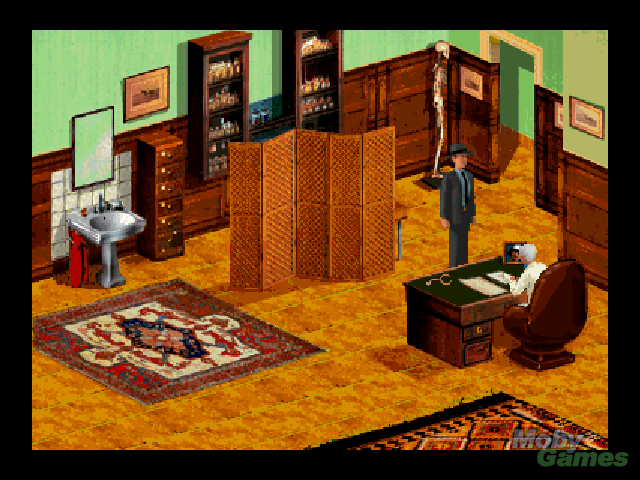
The inventory management suffers from the exact same conversion issue. Combining items requires cycling through screen menus with keypresses rather than dragging objects together. When French publication PC Team reviewed the release in June 1996, they awarded it an 84% score, praising the atmospheric atmosphere and plot details while noting the clunky controls. Modern players tend to hit that control wall immediately: the political conspiracy logic is sound, but wrestling with the movement scheme takes real patience.
Where developer Microïds got things right was the structure of the spy work itself. Puzzles rarely rely on absurd item combinations, avoiding the nonsensical "use rubber chicken on pulley" tropes that plagued late-nineties point-and-click titles. Instead, progress comes from paying attention to your environment and behaving like an actual covert operative.
Gathering evidence against Prime Minister Vishaka means reading recovered documents carefully. When you find microfilms or locked file cabinets in Ingleton's house or the US Embassy, the game expects you to deduce codes and cipher keys from notes you picked up earlier in the investigation. The full-motion video (FMV) cutscenes between chapters set up the stakes well, providing genuine satisfaction whenever you assemble a complete dossier out of scattered pieces of film and decoded text.
If you enjoy mid-nineties adventure games with serious narrative ambitions, this title holds up well on the story front. The political balancing act between American agents, Soviet operatives, and local rebels keeps the pacing swift across its fifteen distinct locations. The control scheme is a genuine hurdle, but once your hands adapt to the arrow-key orientation, the underlying detective work takes over.
You can play Secret Mission online, free in your browser right now, with zero installation needed. When you start your game, head straight for the desk drawers in the Black Lotus Hotel room to gather your basic items, and keep a notepad handy for the early ciphers you encounter. It is a dense, strange artifact from the CD-i conversion era, but the plot inside is well worth uncovering.
In Secret Mission, you play Jeff, a 1950s double agent who wakes up in a Southeast Asian hotel room with full amnesia just as an international crisis erupts around him.
You begin in the Black Lotus Hotel with a blank memory and a tight deadline. The fictional kingdom of Opalia has turned into a flashpoint between the United States and the Soviet Union, both attempting to sway the region while Prime Minister Vishaka quietly orchestrates a plot to murder the king. Your job is to piecemeal your identity back together, figure out which side you actually work for, and collect enough physical evidence to stop the assassination before the palace falls.
The campaign takes you across a wide range of backdrop locations, moving from urban modern spaces to dense jungle settings. You will search Doctor Stone's office, tail contacts into the local Dragon Club, sneak into the Palace, and eventually navigate through Thugnot Village, river paths, and remote hermit caves. The narrative leans heavily into classic espionage tropes: you decode encrypted messages, crack safes, snap photos, and manipulate microfilms to build your case against Vishaka.
Microïds originally designed the game for the Philips CD-i before porting it over as a Secret Mission MS-DOS game in 1996. That origin story explains almost every frustrating design choice in the game's interface. Instead of using point-and-click mouse movement standard for adventure games of the era, the developers bound movement to changing arrow-key perspectives. You move Jeff screen by screen using keyboard directional prompts that alter relative to the camera angle, making simple room navigation far more confusing than it ever needed to be.

The inventory management suffers from the exact same conversion issue. Combining items requires cycling through screen menus with keypresses rather than dragging objects together. When French publication PC Team reviewed the release in June 1996, they awarded it an 84% score, praising the atmospheric atmosphere and plot details while noting the clunky controls. Modern players tend to hit that control wall immediately: the political conspiracy logic is sound, but wrestling with the movement scheme takes real patience.
Where developer Microïds got things right was the structure of the spy work itself. Puzzles rarely rely on absurd item combinations, avoiding the nonsensical "use rubber chicken on pulley" tropes that plagued late-nineties point-and-click titles. Instead, progress comes from paying attention to your environment and behaving like an actual covert operative.
Gathering evidence against Prime Minister Vishaka means reading recovered documents carefully. When you find microfilms or locked file cabinets in Ingleton's house or the US Embassy, the game expects you to deduce codes and cipher keys from notes you picked up earlier in the investigation. The full-motion video (FMV) cutscenes between chapters set up the stakes well, providing genuine satisfaction whenever you assemble a complete dossier out of scattered pieces of film and decoded text.

If you enjoy mid-nineties adventure games with serious narrative ambitions, this title holds up well on the story front. The political balancing act between American agents, Soviet operatives, and local rebels keeps the pacing swift across its fifteen distinct locations. The control scheme is a genuine hurdle, but once your hands adapt to the arrow-key orientation, the underlying detective work takes over.
You can play Secret Mission online, free in your browser right now, with zero installation needed. When you start your game, head straight for the desk drawers in the Black Lotus Hotel room to gather your basic items, and keep a notepad handy for the early ciphers you encounter. It is a dense, strange artifact from the CD-i conversion era, but the plot inside is well worth uncovering.
How Secret Mission (1996) is played — the keys the game listens to, grouped by what they do.
Highlighted keys are mapped — hover or tap one to see what it does.
Movement directions change relative to camera perspective depending on the location. Action menu provides options to speak, take, move, give, open, combine, look, and save.
The on-screen keyboard and gamepad mapping the browser player uses on a phone, a tablet or a controller, as opposed to the real keys above. $PRO members make their own in the player and share them here; anyone can pick one to play with.
Cheat codes, console commands and memory pokes for Secret Mission (1996) — each one verified and attributed.
Sign in to submitHow Secret Mission (1996) is played — the keys the game listens to, grouped by what they do.
Highlighted keys are mapped — hover or tap one to see what it does.
Movement directions change relative to camera perspective depending on the location. Action menu provides options to speak, take, move, give, open, combine, look, and save.
The on-screen keyboard and gamepad mapping the browser player uses on a phone, a tablet or a controller, as opposed to the real keys above. $PRO members make their own in the player and share them here; anyone can pick one to play with.
Cheat codes, console commands and memory pokes for Secret Mission (1996) — each one verified and attributed.
Sign in to submit