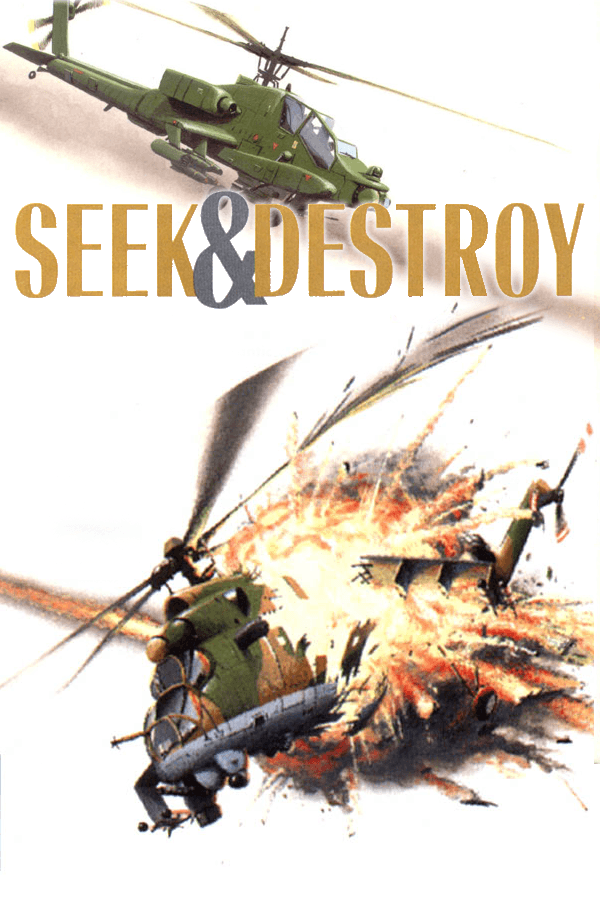
aka Seek & Destroy
Seek and Destroy takes the top-down vehicular chaos of arcade shooters and forces you to balance your ammo budgets in a hangar before every mission.
Most action games from 1996 let you pick up a bigger gun and hold down the fire button. This one makes you pay for every shell first. You play as one of the last surviving Vehicular Combat Troopers fighting a paramilitary force across 20 multi-phase missions. Before you launch into the desert or jungle, you step into a shopping phase where gathered gold medals buy your survival.
That pre-mission screen is where campaigns live or die. You spend your hard-earned medals to upgrade weapons across three power tiers, buy fuel capacity, harden your armor, and increase your speed. You also have to manually assign ammunition counts to individual vehicle bays. Pick the wrong loadout for a long desert run and your engine starves mid-flight, leaving you stranded with zero armor.
This heavy focus on logistics makes the high difficulty even harsher. If you spend all your cash on heavy ordnance but neglect your fuel tank, you might clear three enemy bases only to watch your vehicle sputter out over open water. It is a strict system that punished impatient players who just wanted to blow up turrets.
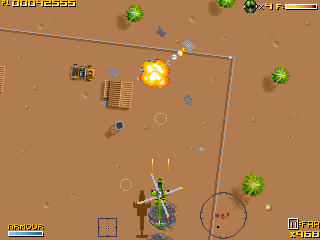
Before launching a phase, you choose between an Apache attack helicopter and a heavy three-barreled battle tank. Certain missions force a specific ride, but when you get the choice, the handling completely changes your attack vectors. The chopper lets you fly over water and terrain obstacles, while the tank provides a solid ground platform for heavy shelling.
Programmer Aaron Koolen built the engine using Rational Systems DOS/4GW protected mode to handle the high-speed motion. Instead of full 3D rendering, the playfield only scrolls vertically while ground tiles and 2D sprites rotate and scale underneath you. Graphics artist Rodney Smith and 3D artist Grant Wallis used this trick to create a convincing sense of altitude and rotational momentum in standard VGA resolutions.
The audio side relied on Paul Andrews' sound library to punch through PC speakers. If you had a Sound Blaster 16 or a Gravis Ultrasound installed, the game rewarded you with crisp digitized voice lines and deep, bass-heavy explosions. Hearing your co-pilot confirm target locks over the roar of your engine gave the military theme extra weight.
The campaign spans five distinct Operations set across deserts, dense jungles, snowy regions, and open oceans. Your objectives constantly shift during a mission, moving beyond standard destruction to include the following operational duties:
To clear these goals, you carry a varied arsenal. You start with a basic chain gun and unguided rockets or tank shells. As your bank account grows, you unlock special items like napalm, air strikes, flame throwers, Mega Missiles, Super Napalm, mines, and heavy Power Shells.
Unlike many arcade titles of the era, the design lacks traditional boss fights at the end of stages. Instead, developer Vision Software chose to test players with massive, overwhelming enemy waves in later levels. You face dense clusters of fixed gun emplacements, hostile choppers, enemy tanks, and swarms of foot soldiers all shooting at once.
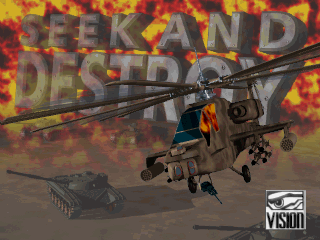
The transition from its original Amiga releases in 1993 and 1994 to this updated 1996 release on MS-DOS brought sharper graphics, but it kept some frustrating design choices. Published by Safari Software and Epic MegaGames, the game shared shareware channels with eight free levels, but full retail players ran into a brick wall with the save system. You cannot save mid-mission or use level passwords, meaning a single mistake after twenty minutes of carefully clearing a map sends you straight back to the briefing.
Contemporary reviewers were divided on whether the tactical twist was enough. German magazine Power Play gave the DOS release a 60% rating, noting that while the action was fast, it lacked the creative wit and refined landscape detail seen in EA's Jungle Strike. The high difficulty spike in later operations turned off casual players who did not want to re-run long levels.
Still, outlet Computer Games gave it a 4 out of 5, finding real satisfaction in its responsive controls and weapon variety. The game never reached the mainstream fame of major DOS shooters, but action fans who enjoyed fine-tuning their loadouts loved the sheer carnage on display.
This shooter succeeds because it forces you to think like a pilot rather than an invincible action hero. Balancing speed, armor, fuel, and ammunition before dropping into a zone creates real tension that standard top-down blasters lack. The explosion sound effects still feel punchy, and sweeping over an enemy base with a upgraded Apache remains deeply satisfying.
The harsh difficulty and lack of mid-mission checkpoints mean it will test your patience, but the core shooting mechanics hold up well. If you enjoy tactical mission design and managing hardware setups between firefights, it offers a great retro challenge.
You can play Seek and Destroy free in your browser right now with no setup needed. Modern players often expect a simple arcade drive-and-shoot experience, so make sure you invest heavily in fuel and armor upgrades before taking off on your first desert run.
Seek and Destroy takes the top-down vehicular chaos of arcade shooters and forces you to balance your ammo budgets in a hangar before every mission.
Most action games from 1996 let you pick up a bigger gun and hold down the fire button. This one makes you pay for every shell first. You play as one of the last surviving Vehicular Combat Troopers fighting a paramilitary force across 20 multi-phase missions. Before you launch into the desert or jungle, you step into a shopping phase where gathered gold medals buy your survival.
That pre-mission screen is where campaigns live or die. You spend your hard-earned medals to upgrade weapons across three power tiers, buy fuel capacity, harden your armor, and increase your speed. You also have to manually assign ammunition counts to individual vehicle bays. Pick the wrong loadout for a long desert run and your engine starves mid-flight, leaving you stranded with zero armor.
This heavy focus on logistics makes the high difficulty even harsher. If you spend all your cash on heavy ordnance but neglect your fuel tank, you might clear three enemy bases only to watch your vehicle sputter out over open water. It is a strict system that punished impatient players who just wanted to blow up turrets.

Before launching a phase, you choose between an Apache attack helicopter and a heavy three-barreled battle tank. Certain missions force a specific ride, but when you get the choice, the handling completely changes your attack vectors. The chopper lets you fly over water and terrain obstacles, while the tank provides a solid ground platform for heavy shelling.
Programmer Aaron Koolen built the engine using Rational Systems DOS/4GW protected mode to handle the high-speed motion. Instead of full 3D rendering, the playfield only scrolls vertically while ground tiles and 2D sprites rotate and scale underneath you. Graphics artist Rodney Smith and 3D artist Grant Wallis used this trick to create a convincing sense of altitude and rotational momentum in standard VGA resolutions.
The audio side relied on Paul Andrews' sound library to punch through PC speakers. If you had a Sound Blaster 16 or a Gravis Ultrasound installed, the game rewarded you with crisp digitized voice lines and deep, bass-heavy explosions. Hearing your co-pilot confirm target locks over the roar of your engine gave the military theme extra weight.
The campaign spans five distinct Operations set across deserts, dense jungles, snowy regions, and open oceans. Your objectives constantly shift during a mission, moving beyond standard destruction to include the following operational duties:
To clear these goals, you carry a varied arsenal. You start with a basic chain gun and unguided rockets or tank shells. As your bank account grows, you unlock special items like napalm, air strikes, flame throwers, Mega Missiles, Super Napalm, mines, and heavy Power Shells.
Unlike many arcade titles of the era, the design lacks traditional boss fights at the end of stages. Instead, developer Vision Software chose to test players with massive, overwhelming enemy waves in later levels. You face dense clusters of fixed gun emplacements, hostile choppers, enemy tanks, and swarms of foot soldiers all shooting at once.

The transition from its original Amiga releases in 1993 and 1994 to this updated 1996 release on MS-DOS brought sharper graphics, but it kept some frustrating design choices. Published by Safari Software and Epic MegaGames, the game shared shareware channels with eight free levels, but full retail players ran into a brick wall with the save system. You cannot save mid-mission or use level passwords, meaning a single mistake after twenty minutes of carefully clearing a map sends you straight back to the briefing.
Contemporary reviewers were divided on whether the tactical twist was enough. German magazine Power Play gave the DOS release a 60% rating, noting that while the action was fast, it lacked the creative wit and refined landscape detail seen in EA's Jungle Strike. The high difficulty spike in later operations turned off casual players who did not want to re-run long levels.
Still, outlet Computer Games gave it a 4 out of 5, finding real satisfaction in its responsive controls and weapon variety. The game never reached the mainstream fame of major DOS shooters, but action fans who enjoyed fine-tuning their loadouts loved the sheer carnage on display.
This shooter succeeds because it forces you to think like a pilot rather than an invincible action hero. Balancing speed, armor, fuel, and ammunition before dropping into a zone creates real tension that standard top-down blasters lack. The explosion sound effects still feel punchy, and sweeping over an enemy base with a upgraded Apache remains deeply satisfying.
The harsh difficulty and lack of mid-mission checkpoints mean it will test your patience, but the core shooting mechanics hold up well. If you enjoy tactical mission design and managing hardware setups between firefights, it offers a great retro challenge.
You can play Seek and Destroy free in your browser right now with no setup needed. Modern players often expect a simple arcade drive-and-shoot experience, so make sure you invest heavily in fuel and armor upgrades before taking off on your first desert run.
How Seek and Destroy is played — the keys the game listens to, grouped by what they do.
Highlighted keys are mapped — hover or tap one to see what it does.
Key map is incomplete as manual bindings for weapons and actions were not available in sources. Sound setup is managed via a separate setup executable.
The on-screen keyboard and gamepad mapping the browser player uses on a phone, a tablet or a controller, as opposed to the real keys above. $PRO members make their own in the player and share them here; anyone can pick one to play with.
Cheat codes, console commands and memory pokes for Seek and Destroy — each one verified and attributed.
Sign in to submitHow Seek and Destroy is played — the keys the game listens to, grouped by what they do.
Highlighted keys are mapped — hover or tap one to see what it does.
Key map is incomplete as manual bindings for weapons and actions were not available in sources. Sound setup is managed via a separate setup executable.
The on-screen keyboard and gamepad mapping the browser player uses on a phone, a tablet or a controller, as opposed to the real keys above. $PRO members make their own in the player and share them here; anyone can pick one to play with.
Cheat codes, console commands and memory pokes for Seek and Destroy — each one verified and attributed.
Sign in to submit