
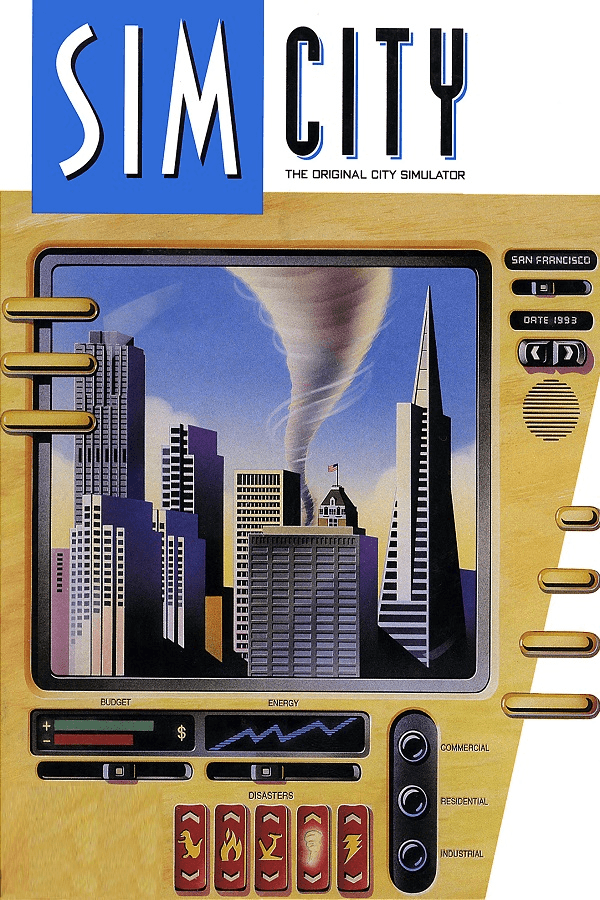

In SimCity, failure rarely comes from a sudden enemy attack or a missed jump; it happens because you spent your last few dollars laying pavement toward a coal plant that nobody lives near enough to use.
When designer Will Wright was working on the Commodore 64 action game Raid on Bungeling Bay, he made an odd discovery. Building the islands with his internal software editor, named Micropolis, was significantly more enjoyable than shooting at the gun emplacements on them. He kept tweaking the layout tools, adding system mechanics that simulated population movement, land value, and traffic flow based on real urban planning theories.
Most game publishers in the mid-1980s turned the concept down flat. They looked at the top-down grid and asked how a player was supposed to win a game that had no final screen, no high score board, and no ending credits. Wright teamed up with Jeff Braun to found Maxis Software Inc., eventually securing a distribution partner in Brøderbund Software, Inc. to get the title onto store shelves. Programmer Daniel Goldman built the MS-DOS port, translating Wright's tile-based system into a flexible toolset that allowed players to act as mayor and city planner on a single screen.
Starting a new map in the 1989 original demands strict budget discipline. You begin with a completely open landscape or a custom piece of terrain, a set amount of cash, and a blank 2D grid. The core structure relies on three zone types: residential, commercial, and industrial, commonly known as RCI. Residential zones bring in labor, industrial zones generate manufacturing jobs, and commercial zones create retail trade. None of them do anything until you connect them with power lines running from a coal or nuclear power plant.
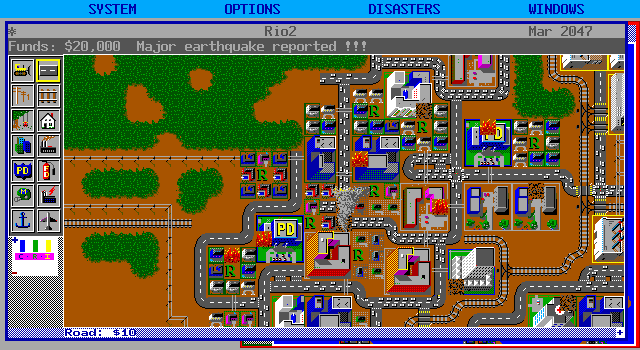
The simulation runs on a continuous feedback loop that demands constant adjustments. Coal power is cheap but spews heavy pollution over adjacent neighborhood tiles, driving down land values; nuclear power produces clean energy but costs far more up front and carries the constant, lingering threat of a meltdown. If you cut public services like police or fire station funding to save cash, crime spikes and uncontained fires will quickly gut entire neighborhoods.
Players quickly discovered clever workarounds within the economic simulation. One famous glitch involves overlaying power lines directly over road or rail tiles. Doing this prevents transportation lines from deteriorating over time, letting you set your transportation budget to zero percent without your road network falling apart. If you get desperate for funds without taking out expensive loans, pausing the game, holding down the Shift key, and typing fund instantly awards $10,000. However, typing that code four to eight times in succession triggers an immediate earthquake to punish your greed. Serious cheat enthusiasts skip the in-game codes entirely, opening their .cty save files in a hex editor to modify offsets 0xc24 through 0xc27 for unlimited capital.
As your township expands toward higher population tiers, the real nightmare of urban management sets in. Once you hit the threshold for a Metropolis or chase the elusive 500,000 resident mark for a Megalopolis, traffic congestion becomes an absolute monster. Heavy traffic chokes roads, causing air pollution to skyrocket, land values to plummet, and citizens to abandon high-density residential blocks in droves. Laying down expensive rail lines helps relieve traffic bottlenecks, but rail consumes valuable land and bleeds tax money in upkeep.
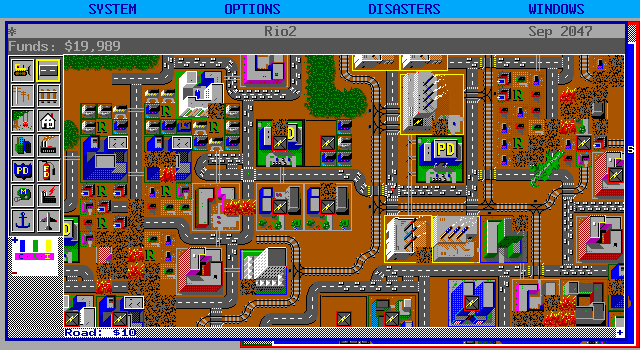
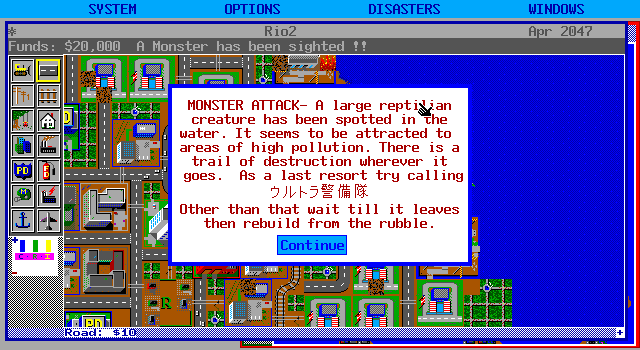
Disasters represent the main active hazard standing between you and a stable budget. Floods, tornadoes, fires, and earthquakes can strike randomly or be triggered manually from the mayor's menu. In early releases of the game, a giant Godzilla-style monster would occasionally stomp through your commercial district, demolishing power lines and crushing police stations. Due to legal concerns raised by Toho Company Ltd. over their trademarked kaiju, later prints recolored the sprite into an orange reptilian monster.
For players who preferred structured missions over open-ended sandbox building, the game offered eight predefined scenario challenges. These timed scenarios dropped you into real-world municipalities facing immediate crises, such as managing severe industrial decay in Detroit or surviving a monster attack in Tokyo. Clearing a scenario required stabilizing the city's budget and crime rate before time ran out.
Looking at this early design today, the graphics are coarse and pixelated, and you have to lay down every single stretch of road click by click without the drag-and-drop tools from later sequels. The underlying math is where it shines. Put a seaport next to a quiet patch of grass, and you get to watch that cheap dirt zone grow into a cluster of high-rises purely because of your trade link.
The absolute strictness of the economic model is where new mayors usually run into a wall. Tax rates set too high will cause citizens to migrate out of your city instantly, while tax rates set too low leave you unable to rebuild infrastructure after a routine fire wiped out a power line. It forces you to think three moves ahead before spending a single dollar on municipal expansion.
This release transformed how designers thought about non-linear strategy, proving that players would happily spend hours balancing economic charts and tile layouts without needing a final boss to defeat. Its runaway success resulted in over one million copies sold by late 1992, establishing a framework that defined construction games for decades.
You can play SimCity free in your browser right now with no setup needed. Jump straight into a fresh grid, drop down a single coal plant, and see if you can balance an industrial zone and a fire station without going completely bankrupt before your very first annual tax collection.
In SimCity, failure rarely comes from a sudden enemy attack or a missed jump; it happens because you spent your last few dollars laying pavement toward a coal plant that nobody lives near enough to use.
When designer Will Wright was working on the Commodore 64 action game Raid on Bungeling Bay, he made an odd discovery. Building the islands with his internal software editor, named Micropolis, was significantly more enjoyable than shooting at the gun emplacements on them. He kept tweaking the layout tools, adding system mechanics that simulated population movement, land value, and traffic flow based on real urban planning theories.
Most game publishers in the mid-1980s turned the concept down flat. They looked at the top-down grid and asked how a player was supposed to win a game that had no final screen, no high score board, and no ending credits. Wright teamed up with Jeff Braun to found Maxis Software Inc., eventually securing a distribution partner in Brøderbund Software, Inc. to get the title onto store shelves. Programmer Daniel Goldman built the MS-DOS port, translating Wright's tile-based system into a flexible toolset that allowed players to act as mayor and city planner on a single screen.
Starting a new map in the 1989 original demands strict budget discipline. You begin with a completely open landscape or a custom piece of terrain, a set amount of cash, and a blank 2D grid. The core structure relies on three zone types: residential, commercial, and industrial, commonly known as RCI. Residential zones bring in labor, industrial zones generate manufacturing jobs, and commercial zones create retail trade. None of them do anything until you connect them with power lines running from a coal or nuclear power plant.
The simulation runs on a continuous feedback loop that demands constant adjustments. Coal power is cheap but spews heavy pollution over adjacent neighborhood tiles, driving down land values; nuclear power produces clean energy but costs far more up front and carries the constant, lingering threat of a meltdown. If you cut public services like police or fire station funding to save cash, crime spikes and uncontained fires will quickly gut entire neighborhoods.
Players quickly discovered clever workarounds within the economic simulation. One famous glitch involves overlaying power lines directly over road or rail tiles. Doing this prevents transportation lines from deteriorating over time, letting you set your transportation budget to zero percent without your road network falling apart. If you get desperate for funds without taking out expensive loans, pausing the game, holding down the Shift key, and typing fund instantly awards $10,000. However, typing that code four to eight times in succession triggers an immediate earthquake to punish your greed. Serious cheat enthusiasts skip the in-game codes entirely, opening their .cty save files in a hex editor to modify offsets 0xc24 through 0xc27 for unlimited capital.
As your township expands toward higher population tiers, the real nightmare of urban management sets in. Once you hit the threshold for a Metropolis or chase the elusive 500,000 resident mark for a Megalopolis, traffic congestion becomes an absolute monster. Heavy traffic chokes roads, causing air pollution to skyrocket, land values to plummet, and citizens to abandon high-density residential blocks in droves. Laying down expensive rail lines helps relieve traffic bottlenecks, but rail consumes valuable land and bleeds tax money in upkeep.
Disasters represent the main active hazard standing between you and a stable budget. Floods, tornadoes, fires, and earthquakes can strike randomly or be triggered manually from the mayor's menu. In early releases of the game, a giant Godzilla-style monster would occasionally stomp through your commercial district, demolishing power lines and crushing police stations. Due to legal concerns raised by Toho Company Ltd. over their trademarked kaiju, later prints recolored the sprite into an orange reptilian monster.
For players who preferred structured missions over open-ended sandbox building, the game offered eight predefined scenario challenges. These timed scenarios dropped you into real-world municipalities facing immediate crises, such as managing severe industrial decay in Detroit or surviving a monster attack in Tokyo. Clearing a scenario required stabilizing the city's budget and crime rate before time ran out.
Looking at this early design today, the graphics are coarse and pixelated, and you have to lay down every single stretch of road click by click without the drag-and-drop tools from later sequels. The underlying math is where it shines. Put a seaport next to a quiet patch of grass, and you get to watch that cheap dirt zone grow into a cluster of high-rises purely because of your trade link.
The absolute strictness of the economic model is where new mayors usually run into a wall. Tax rates set too high will cause citizens to migrate out of your city instantly, while tax rates set too low leave you unable to rebuild infrastructure after a routine fire wiped out a power line. It forces you to think three moves ahead before spending a single dollar on municipal expansion.
This release transformed how designers thought about non-linear strategy, proving that players would happily spend hours balancing economic charts and tile layouts without needing a final boss to defeat. Its runaway success resulted in over one million copies sold by late 1992, establishing a framework that defined construction games for decades.
You can play SimCity free in your browser right now with no setup needed. Jump straight into a fresh grid, drop down a single coal plant, and see if you can balance an industrial zone and a fire station without going completely bankrupt before your very first annual tax collection.
How SimCity is played — the keys the game listens to, grouped by what they do.
Highlighted keys are mapped — hover or tap one to see what it does.
Individual control mappings could not be fully enumerated verbatim from the retrieved sources, but the game natively supports mouse/joystick control as primary input alongside keyboard navigation and typing for naming/files.
The on-screen keyboard and gamepad mapping the browser player uses on a phone, a tablet or a controller, as opposed to the real keys above. $PRO members make their own in the player and share them here; anyone can pick one to play with.
Cheat codes, console commands and memory pokes for SimCity — each one verified and attributed.
Sign in to submitaka Micropolis · SimCity Classic · SimCity Enhanced CD-ROM
How SimCity is played — the keys the game listens to, grouped by what they do.
Highlighted keys are mapped — hover or tap one to see what it does.
Individual control mappings could not be fully enumerated verbatim from the retrieved sources, but the game natively supports mouse/joystick control as primary input alongside keyboard navigation and typing for naming/files.
The on-screen keyboard and gamepad mapping the browser player uses on a phone, a tablet or a controller, as opposed to the real keys above. $PRO members make their own in the player and share them here; anyone can pick one to play with.
Cheat codes, console commands and memory pokes for SimCity — each one verified and attributed.
Sign in to submit