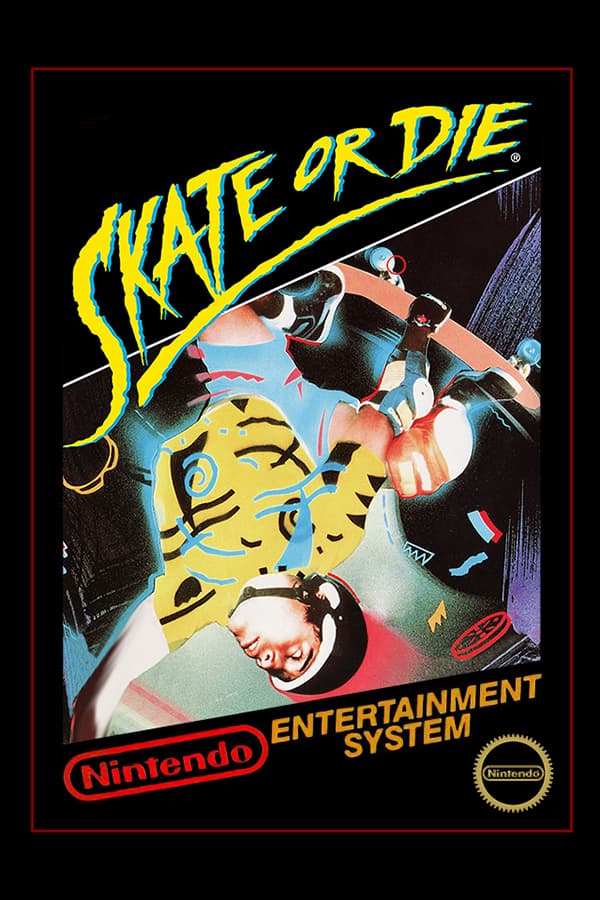
Before you ever drop into a halfpipe in Skate or Die, you are dropped into Rodney's skate shop to register your skater and stare at a pixelated clerk who looks suspiciously like Rodney Dangerfield.
Rodney Reclose and the shop room hub
Most multi-event sports titles from the late 1980s handed you a dry text menu, but this game makes you roll through an indoor lobby to pick your event. Stepping into the skate shop puts you face to face with Rodney Reclose, a Mohawk-sporting shopkeeper, and his son Bionic Lester, who stands ready to challenge you in the head-to-head events. It was a clever piece of world-building designed by ex-Epyx programmers Michael Kosaka, Stephen Landrum, and David Bunch, who brought the multi-event structure of Epyx hits like California Games over to Electronic Arts, Inc. for this 1988 release.
The main menu room lets up to eight players sign in for alternating turns or direct competition before heading out to five distinct events. You can take on practice runs, start a full tournament, or just head straight for the ramp. Taking inspiration from Atari's 1986 arcade machine 720°, which supplied the original digitized voice sample for the title phrase, the game captures the messy edge of late-eighties skate culture through raw arcade mechanics.
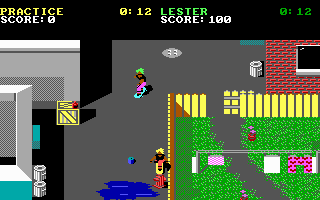
Five ways to crash in the 1988 MS-DOS release of Skate or Die
The package contains five mini-games, each testing a completely different mechanical skill set. Half the events take place on ramps and pools, while the rest pull the camera back for a diagonal top-down view of suburban streets and drainage pipes.
- Freestyle Ramp: You get 10 attempts on a halfpipe to execute kickflips, handplants, and aerials, with a panel of five AI judges scoring your style and trick variety.
- High Jump: A straightforward vertical challenge where you build up speed along the halfpipe to launch your skater as high as possible above the top lip.
- Downhill Race: A single-player overhead sprint against a 90-second clock through a winding street path packed with street curb hazards and sharp turns.
- Downhill Jam: A violent, side-by-side downhill rumble against Lester or another player down a concrete alley, complete with punches and body slams.
- Pool Joust: A brutal one-on-one duel inside a drained concrete pool where both competitors wield wooden sticks to knock each other off their boards.
Learning the trick inputs requires patience. The diagonal top-down perspective on the downhill tracks completely changes how you judge turns and obstacle placement, forcing you to execute quick directional taps rather than sweeping motions. Timing your pumps on the halfpipe takes practice, and mistiming a trick launch sends your skater face-first into the wood grain, accompanied by a harsh crunch from the system speaker.
EGA brown wood and PC speaker screams
Converting the original Commodore 64 codebase over to IBM PC compatibles fell to programmer Arti Haroutunian at Sculptured Software. The 1988 MS-DOS release offers support for both CGA and 16-color EGA display adapters, though the visual palette leans heavily on dark brown wood textures across the ramp graphics. Compared to the rich color palettes seen on home computers like the C64 or Atari ST, the PC version looks noticeably muted, relying on stark contrast to keep hazards visible on screen.
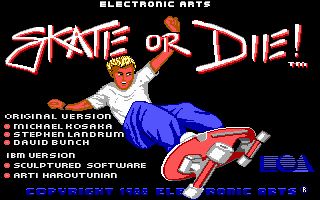
Audio is handled entirely through the internal PC speaker or early sound hardware, resulting in sharp, bleepy renditions of the title score. The sound effects consist mainly of dry white-noise scrapes when wheels hit pavement and low-pitched thuds whenever your skater falls flat on their face. It lacks the punchy SID chip synthesis of its C64 sibling, but the sound feedback is direct enough to let you know instantly when a trick input has failed.
Why Pool Joust is still the main event in Skate or Die
While the racing modes can feel unforgiving due to stiff keyboard response, the combat-focused events remain genuinely fun during multiplayer sessions. Pool Joust plays like a wrestling match on wheels, as you carve up and down the walls of a drained swimming pool to gain momentum, sweeping your stick into your rival's ribs to take their last drop of health. Downhill Jam offers a similar brand of chaotic fun, encouraging you to kick opponents into sewer grates and fallen trash cans to take the lead.
The steep difficulty wall in the trick events will test anyone used to modern skateboarding titles where tricks snap automatically onto rails. Here, pulling off a clean handplant or high-scoring air trick demands exact positioning, and missing your landing angle by a few degrees results in an instant wipeout. It was this demanding design that prompted EA to follow up a year later with the winter-themed Ski or Die, carrying forward the same multi-event philosophy.
Play Skate or Die free right now
If you want to sample this classic piece of sports history, you do not need an old DOS rig or a stack of 5.25-inch floppy disks. You can play Skate or Die free in your browser right here, fully configured and ready to go in a single click without installing extra software.
Jump straight into the Pool Joust to test your aggressive steering, or head over to the Freestyle Ramp to see if you can build enough pump speed to clear the lip. The keyboard controls require a couple of practice runs to master the diagonal steering angles, but knocking Bionic Lester off his skateboard inside Rodney's pool is just as satisfying today as it was in 1988.