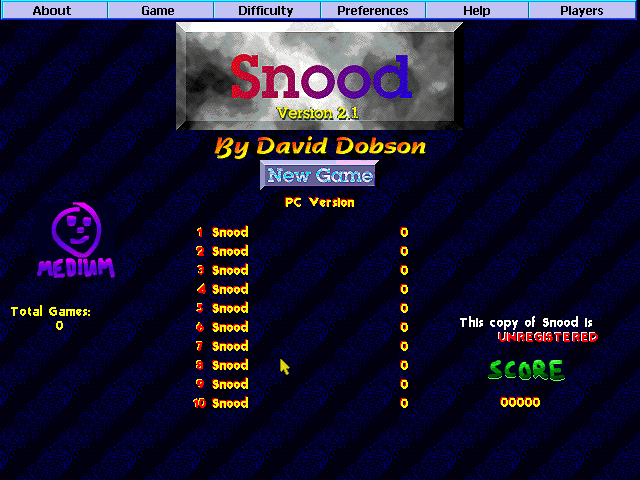
aka Snood Advance
Few PC titles consumed late-night study hours in dorm rooms quite like Snood, a bizarre tile matching game where you shoot disembodied head-shaped blocks out of a bottom-mounted launcher.
Before it became an obsession across university computer labs at the turn of the millennium, Snood started as a simple personal project. Dave Dobson, a geology professor, programmed the initial Macintosh version in 1996 as a gift for his wife Christina while he was in graduate school. He based the mechanics on Taito's arcade hit Puzzle Bobble, replacing the original bubble graphics with strange, expressive face-blocks. After forming Word of Mouse Games, later named Snood, LLC, Dobson ported the code to bring the 1999 release to DOS users who lacked access to the original Mac download.
Without a publisher pushing it into retail stores, the game spread entirely by word of mouth and shareware distribution sites. By 2001, tracking firm Jupiter Media Metrix listed it as the ninth most played PC game in the world, with more than 1.5 million active players. Over 200,000 people paid the registration fee to unlock the full version. That word-of-mouth spread meant nearly everyone who owned a PC around the year 2000 had spent at least one evening lining up angled shots off the screen margins.
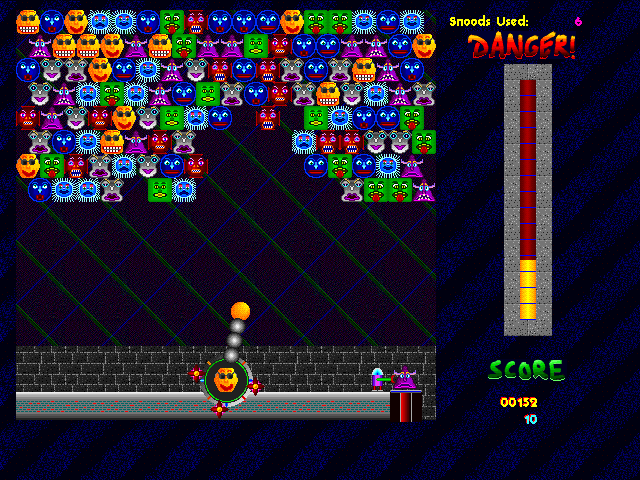
The rules in this puzzle title seem simple when a match starts, but the geometry quickly gets messy. You operate a rotating cannon along the bottom of the screen, aiming colorful facial blocks called Snoods up at a wall of matching faces hanging from the ceiling. You can bounce shots off the left and right walls to bank projectiles around stubborn clusters. Matching three or more identical faces makes that cluster vanish instantly, freeing up space near the top.
The real scoring strategy relies on dropping unattached pieces rather than clearing them directly. Any block left hanging without a direct connection to the ceiling or another anchored block falls down to safety and awards huge bonus points. If you aim carelessly and fire a shot that fails to clear any pieces, the Danger bar at the side of the screen ticks upward. Once that meter fills completely, the entire ceiling drops down by one row, pushing the faces closer to your launcher.
If any face drops below the bottom boundary line or touches your launcher, your run ends on the spot. Higher difficulty modes complicate your bank shots by introducing Skulls starting at the Medium setting. Skulls are nuisance pieces that cannot be matched by shooting more Skulls at them. The only way to clear a Skull from the grid is to shoot away the normal pieces holding it up, letting gravity pull it off the board.
Because the game relied on shareware registration codes, unregistered copies eventually circulated across early file-sharing networks. Dave Dobson built a famously blunt anti-piracy pop-up into version 3.52 to address invalid registration keys. Instead of silently crashing the game, the program launched a sequence of pop-up windows delivering a direct lecture to the player.
The pop-up reminded the user that software piracy was punishable by federal law, adding a personal plea directly from the creator:
Software piracy is punishable by federal law. You should be ashamed of yourself. The game costs under $15, for Pete's sake... I'm just a guy with two young kids who programs in his spare time. I'm not some faceless corporation.
That personal plea worked because the game never felt like a product turned out by a huge studio. It played like a personal project made by someone who enjoyed solving spatial puzzles during break hours. The lack of a real-time clock in standard modes meant you could pause mid-shot, calculate your wall angles with a straight edge against the monitor, and take your shot without the game rushing your decisions.
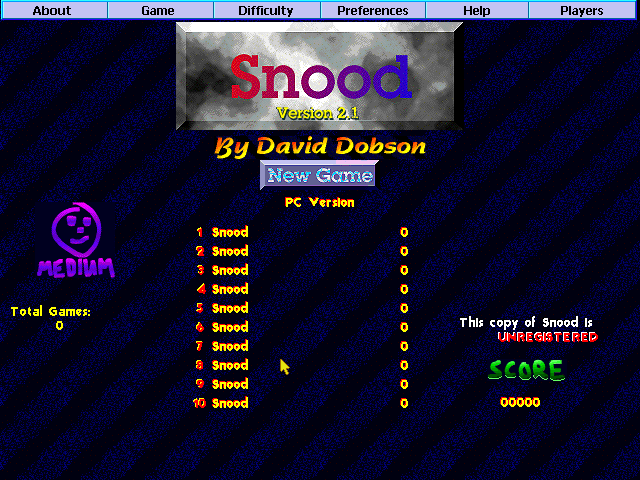
Even back in 1999, nobody was playing the DOS version of Snood for graphical fidelity. Running at a crisp 640x480 resolution, the SVGA visuals showed off exaggerated, strange faces with bugged-out eyes, grimacing mouths, and goofy grins. Reviewers at the time often called the faces outright ugly, comparing the visual presentation unfavorably to the polished arcade sprites of Taito's originals. Yet those distinct facial expressions made every piece instantly readable at a quick glance, which mattered when the board stacked up near the bottom margin.
The game structure offered enough variety to keep players coming back long after the initial novelty wore off. Alongside the main game, you had 50 pre-designed challenge puzzles, an Armageddon mode for rapid play, and a Journey mode that took you through escalating difficulty levels step by step. Later updates introduced special pieces like the Wild Card and Cutter, but the core mechanics of line-of-sight bouncing and gravity drops remained the real draw.
The one structural flaw that bothered dedicated players was how quickly a bad board setup on higher difficulties could trap you. If the random number generator fed you a string of useless colors while Skulls blocked your bank shots, the Danger bar would punish you rapidly without offering a realistic way out. Even with those harsh random spills, the quick restart button meant most players immediately kicked off another round.
In the late-nineties puzzle scene, this shareware hit proved that clean mechanics beat fancy graphics every time. It took a proven arcade formula, stripped away the timed pressure, and gave you a turn-based matching game you could learn in thirty seconds. The art style is absurd, but the satisfying snap of dropping a massive cluster of pieces with one well-placed bank shot feels just as good now as it did on a CRT monitor.
You can play Snood online right here in your web browser with no setup required. Jump straight into the classic MS-DOS game, pick Medium difficulty to experience the agony of dodging Skulls, and see if you can pull off a ceiling-clearing bank shot on your very first run.
Few PC titles consumed late-night study hours in dorm rooms quite like Snood, a bizarre tile matching game where you shoot disembodied head-shaped blocks out of a bottom-mounted launcher.
Before it became an obsession across university computer labs at the turn of the millennium, Snood started as a simple personal project. Dave Dobson, a geology professor, programmed the initial Macintosh version in 1996 as a gift for his wife Christina while he was in graduate school. He based the mechanics on Taito's arcade hit Puzzle Bobble, replacing the original bubble graphics with strange, expressive face-blocks. After forming Word of Mouse Games, later named Snood, LLC, Dobson ported the code to bring the 1999 release to DOS users who lacked access to the original Mac download.
Without a publisher pushing it into retail stores, the game spread entirely by word of mouth and shareware distribution sites. By 2001, tracking firm Jupiter Media Metrix listed it as the ninth most played PC game in the world, with more than 1.5 million active players. Over 200,000 people paid the registration fee to unlock the full version. That word-of-mouth spread meant nearly everyone who owned a PC around the year 2000 had spent at least one evening lining up angled shots off the screen margins.
The rules in this puzzle title seem simple when a match starts, but the geometry quickly gets messy. You operate a rotating cannon along the bottom of the screen, aiming colorful facial blocks called Snoods up at a wall of matching faces hanging from the ceiling. You can bounce shots off the left and right walls to bank projectiles around stubborn clusters. Matching three or more identical faces makes that cluster vanish instantly, freeing up space near the top.
The real scoring strategy relies on dropping unattached pieces rather than clearing them directly. Any block left hanging without a direct connection to the ceiling or another anchored block falls down to safety and awards huge bonus points. If you aim carelessly and fire a shot that fails to clear any pieces, the Danger bar at the side of the screen ticks upward. Once that meter fills completely, the entire ceiling drops down by one row, pushing the faces closer to your launcher.
If any face drops below the bottom boundary line or touches your launcher, your run ends on the spot. Higher difficulty modes complicate your bank shots by introducing Skulls starting at the Medium setting. Skulls are nuisance pieces that cannot be matched by shooting more Skulls at them. The only way to clear a Skull from the grid is to shoot away the normal pieces holding it up, letting gravity pull it off the board.
Because the game relied on shareware registration codes, unregistered copies eventually circulated across early file-sharing networks. Dave Dobson built a famously blunt anti-piracy pop-up into version 3.52 to address invalid registration keys. Instead of silently crashing the game, the program launched a sequence of pop-up windows delivering a direct lecture to the player.
The pop-up reminded the user that software piracy was punishable by federal law, adding a personal plea directly from the creator:
Software piracy is punishable by federal law. You should be ashamed of yourself. The game costs under $15, for Pete's sake... I'm just a guy with two young kids who programs in his spare time. I'm not some faceless corporation.
That personal plea worked because the game never felt like a product turned out by a huge studio. It played like a personal project made by someone who enjoyed solving spatial puzzles during break hours. The lack of a real-time clock in standard modes meant you could pause mid-shot, calculate your wall angles with a straight edge against the monitor, and take your shot without the game rushing your decisions.
Even back in 1999, nobody was playing the DOS version of Snood for graphical fidelity. Running at a crisp 640x480 resolution, the SVGA visuals showed off exaggerated, strange faces with bugged-out eyes, grimacing mouths, and goofy grins. Reviewers at the time often called the faces outright ugly, comparing the visual presentation unfavorably to the polished arcade sprites of Taito's originals. Yet those distinct facial expressions made every piece instantly readable at a quick glance, which mattered when the board stacked up near the bottom margin.
The game structure offered enough variety to keep players coming back long after the initial novelty wore off. Alongside the main game, you had 50 pre-designed challenge puzzles, an Armageddon mode for rapid play, and a Journey mode that took you through escalating difficulty levels step by step. Later updates introduced special pieces like the Wild Card and Cutter, but the core mechanics of line-of-sight bouncing and gravity drops remained the real draw.
The one structural flaw that bothered dedicated players was how quickly a bad board setup on higher difficulties could trap you. If the random number generator fed you a string of useless colors while Skulls blocked your bank shots, the Danger bar would punish you rapidly without offering a realistic way out. Even with those harsh random spills, the quick restart button meant most players immediately kicked off another round.
In the late-nineties puzzle scene, this shareware hit proved that clean mechanics beat fancy graphics every time. It took a proven arcade formula, stripped away the timed pressure, and gave you a turn-based matching game you could learn in thirty seconds. The art style is absurd, but the satisfying snap of dropping a massive cluster of pieces with one well-placed bank shot feels just as good now as it did on a CRT monitor.
You can play Snood online right here in your web browser with no setup required. Jump straight into the classic MS-DOS game, pick Medium difficulty to experience the agony of dodging Skulls, and see if you can pull off a ceiling-clearing bank shot on your very first run.
The on-screen keyboard and gamepad mapping the browser player uses on a phone, a tablet or a controller, as opposed to the real keys above. $PRO members make their own in the player and share them here; anyone can pick one to play with.
Cheat codes, console commands and memory pokes for Snood — each one verified and attributed.
Sign in to submitThe on-screen keyboard and gamepad mapping the browser player uses on a phone, a tablet or a controller, as opposed to the real keys above. $PRO members make their own in the player and share them here; anyone can pick one to play with.
Cheat codes, console commands and memory pokes for Snood — each one verified and attributed.
Sign in to submit