
So You Wanna Be A Redneck
Streaming build
Checking storage…71 MB
Preload in background
If you ever wondered what happened when a publisher took 75 fan-made levels from a design contest and shipped them on CD, So You Wanna Be A Redneck gives you every bit of that chaotic mid-nineties energy.
When contest maps make it onto a retail disc
Back in the late nineties, map design contests were the lifeblood of first-person shooter communities. Players spent hundreds of hours in map editors, carving out hallways, placing enemy spawns, and tweaking sound triggers. In 1998, Head Games Publishing, Inc. took 75 single-player user maps and 15 multiplayer arenas submitted to an official mapping competition, bundled them together, and sent the resulting expansion out to store shelves as a standalone pack for Redneck Rampage.
The result is a sprawling, wildly uneven collection of levels that shows off both the brilliant creativity and the utter cruelty of amateur map designers in 1998. Rather than a smooth campaign curve crafted by a single design lead, you get a grab bag of distinct build styles. One map might drop you into a tightly tuned barnyard ambush, while the next presents a massive, confusing labyrinth with missing textures and confusing puzzle logic. That unpredictability gives the expansion a strange appeal, even when a level design completely falls apart under pressure.
What 75 fan maps actually do to Build engine combat
Because these maps were created using Ken Silverman's Build engine, they inherit all the familiar mechanics of late-era 2.5D shooters. You run fast, aim with hitscan precision, and balance your inventory between health items like pork rinds and alcohol. The core loop of action games from this era relies on clear spatial layout, but amateur level designers frequently pushed the engine to its breaking point. You will frequently run across design choices that no commercial studio would have approved:
- Huge, open outdoor fields where hitscan enemies snipe you from distances beyond your effective weapon range.
- Claustrophobic spawn traps that drop heavy alien brute enemies directly on top of your character the instant you touch a keycard.
- Switch hunts where opening a progression door requires hunting down a hidden button tucked behind an obscure corner of a barn.
- Unusual multi-tiered level geometry that abuses Build engine sector tricks to build impossible architecture.
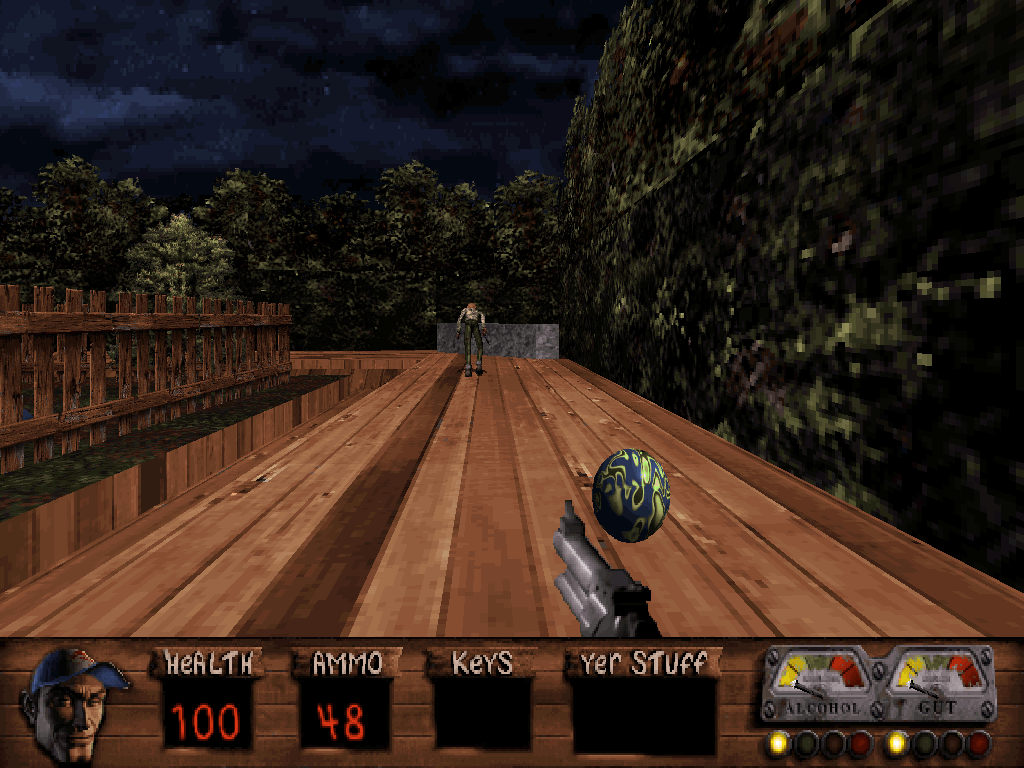
When the combat works, it feels like classic run-and-gun chaos. You circle-strafe around hostile hillbillies and alien invaders, managing your health meters while hoarding high-tier ammo for narrow hallway brawls. But when the maps falter, you spend twenty minutes circling an empty map trying to figure out which wall texture is actually a secret door needed to finish the level.
Sound disputes and a German indexing ban for So You Wanna Be A Redneck
The development history of this pack holds a couple of infamous details that fans still bring up. First was its immediate collision with European ratings boards. On May 30, 1998, Germany's BPjS (Federal Department for Media Harmful to Young Persons) officially placed the title on its indexing list. The combination of crude slapstick gore, explicit language, and irreverent humor meant that German shops were strictly restricted from selling or advertising the game to minors, effectively cutting off commercial distribution in that market.
The second controversy centered around its audio assets. Beyond importing user-created sector architecture, the expansion incorporated various custom audio samples submitted by community creators. Over the years, community members pointed out that several custom sound files embedded in the level files had been pulled from fan projects without proper attribution or permission from their original creators. It shows how loosely digital media and community creations were managed during the early days of commercialized mod culture.
Why this level pack still divides shooter fans
If you launch this title expecting a polished narrative campaign, you will likely end up frustrated by the fifth map. The keycard placement is occasionally absurd, save points require constant manual discipline, and the sheer volume of content means quality control varies wildly from level to level. Yet for anyone who loves the frantic speed, sector tricks, and raw gunplay of late-nineties PC shooters, the pack is a wild time capsule of player-made content from the height of the Build engine era.
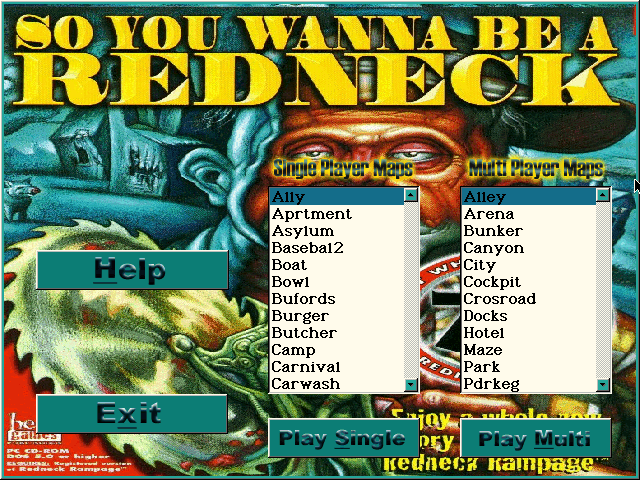
A common modern technical headache occurs when modern players try to configure the disc through DOSBox, only to receive errors claiming that the disc directory contains no executable files. This happens because the disc installer relied on a Windows launcher wrapper to unpack content into the primary installation directory rather than housing a plain DOS executable directly on the root level.
You do not need to wrestle with configuration files or mount mount points to explore this compilation today. You can play So You Wanna Be A Redneck free in your browser right now with no setup required. If you want to experience the peak of late-nineties community map contests, hop in, pick up a double-barrel shotgun, and test your skills against 75 levels of unrefined retro action.
Players' controls
Touch and gamepad controls
The on-screen keyboard and gamepad mapping the browser player uses on a phone, a tablet or a controller, as opposed to the real keys above. $PRO members make their own in the player and share them here; anyone can pick one to play with.
Make your own touch controlsPRO
- 1Open the editorSign in below, then pick what to make. The game starts with the editor open over it.
- 2Place your keysAdd keys and drag them where your thumbs rest, or map a controller's buttons. Test plays the game with them; Save keeps them, and you play with them from then on.
- 3Share themShare them right after saving in the game, or name and share them here. Players vote, and the best become this game's controls for everyone.
Go PROSee how it worksSign in+20 XP for sharing · +50 XP if yours become the game's own
- The game's own controlsNone yet: played with a real keyboard only.In use
2 screenshots
From the archive
No gameplay video yet
No gameplay video for So You Wanna Be A Redneck yet. Sign in to add one.
No reviews yet
Tell the community what you think of So You Wanna Be A Redneck. Reviews are public and tied to your username.
No archived manuals for So You Wanna Be A Redneck yet
No manuals archived for this title yet. Sign in to upload the first scan.
Cheat codes, console commands and memory pokes for So You Wanna Be A Redneck — each one verified and attributed.
Sign in to submitNo cheats yet for this title
Know a working cheat, poke or trainer? Add it with the button above. Moderators check every entry before it goes live.
No archived soundtrack for So You Wanna Be A Redneck yet
No soundtrack archived for this title yet. Sign in to upload the first rip.
No save states for So You Wanna Be A Redneck yet
No save states for this title yet. Sign in to share one.
Discussions
Sign in to post- Threads0
- Total posts0
- Online now6
Community · So You Wanna Be A Redneck
Who's contributing, and what's new
- Reviews0
- Threads0
- Uploadsapproved0
- Contributors0
Recent activity