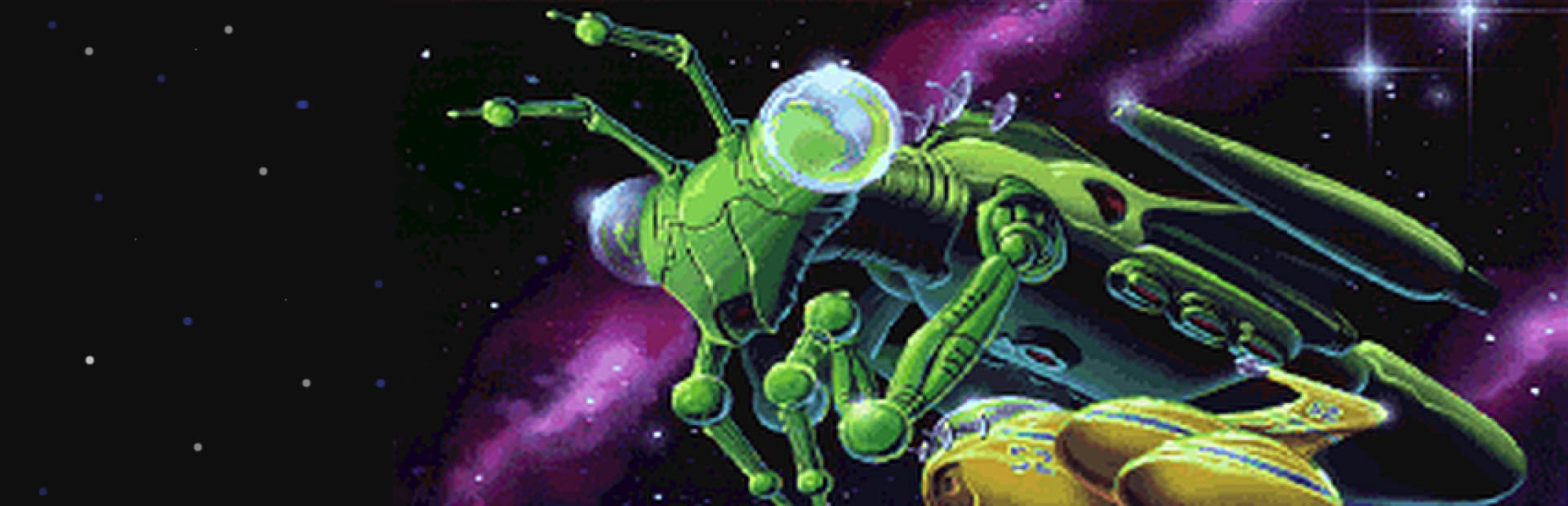
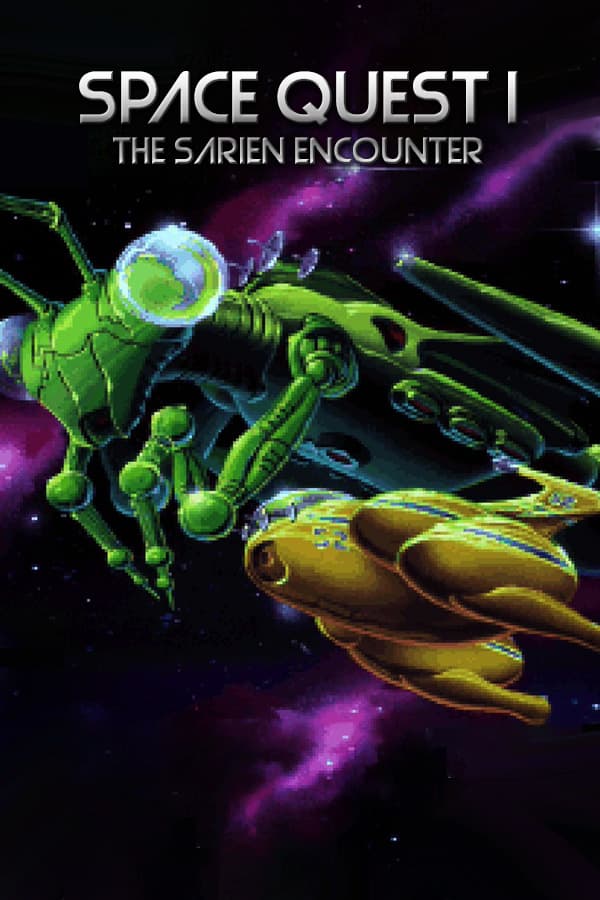
If you leave Roger Wilco standing in a closet for too long, you might miss the moment the ship is invaded in Space Quest I: The Sarien Encounter, but waking up to dead scientists and a fifteen-minute self-destruct timer quickly gets your attention.
You begin the game as a low-ranking janitor asleep on the research starship Arcada. The moment you step into the hallway, the blare of the alarm and the bodies of your crewmates make the situation clear: the evil Sarien race has boarded the vessel, slaughtered everyone in sight, and stolen the Star Generator. You have fifteen minutes of real time to navigate the ship, gather key cards, locate an escape pod, and leave before the Arcada explodes.
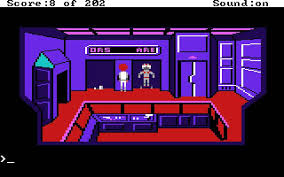
Movement uses the keyboard arrow keys or a joystick to direct Roger across Sierra's flip-screen rooms, while commands are typed directly into a text parser. The AGI engine running the 1986 release renders everything in bright 16-color CGA or EGA graphics, accompanied by the chirps and bleeps of the standard PC speaker. Solving early puzzles requires checking every corpse, picking up essential item cards, and making sure you do not wander directly into the path of a Sarien guard's laser blast.
Death comes frequently and without warning. If you forget to save every few minutes, a single misstep or a slow command typing entry forces you back to the title screen. This aggressive lethal loop sets the tone for the entire adventure, balancing slapstick death animations against strict, time-sensitive survival puzzles.
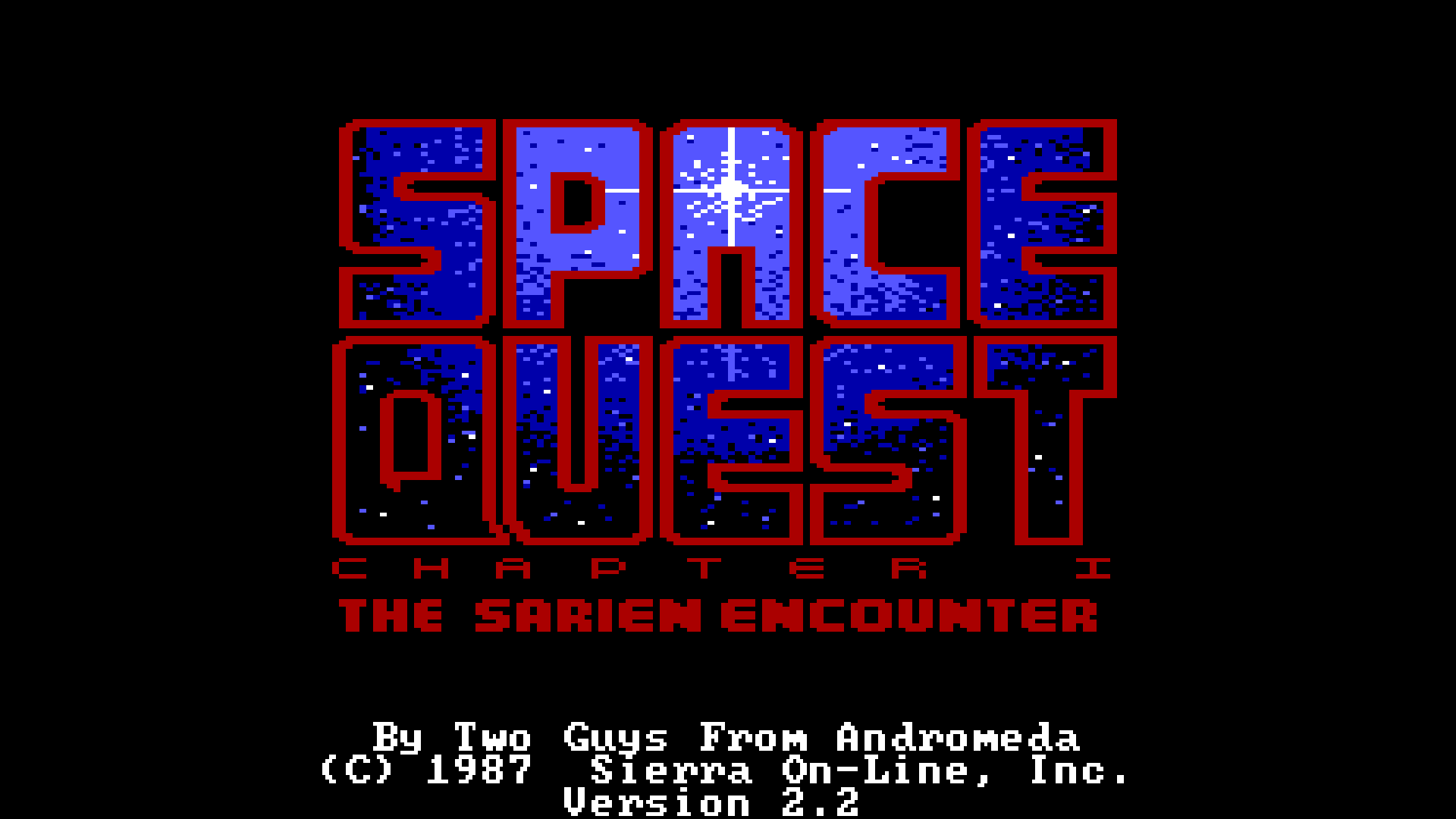
The project was designed and written by Sierra programmers Scott Murphy and Mark Crowe, who branded themselves the "Two Guys from Andromeda." Wanting to break away from the heavy, high-fantasy tone of King's Quest, they pitched a sci-fi comedy focused on an incompetent underdog. Sierra On-Line backed the concept, letting them weave absurd pop-culture nods and meta-humor directly into the narrative logic.
Players who explore every obscure corner of the game world find several famous easter eggs hidden by the pair. Typing "scott" or "scott murphy" into the parser triggers a secret text response directly from the designer. In the settlement of Ulence Flats, walking behind the droid shop and typing "take leak" rewards you with hidden currency and a juvenile joke. That same store caused real-world headaches when corporate giant Toys "R" Us threatened Sierra with legal action over the original store name "Droids-R-Us," forcing later disk shipments to alter the sign to "Droids-B-Us."
Pop culture references run rampant throughout the planetary settlement. Inside the local Rocket Bar, pixelated caricatures of ZZ Top and The Blues Brothers perform on stage while you search for local contacts. These offbeat touches helped make the title a massive commercial hit, pushing sales beyond 100,000 units shortly after launch and eventually exceeding 200,000 copies.
After escaping the Arcada, you crash-land on the arid planet Kerona, where the game shifts from quiet spatial survival to brutal execution traps. You must trek across the desert, avoid giant sand worms, locate a subterranean settlement, and secure a sand skimmer vehicle. The skimmer sequence is notoriously frustrating even for early adventure games. Steering the vehicle across the desert grid requires dodging rock formations at high speed, where a single pixel collision results in instant fiery death.
Once you reach Ulence Flats, the mechanical pacing stumbles again at the local slot machine. To progress, you need enough local buckazoids to buy a spaceship and a navigation droid. Because normal puzzle rewards do not provide enough funds, you are forced to sit at a gambling machine, repeatedly press keys, and save and reload until you hit the jackpot. It turns a clever comedic premise into a slow, luck-based grind.
The final act on the Sarien battlecruiser Deltaur recovers the momentum. Infiltrating the flagship requires you to acquire a translator beam, steal a Sarien armor suit as a disguise, and navigate the hallways undetected. Positioning yourself correctly to drop a gas grenade down an elevator shaft or tricking security bots displays the clever lateral thinking that makes the high risk of death worthwhile.
Compared to other releases from the mid-eighties like Space Quest I: The Sarien Encounter, the game succeeds because it never takes its space-opera setting seriously. While contemporary titles demanded strict logic and punished simple mistakes with total dead ends, Roger Wilco's misadventures keep you invested through sheer slapstick charm and sharp written responses to bizarre commands.
The core design certainly shows its age in the unforgiving arcade minigames and the need for constant file saving. Yet the atmosphere, punchy parser responses, and memorable set pieces carry the experience forward. If you want to sample the golden age of text-parser design, this Space Quest I: The Sarien Encounter MS-DOS game is worth playing if you appreciate retro gaming history.
You can play Space Quest I: The Sarien Encounter online free in your browser right here, with no extra software required. Fire up the escape pod, keep your fingers ready on the save key, and spend ten minutes trying to outsmart a Sarien battlecruiser on your lunch break.
If you leave Roger Wilco standing in a closet for too long, you might miss the moment the ship is invaded in Space Quest I: The Sarien Encounter, but waking up to dead scientists and a fifteen-minute self-destruct timer quickly gets your attention.
You begin the game as a low-ranking janitor asleep on the research starship Arcada. The moment you step into the hallway, the blare of the alarm and the bodies of your crewmates make the situation clear: the evil Sarien race has boarded the vessel, slaughtered everyone in sight, and stolen the Star Generator. You have fifteen minutes of real time to navigate the ship, gather key cards, locate an escape pod, and leave before the Arcada explodes.
Movement uses the keyboard arrow keys or a joystick to direct Roger across Sierra's flip-screen rooms, while commands are typed directly into a text parser. The AGI engine running the 1986 release renders everything in bright 16-color CGA or EGA graphics, accompanied by the chirps and bleeps of the standard PC speaker. Solving early puzzles requires checking every corpse, picking up essential item cards, and making sure you do not wander directly into the path of a Sarien guard's laser blast.
Death comes frequently and without warning. If you forget to save every few minutes, a single misstep or a slow command typing entry forces you back to the title screen. This aggressive lethal loop sets the tone for the entire adventure, balancing slapstick death animations against strict, time-sensitive survival puzzles.
The project was designed and written by Sierra programmers Scott Murphy and Mark Crowe, who branded themselves the "Two Guys from Andromeda." Wanting to break away from the heavy, high-fantasy tone of King's Quest, they pitched a sci-fi comedy focused on an incompetent underdog. Sierra On-Line backed the concept, letting them weave absurd pop-culture nods and meta-humor directly into the narrative logic.
Players who explore every obscure corner of the game world find several famous easter eggs hidden by the pair. Typing "scott" or "scott murphy" into the parser triggers a secret text response directly from the designer. In the settlement of Ulence Flats, walking behind the droid shop and typing "take leak" rewards you with hidden currency and a juvenile joke. That same store caused real-world headaches when corporate giant Toys "R" Us threatened Sierra with legal action over the original store name "Droids-R-Us," forcing later disk shipments to alter the sign to "Droids-B-Us."
Pop culture references run rampant throughout the planetary settlement. Inside the local Rocket Bar, pixelated caricatures of ZZ Top and The Blues Brothers perform on stage while you search for local contacts. These offbeat touches helped make the title a massive commercial hit, pushing sales beyond 100,000 units shortly after launch and eventually exceeding 200,000 copies.
After escaping the Arcada, you crash-land on the arid planet Kerona, where the game shifts from quiet spatial survival to brutal execution traps. You must trek across the desert, avoid giant sand worms, locate a subterranean settlement, and secure a sand skimmer vehicle. The skimmer sequence is notoriously frustrating even for early adventure games. Steering the vehicle across the desert grid requires dodging rock formations at high speed, where a single pixel collision results in instant fiery death.
Once you reach Ulence Flats, the mechanical pacing stumbles again at the local slot machine. To progress, you need enough local buckazoids to buy a spaceship and a navigation droid. Because normal puzzle rewards do not provide enough funds, you are forced to sit at a gambling machine, repeatedly press keys, and save and reload until you hit the jackpot. It turns a clever comedic premise into a slow, luck-based grind.
The final act on the Sarien battlecruiser Deltaur recovers the momentum. Infiltrating the flagship requires you to acquire a translator beam, steal a Sarien armor suit as a disguise, and navigate the hallways undetected. Positioning yourself correctly to drop a gas grenade down an elevator shaft or tricking security bots displays the clever lateral thinking that makes the high risk of death worthwhile.
Compared to other releases from the mid-eighties like Space Quest I: The Sarien Encounter, the game succeeds because it never takes its space-opera setting seriously. While contemporary titles demanded strict logic and punished simple mistakes with total dead ends, Roger Wilco's misadventures keep you invested through sheer slapstick charm and sharp written responses to bizarre commands.
The core design certainly shows its age in the unforgiving arcade minigames and the need for constant file saving. Yet the atmosphere, punchy parser responses, and memorable set pieces carry the experience forward. If you want to sample the golden age of text-parser design, this Space Quest I: The Sarien Encounter MS-DOS game is worth playing if you appreciate retro gaming history.
You can play Space Quest I: The Sarien Encounter online free in your browser right here, with no extra software required. Fire up the escape pod, keep your fingers ready on the save key, and spend ten minutes trying to outsmart a Sarien battlecruiser on your lunch break.
How Space Quest I: The Sarien Encounter is played — the keys the game listens to, grouped by what they do.
Highlighted keys are mapped — hover or tap one to see what it does.
A joystick can be used for movement and requires calibration with Ctrl-J.
The on-screen keyboard and gamepad mapping the browser player uses on a phone, a tablet or a controller, as opposed to the real keys above. $PRO members make their own in the player and share them here; anyone can pick one to play with.
Cheat codes, console commands and memory pokes for Space Quest I: The Sarien Encounter — each one verified and attributed.
Sign in to submitCheat codes, console commands and memory pokes for Space Quest I: The Sarien Encounter — each one verified and attributed.
Sign in to submit