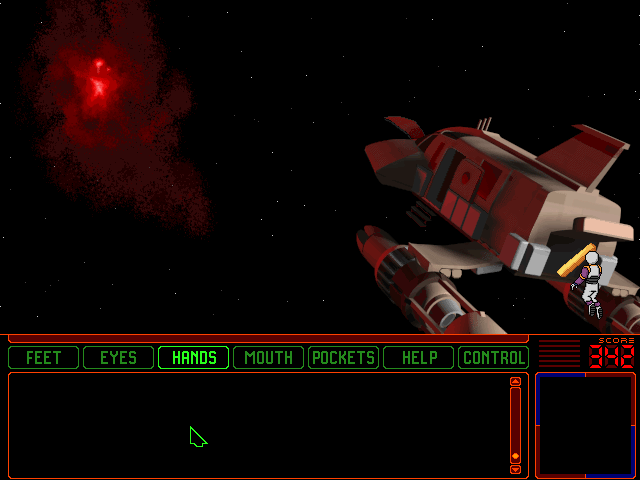
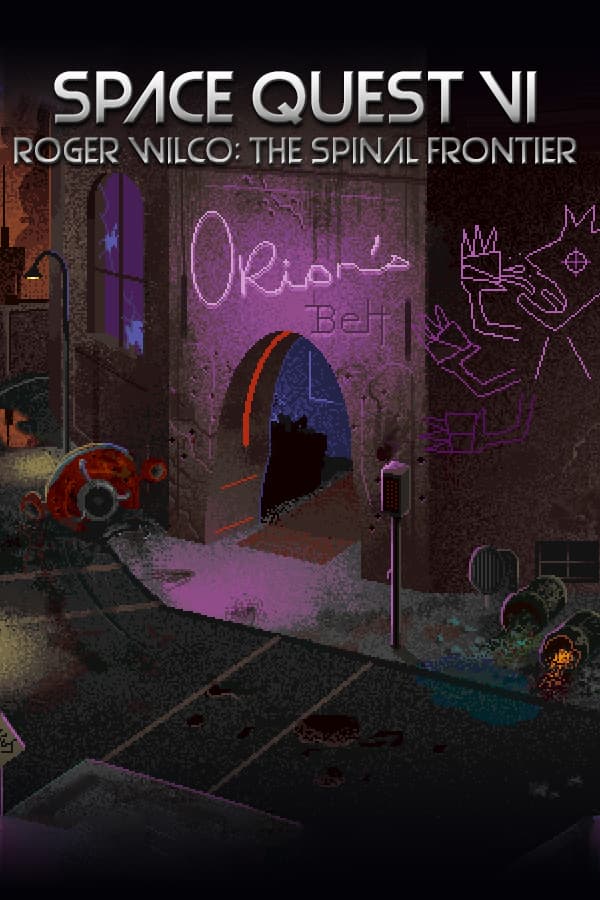

Space Quest VI: Roger Wilco in the Spinal Frontier takes Sierra's famous janitor out of his customary hero role and throws him right back down to second-class deck-scrubber aboard the SCS DeepShip 86.
The game opens with Roger Wilco suffering a court-martial for his past heroics, stripped of his honours and assigned to the lowest ranks of the SCS DeepShip 86. What begins as routine janitorial humiliation quickly spirals when Roger visits the neon-drenched planet of Polysorbate LX, gets entangled in a kidnapping, and stumbles across a sinister conspiracy known as Project Immortality led by the ancient villain Sharpei. To save his crewmate Stellar Santiago from killer nanites, Roger has to use miniaturisation technology and travel directly inside her body, solving organic puzzles across her stomach, esophagus, and brain.
Sierra built this 1995 adventure on their upgraded SCI32 engine, pushing the visuals to crisp 640x480 SVGA resolutions. The traditional icon bar gave way to a bottom-screen verb bar that clearly borrowed design cues from LucasArts' SCUMM interface. Returning narrator Gary Owens delivers every line with smooth radio-announcer deadpan, which keeps the tone breezy even when the narrative stumbles. The physical game box even came packaged with "The Popular Janitronics," a satirical magazine filled with world-building jokes that doubled as an anti-piracy manual check.
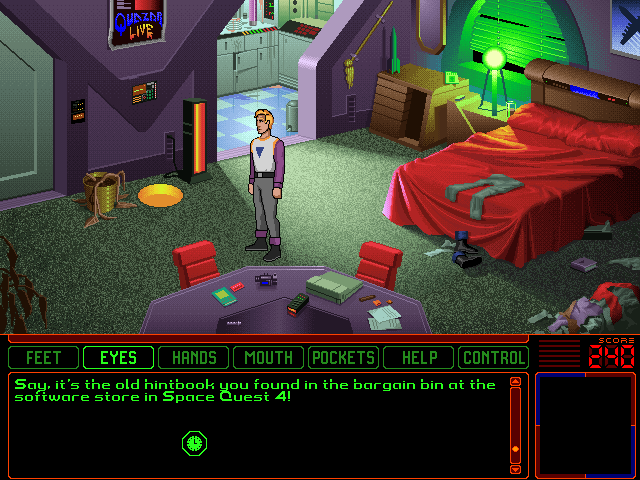
The development of Space Quest VI: Roger Wilco in the Spinal Frontier was famously rocky. Original co-creator Scott Murphy initially served as a consultant while Josh Mandel took charge of writing and primary design. Mandel was forced out mid-way through production due to internal disputes at Sierra On-Line, Inc., leaving Murphy to finish the project. The draft working title, Where in Corpsman Santiago is Roger Wilco?, also had to be dropped after legal threats from the copyright owners of the Carmen Sandiego franchise.
You can feel that mid-game handover in the inventory logic. Early chapters on Polysorbate LX rely on familiar point-and-click gathering, like scrounging for buckazoids, testing an arcade cabinet called Stooge Fighter 3, or using your Datacorder to scan for Droidium. Once Roger shrinks and enters Stellar's internal organs, however, the structure shifts toward bizarre biological interactions that feel disconnected from earlier clues. Modern retrospectives, including a 2/5 from Adventure Gamers, hit hard on this jarring shift, pointing out how late-game puzzles abandon logical setup for brute-force experimentation.
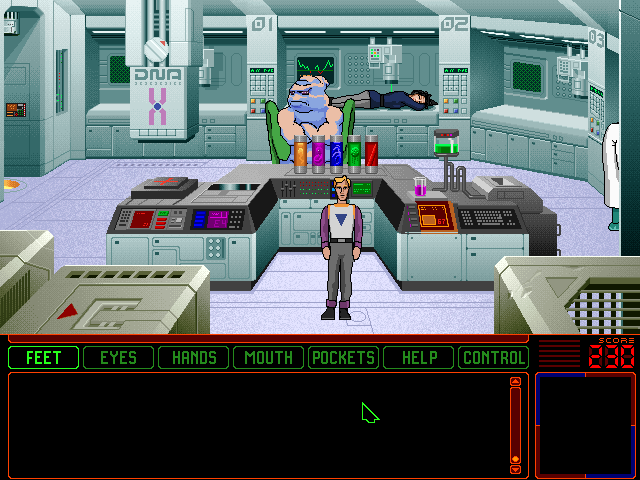
When Sierra released this 1995 release, period magazines gave it respectable scores: Computer Gaming World rated it 3/5, while French magazine Joystick awarded it 70%. Yet even then, reviewers noted that while background art looked clean, some locations felt sterile and devoid of interactive depth. Crucially, the reliance on endless slapstick bodily harm directed at Roger began to wear thin for players who wanted clever banter over repeated slapstick demotions.
Running the original Space Quest VI: Roger Wilco in the Spinal Frontier MS-DOS game on original mid-nineties hardware introduced severe processor glitches. Modern users running high-speed CPUs routinely encounter the infamous "Could not open robot resource 410" error during specific cutscenes. Another recurring problem involves fast subtitle playback, where dialog text flies across the screen at unreadable speeds if digital audio timing isn't locked down properly.
Despite its production troubles, the game succeeds on pure visual style and vocal delivery. Gary Owens brings high energy to every single description, turning mundane object hunting into a Saturday morning cartoon. If you enjoy classic mid-nineties Sierra productions, the early chapters offer plenty of solid humor and visual gags that sit easily alongside contemporaries like Full Throttle.
You can play Space Quest VI: Roger Wilco in the Spinal Frontier online directly in your browser without tracking down setup files or patching resource bugs. You can experience Space Quest VI: Roger Wilco in the Spinal Frontier free in your browser, complete with full SVGA graphics and digital voice acting intact. Boot it up, scan your first room for Droidium, and enjoy one of Sierra's most visually ambitious comedy adventures.
Space Quest VI: Roger Wilco in the Spinal Frontier takes Sierra's famous janitor out of his customary hero role and throws him right back down to second-class deck-scrubber aboard the SCS DeepShip 86.
The game opens with Roger Wilco suffering a court-martial for his past heroics, stripped of his honours and assigned to the lowest ranks of the SCS DeepShip 86. What begins as routine janitorial humiliation quickly spirals when Roger visits the neon-drenched planet of Polysorbate LX, gets entangled in a kidnapping, and stumbles across a sinister conspiracy known as Project Immortality led by the ancient villain Sharpei. To save his crewmate Stellar Santiago from killer nanites, Roger has to use miniaturisation technology and travel directly inside her body, solving organic puzzles across her stomach, esophagus, and brain.
Sierra built this 1995 adventure on their upgraded SCI32 engine, pushing the visuals to crisp 640x480 SVGA resolutions. The traditional icon bar gave way to a bottom-screen verb bar that clearly borrowed design cues from LucasArts' SCUMM interface. Returning narrator Gary Owens delivers every line with smooth radio-announcer deadpan, which keeps the tone breezy even when the narrative stumbles. The physical game box even came packaged with "The Popular Janitronics," a satirical magazine filled with world-building jokes that doubled as an anti-piracy manual check.
The development of Space Quest VI: Roger Wilco in the Spinal Frontier was famously rocky. Original co-creator Scott Murphy initially served as a consultant while Josh Mandel took charge of writing and primary design. Mandel was forced out mid-way through production due to internal disputes at Sierra On-Line, Inc., leaving Murphy to finish the project. The draft working title, Where in Corpsman Santiago is Roger Wilco?, also had to be dropped after legal threats from the copyright owners of the Carmen Sandiego franchise.
You can feel that mid-game handover in the inventory logic. Early chapters on Polysorbate LX rely on familiar point-and-click gathering, like scrounging for buckazoids, testing an arcade cabinet called Stooge Fighter 3, or using your Datacorder to scan for Droidium. Once Roger shrinks and enters Stellar's internal organs, however, the structure shifts toward bizarre biological interactions that feel disconnected from earlier clues. Modern retrospectives, including a 2/5 from Adventure Gamers, hit hard on this jarring shift, pointing out how late-game puzzles abandon logical setup for brute-force experimentation.
When Sierra released this 1995 release, period magazines gave it respectable scores: Computer Gaming World rated it 3/5, while French magazine Joystick awarded it 70%. Yet even then, reviewers noted that while background art looked clean, some locations felt sterile and devoid of interactive depth. Crucially, the reliance on endless slapstick bodily harm directed at Roger began to wear thin for players who wanted clever banter over repeated slapstick demotions.
Running the original Space Quest VI: Roger Wilco in the Spinal Frontier MS-DOS game on original mid-nineties hardware introduced severe processor glitches. Modern users running high-speed CPUs routinely encounter the infamous "Could not open robot resource 410" error during specific cutscenes. Another recurring problem involves fast subtitle playback, where dialog text flies across the screen at unreadable speeds if digital audio timing isn't locked down properly.
Despite its production troubles, the game succeeds on pure visual style and vocal delivery. Gary Owens brings high energy to every single description, turning mundane object hunting into a Saturday morning cartoon. If you enjoy classic mid-nineties Sierra productions, the early chapters offer plenty of solid humor and visual gags that sit easily alongside contemporaries like Full Throttle.
You can play Space Quest VI: Roger Wilco in the Spinal Frontier online directly in your browser without tracking down setup files or patching resource bugs. You can experience Space Quest VI: Roger Wilco in the Spinal Frontier free in your browser, complete with full SVGA graphics and digital voice acting intact. Boot it up, scan your first room for Droidium, and enjoy one of Sierra's most visually ambitious comedy adventures.
How Space Quest VI: Roger Wilco in the Spinal Frontier is played — the keys the game listens to, grouped by what they do.
Highlighted keys are mapped — hover or tap one to see what it does.
Key remapping is available via SETUP.EXE or DOSBox Mapper. Original keyboard shortcut map could not be fully verified in textual manual archives.
The on-screen keyboard and gamepad mapping the browser player uses on a phone, a tablet or a controller, as opposed to the real keys above. $PRO members make their own in the player and share them here; anyone can pick one to play with.
Cheat codes, console commands and memory pokes for Space Quest VI: Roger Wilco in the Spinal Frontier — each one verified and attributed.
Sign in to submitHow Space Quest VI: Roger Wilco in the Spinal Frontier is played — the keys the game listens to, grouped by what they do.
Highlighted keys are mapped — hover or tap one to see what it does.
Key remapping is available via SETUP.EXE or DOSBox Mapper. Original keyboard shortcut map could not be fully verified in textual manual archives.
The on-screen keyboard and gamepad mapping the browser player uses on a phone, a tablet or a controller, as opposed to the real keys above. $PRO members make their own in the player and share them here; anyone can pick one to play with.
Cheat codes, console commands and memory pokes for Space Quest VI: Roger Wilco in the Spinal Frontier — each one verified and attributed.
Sign in to submit