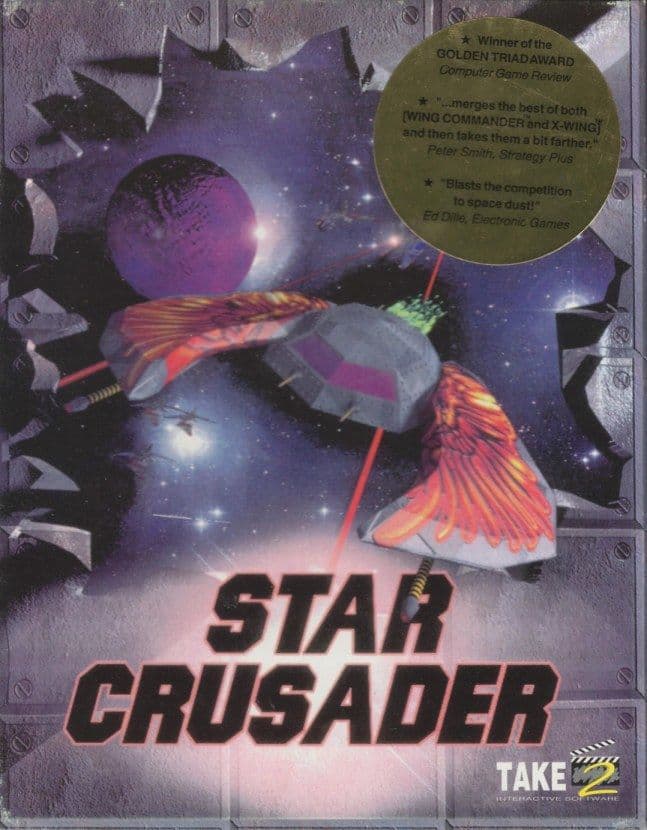
Flying space combat missions across the Ascalon Rift in Star Crusader gives you over a hundred branch-heavy sorties, full wingman management, and the rare choice to betray your own empire mid-campaign.
You begin in the boots of Roman Alexandria, an imperial fighter pilot stationed on the frontline of the Ascalon Rift. Strap into the first-person cockpit and the instrumentation takes over: shield monitors, engine throttles, target locks, and a communications suite for issuing direct wingman orders. Rather than forcing you down a rigid linear corridor, this 1994 space simulation game hands you a sprawling campaign of 104 missions that cover everything from fast-paced dogfighting and bomber escort duty to capturing enemy freighters and sneaking through stealth reconnaissance sweeps.
Target management is central to surviving every dogfight. You cycle through hostile fighters, order your wingmen to target specific ships or fall back, and monitor secondary systems while watching capital ships trade heavy laser fire. The mission variety keeps you busy, but combat exposes a flaw in how the game models flight. Ships stop on a dime the moment you cut the throttle, lacking the drift or momentum you expect in space combat, which leaves dogfights feeling slightly static once you get used to the movement.
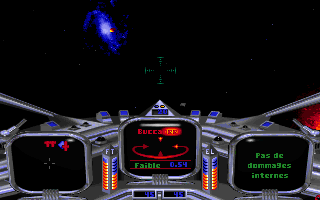
On release, the visual engine built by programmer Glenn A. Dill pushed serious hardware requirements for an MS-DOS title from 1994. Running at high SVGA resolutions, Star Crusader filled the screen with Gouraud-shaded spacecraft and fully texture-mapped capital ships. Pushing those detailed 3D models required a 386SX processor running at 20 MHz, 8 MB of RAM, and 30 MB of precious hard drive space. Played through a Sound Blaster card, the hum of engine drives and digitized explosion rumbles gave the dogfights real weight.
Yet that visual polish came with trade-offs in combat execution. Period reviews picked up on the contrast immediately. Next Generation Magazine called out the flight model for lacking originality while praising its deep structure, noting it delivered the depth of Wing Commander III without the excessive cinematic fluff. At the same time, players noticed that enemy craft would occasionally pop directly into view or execute bizarre evasive loops, making enemy AI feel erratic during heavy dogfights.
What sets the campaign apart is the decision to let you abandon the Gorene Empire entirely. Mid-way through the conflict, you can choose to defect to the rebel alliance representing five native Rift species. Switching sides completely changes your available hardware and craft:
As the conflict escalates into its late stages, the game shifts perspective from pure dogfighting to high-level carrier management. A strategic map screen opens up, tasking you with assigning pilots to strike packages, managing green recruits coming out of flight school, and coordinating multi-phase fleet assaults. If you want to test those heavy strike craft without risking your campaign pilot, the manual includes simulator cheat combinations: pressing Ctrl+R fully resupplies your ordnance with 99 torpedoes, while Shift+Tab toggles complete invulnerability.
Written and directed by F. J. Lennon alongside co-designers Ryan Ashley Brant, Glenn A. Dill, Rick Hall, and Mark E. Seremet, this project from Take-Two Interactive Software, Inc. and GameTek, Inc. earned Computer Game Review's Golden Triad Award for its sheer structural ambition. The static brief delivery and floaty physics keep it from absolute perfection, but the massive 104-mission scope and defection mechanics mean there is genuine substance behind the cockpit glass.
You can play Star Crusader online right here, running the full Star Crusader MS-DOS game directly in your web browser with no setup required. Modern players often expect a standard linear shooter, but remember to check your wingman controls early on: letting your flight group split targets is the only way you will survive the heavier rebel fleet ambushes.
Flying space combat missions across the Ascalon Rift in Star Crusader gives you over a hundred branch-heavy sorties, full wingman management, and the rare choice to betray your own empire mid-campaign.
You begin in the boots of Roman Alexandria, an imperial fighter pilot stationed on the frontline of the Ascalon Rift. Strap into the first-person cockpit and the instrumentation takes over: shield monitors, engine throttles, target locks, and a communications suite for issuing direct wingman orders. Rather than forcing you down a rigid linear corridor, this 1994 space simulation game hands you a sprawling campaign of 104 missions that cover everything from fast-paced dogfighting and bomber escort duty to capturing enemy freighters and sneaking through stealth reconnaissance sweeps.
Target management is central to surviving every dogfight. You cycle through hostile fighters, order your wingmen to target specific ships or fall back, and monitor secondary systems while watching capital ships trade heavy laser fire. The mission variety keeps you busy, but combat exposes a flaw in how the game models flight. Ships stop on a dime the moment you cut the throttle, lacking the drift or momentum you expect in space combat, which leaves dogfights feeling slightly static once you get used to the movement.
On release, the visual engine built by programmer Glenn A. Dill pushed serious hardware requirements for an MS-DOS title from 1994. Running at high SVGA resolutions, Star Crusader filled the screen with Gouraud-shaded spacecraft and fully texture-mapped capital ships. Pushing those detailed 3D models required a 386SX processor running at 20 MHz, 8 MB of RAM, and 30 MB of precious hard drive space. Played through a Sound Blaster card, the hum of engine drives and digitized explosion rumbles gave the dogfights real weight.
Yet that visual polish came with trade-offs in combat execution. Period reviews picked up on the contrast immediately. Next Generation Magazine called out the flight model for lacking originality while praising its deep structure, noting it delivered the depth of Wing Commander III without the excessive cinematic fluff. At the same time, players noticed that enemy craft would occasionally pop directly into view or execute bizarre evasive loops, making enemy AI feel erratic during heavy dogfights.
What sets the campaign apart is the decision to let you abandon the Gorene Empire entirely. Mid-way through the conflict, you can choose to defect to the rebel alliance representing five native Rift species. Switching sides completely changes your available hardware and craft:
As the conflict escalates into its late stages, the game shifts perspective from pure dogfighting to high-level carrier management. A strategic map screen opens up, tasking you with assigning pilots to strike packages, managing green recruits coming out of flight school, and coordinating multi-phase fleet assaults. If you want to test those heavy strike craft without risking your campaign pilot, the manual includes simulator cheat combinations: pressing Ctrl+R fully resupplies your ordnance with 99 torpedoes, while Shift+Tab toggles complete invulnerability.
Written and directed by F. J. Lennon alongside co-designers Ryan Ashley Brant, Glenn A. Dill, Rick Hall, and Mark E. Seremet, this project from Take-Two Interactive Software, Inc. and GameTek, Inc. earned Computer Game Review's Golden Triad Award for its sheer structural ambition. The static brief delivery and floaty physics keep it from absolute perfection, but the massive 104-mission scope and defection mechanics mean there is genuine substance behind the cockpit glass.
You can play Star Crusader online right here, running the full Star Crusader MS-DOS game directly in your web browser with no setup required. Modern players often expect a standard linear shooter, but remember to check your wingman controls early on: letting your flight group split targets is the only way you will survive the heavier rebel fleet ambushes.
How Star Crusader is played — the keys the game listens to, grouped by what they do.
Highlighted keys are mapped — hover or tap one to see what it does.
Game configuration, audio, and controls can be configured by running SETUP.EXE.
The on-screen keyboard and gamepad mapping the browser player uses on a phone, a tablet or a controller, as opposed to the real keys above. $PRO members make their own in the player and share them here; anyone can pick one to play with.
Cheat codes, console commands and memory pokes for Star Crusader — each one verified and attributed.
Sign in to submitHow Star Crusader is played — the keys the game listens to, grouped by what they do.
Highlighted keys are mapped — hover or tap one to see what it does.
Game configuration, audio, and controls can be configured by running SETUP.EXE.
The on-screen keyboard and gamepad mapping the browser player uses on a phone, a tablet or a controller, as opposed to the real keys above. $PRO members make their own in the player and share them here; anyone can pick one to play with.
Cheat codes, console commands and memory pokes for Star Crusader — each one verified and attributed.
Sign in to submit