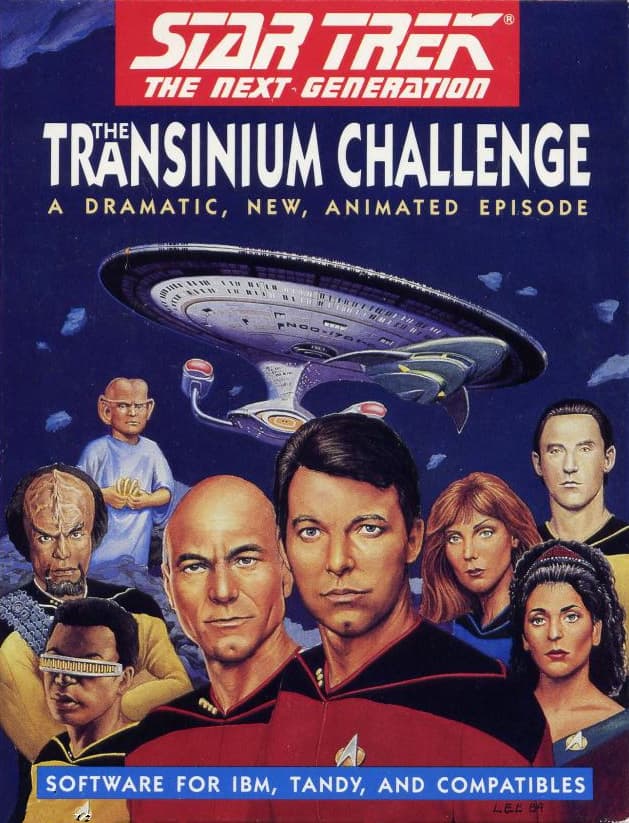
Star Trek: The Next Generation - The Transinium Challenge
Checking…
Taking control of Commander William T. Riker in Star Trek: The Next Generation - The Transinium Challenge meant trading text prompts for context buttons while investigating a terrorist strike on the Aquila station. Instead of wrestling with a parser, you direct the crew through icon-driven menus to analyze alien ruins and uncover why children are wandering the planet's surface.
When Star Trek: The Next Generation - The Transinium Challenge swapped text parsers for action buttons
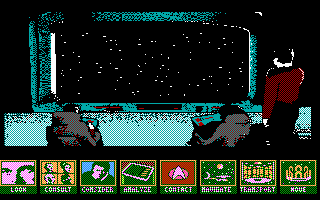
The game kicks off with urgency. An allied outpost in the Aquila Star System has suffered a brutal attack, and Starfleet sends the USS Enterprise to figure out who hit it and why. Rather than typing commands like in traditional text adventures, you navigate this mystery by clicking through action options at the bottom of the screen. You click Consider to inspect items in your inventory, beam down to explore planets and outposts like D-39, or use Analyze to let the ship's computer make sense of the evidence you find in ancient ruins.
When you need tactical or scientific input, you hit Conference to gather your senior officers in the observation lounge. The game pulls up digitized portraits of the television cast to share their thoughts on your current findings. Sitting across from pixelated renderings of Captain Picard, Data, and Geordi La Forge makes you feel like you are running an actual staff meeting on the flagship. In 1989, seeing the real cast recreated on a PC display was a huge selling point, even if their expressions were locked into brief, repeating animation frames.
The actual puzzle solving relies heavily on logical deduction rather than trial and error. As Riker, you spend your time hopping between space navigation, tactical evaluations, and landing party assignments. Exploring the Velura mining outpost brings you face to face with local characters, including a stressed-out assistant named Mr. Smith who does nothing but complain about his job. Progress depends on gathering clues from these conversations, bringing physical evidence back to the ship, and having your department heads break down the data until the larger picture comes into view.
Pixelated monochrome graphics and the lost promise of digitized crew portraits
While the mechanical premise of button-driven gameplay felt accessible, the technical presentation was a hurdle for players even on release. Developed by TRANS Fiction Systems and published by Simon & Schuster Interactive, the project attempted to squeeze high-resolution digitized photos onto IBM-compatible PCs. The result on screen was stark, high-contrast monochrome graphics that turned detailed sets into rough patterns of black and white pixels.
The prose carries the atmospheric weight that the visual art struggles to maintain. Scenario writer Scott Bechtold and co-designer Cindy Shapiro wrote detailed descriptive paragraphs that give the ruined Aquilan architecture and deep-space outposts genuine texture. When you arrive at a landing site, reading the terminal screens and location descriptions paints a clear picture of an ancient, lost civilization. It feels much closer to reading a solid tie-in novel than watching an episode of the show.
Compared to other adventure games released in 1989, the visual engine felt severely restricted. While contemporary PC titles were moving into 16-color EGA and early VGA palettes, this presentation remained stuck in low-color display modes with minimal motion. You watch the same short graphics loops repeat while reading long blocks of narrative text, which means your imagination has to do most of the heavy lifting during away missions.
The ghost of Mr. Smith haunts the Enterprise lounge
The most famous flaw in the design is a logic bug that fans have discussed for decades. When you meet Mr. Smith at the Velura mining outpost, Starfleet protocol prevents you from beaming him aboard the Enterprise. He remains on the surface, grumbling about his work environment. Yet if you head straight to the observation lounge and open up crew conference topics, Picard and the rest of the staff speak as if Smith is wandering the corridors of your ship.
Your senior officers will actively complain that "he is constantly getting in the way" and urge you to "get rid of that man" immediately. It creates a surreal situation where your entire staff is plagued by an invisible passenger who legally never left the planet below. This bug highlighted the difficulty of tracking complex narrative flags in early adventure game code, leaving players wondering if they had missed a crucial story event or broken the mission sequence.
Despite these logic glitches, the core design team under director Ron Martinez built a distinct framework for sci-fi investigations. The production credited Angela Greene for art direction, Amy Goldman for graphics production, and Gregory Guerin alongside Shapiro for programming. Their effort laid down early ideas for how a narrative simulation could work on desktop computers without forcing players to memorize arbitrary parser verbs.
Where Star Trek: The Next Generation - The Transinium Challenge leaves classic Trek fans today
Looking back at the physical manual and packaging reveals another curious piece of trivia: a bold advertisement for a planned sequel titled Star Trek: A Hostage to Reason. That follow-up game was cancelled before it ever reached store shelves, leaving this release as a standalone experiment. It came out right when software houses were still testing how to adapt televised sci-fi into interactive software.
To enjoy a playthrough today, you have to meet the game on its own terms and accept its stark visuals. The strength of the release lies in its heavy emphasis on procedure, ship operations, and reading detailed planetary reports. If you go into it expecting action-heavy phaser battles, you will be disappointed, but if you enjoy methodically gathering clues and managing away-team findings from the captain's chair, the narrative holds up.
You can play Star Trek: The Next Generation - The Transinium Challenge online, free in your browser right now, with nothing to install and no setup required. If you want to experience the early DOS era of Starfleet adventure design, take command of Commander Riker, open the observation lounge, and see if you can resolve the Aquila station mystery without getting baffled by the ship's phantom civilian passenger.
Players' controls
Touch and gamepad controls
The on-screen keyboard and gamepad mapping the browser player uses on a phone, a tablet or a controller, as opposed to the real keys above. $PRO members make their own in the player and share them here; anyone can pick one to play with.
Make your own touch controlsPRO
- 1Open the editorSign in below, then pick what to make. The game starts with the editor open over it.
- 2Place your keysAdd keys and drag them where your thumbs rest, or map a controller's buttons. Test plays the game with them; Save keeps them, and you play with them from then on.
- 3Share themShare them right after saving in the game, or name and share them here. Players vote, and the best become this game's controls for everyone.
Go PROSee how it worksSign in+20 XP for sharing · +50 XP if yours become the game's own
- The game's own controlsNone yet: played with a real keyboard only.In use
2 screenshots
From the archive
No gameplay video yet
No gameplay video for Star Trek: The Next Generation - The Transinium Challenge yet. Sign in to add one.
No reviews yet
Tell the community what you think of Star Trek: The Next Generation - The Transinium Challenge. Reviews are public and tied to your username.
No archived manuals for Star Trek: The Next Generation - The Transinium Challenge yet
No manuals archived for this title yet. Sign in to upload the first scan.
Cheat codes, console commands and memory pokes for Star Trek: The Next Generation - The Transinium Challenge — each one verified and attributed.
Sign in to submitNo cheats yet for this title
Know a working cheat, poke or trainer? Add it with the button above. Moderators check every entry before it goes live.
No archived soundtrack for Star Trek: The Next Generation - The Transinium Challenge yet
No soundtrack archived for this title yet. Sign in to upload the first rip.
No save states for Star Trek: The Next Generation - The Transinium Challenge yet
No save states for this title yet. Sign in to share one.
Discussions
Sign in to post- Threads0
- Total posts0
- Online now6
Community · Star Trek: The Next Generation - The Transinium Challenge
Who's contributing, and what's new
- Reviews0
- Threads0
- Uploadsapproved0
- Contributors0
Recent activity
Nothing here yet
Reviews, discussion threads and approved uploads appear here as members add them.