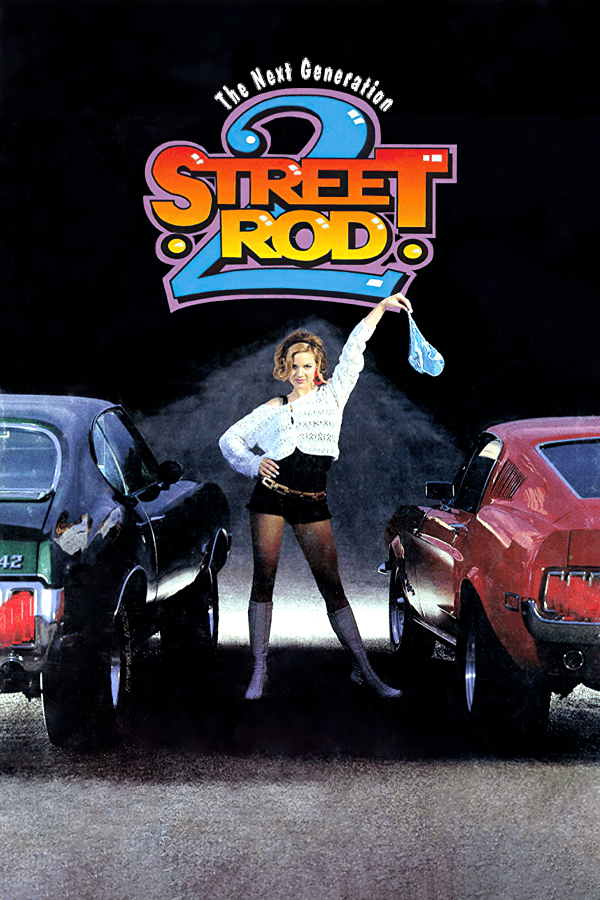
Street Rod 2: The Next Generation
In Street Rod 2: The Next Generation, the real satisfaction comes from sitting in a virtual garage in the summer of 1969, unbolting an engine block with your mouse, and praying your transmission does not blow apart on the drag strip.
The grease under your fingernails made every win feel earned
Most racing titles from the early nineties put you straight onto the starting grid, but this game understood that half the fun of muscle car culture happens before you ever turn the key. Starting on June 14, 1969, you begin with a modest chunk of cash and a local newspaper filled with classified ads. You scour the listings for classic American iron like a 1963 Corvette V8, a 1967 Chevrolet Camaro, a 1966 Dodge Charger, or a 1969 Pontiac Firebird, constantly balancing your limited budget against what needs fixing.
The garage simulation remains the absolute highlight of the experience. You click on individual bolts to strip off worn parts, pull out the engine, swap differentials, and install upgraded mufflers, exhausts, or entire multi-barrel carburetor setups. You even have to adjust gear ratios by hand to find the sweet spot between low-end launch torque and top-end speed. Before you even head out to find a opponent, you have to drive down to the local gas station and manually pump your own fuel into the tank, a tiny touch that makes the world feel grounded.
Where mechanics shine and roadworks punish the smallest error
Once your machine is running, you roll up to Burgers Bungalow to find rival racers looking for action. Races fall into three distinct categories:
- Drag Race: A pure test of timing where you shift quickly through the gears without over-revving and blowing your engine.
- Mulholland Drive: A dangerous winding road littered with barriers, tight turns, and roadworks sections.
- The Aqueduct: A high-speed concrete channel with steep sloped walls that reward aggressive line choices.
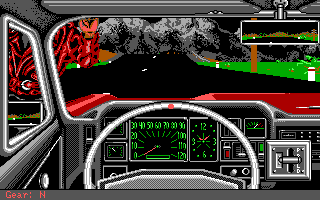
While garage work is a joy, the actual driving mechanics are infamous for their brutal difficulty. The MS-DOS game demands extreme precision, particularly when cornering under pressure. On Mulholland Drive, hitting a patch of roadworks at anything over 50 miles per hour will instantly flip your car into the rocks, ruining weeks of painstaking labor in a second. The Aqueduct is equally unforgiving, as driving too high up the sloped concrete walls sends your chassis rolling into the drain below.
Outsmarting The King on a gallon of fuel
Your ultimate goal in Street Rod 2: The Next Generation is to track down the local hotshot known as The King, defeat him in a series of races, and claim both his crown and his girl. The King drives a formidable 1969 Shelby GT500 equipped with a unique supercharger you cannot buy in any catalog. Facing him head-on with equal hardware is usually a quick path to losing your pink slip, which forced clever players to develop genuine tactical shortcuts.
The most famous community strategy involves managing your car's weight by draining the gas tank. Liquid fuel adds significant weight, so experienced drivers head to the pumps and fill up with exactly one gallon of fuel for drag strips or two gallons for Mulholland Drive. That minimal fuel load lightens the vehicle just enough to give your launch an advantage off the line. Designed by Andrzej Sanojca, Natalia Wroblewska, and Jim Siefert, the title also featured a soundtrack composed by Dorota Błaszczak and Marcin Grzegorzewski that hummed clean through a PC speaker and sang on Sound Blaster hardware.
Flaws, frustrations, and who should play it today
It is impossible to discuss this title without acknowledging its steep learning curve. The steering controls are exceptionally sensitive, and losing a prized vehicle because a pixel on your tire scraped a drainage ditch on the Aqueduct can test anyone's patience. The game does not forgive sloppy gear shifts or impulsive bets, and blowing an expensive manifold because you held a gear two seconds too long hurts as much now as it did in 1991.
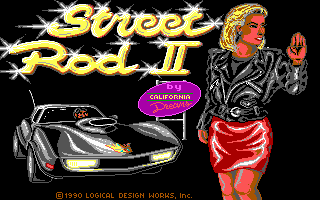
Yet for fans of mechanical tuning and classic car culture, those sharp edges are part of the appeal. Compared to other racing games released around 1991 by publisher California Dreams and developer Logical Design Works, the depth of the garage mechanics sets it apart from typical arcade entries. If you enjoy hands-on car customization where every bolt matters and every race carries real risk, it still offers a level of mechanical depth you rarely see elsewhere.
Fire up the engine directly in your browser
You can play Street Rod 2: The Next Generation free in your browser right here, without needing to configure system files or set up mounting directories. Mouse controls make stripping down engine heads and tweaking transmission ratios far easier today than it ever was on original hardware.
When you start your campaign, resist the urge to buy the prettiest body in the paper right away. Buy a cheap runabout, spend your remaining cash on solid internal upgrades, and remember to keep only a single gallon of gas in your tank when you head to the drag strip for your first pink slip battle.