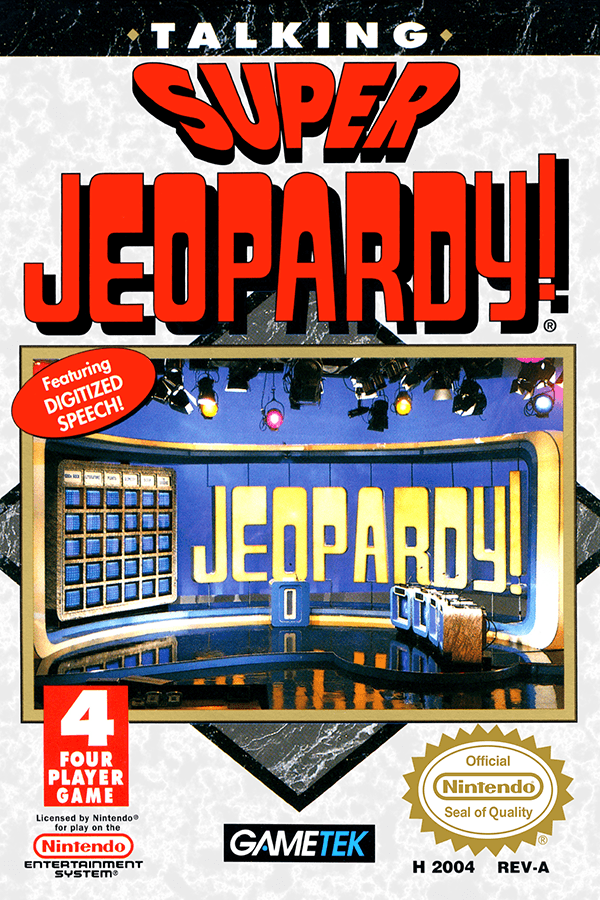
Super Jeopardy! brings the high-stakes 1990 TV tournament spin-off to MS-DOS, pitting four contestants against an 80-second timer and a single shared PC keyboard.
Four Players, One Keyboard, and an 80-Second Timer
Most trivia adaptations from this period played it safe with two-player setups or basic turn-taking, but GameTek opted for four contestant slots right out of the gate. You can pick your avatar from a selection of male and female faces, fill any empty seats with computer-controlled opponents, and start picking categories off the board. The twist, just like the televised tournament it was adapted from, is that the point values run higher and the questions demand quicker recall than standard game show fare.
Once a clue lights up across the screen, the real scramble begins. Buzzing in requires everyone to hover over assigned keys on the same physical keyboard, which leads to immediate elbowing when two people know the answer to a high-value category. When you land the buzz, the game hands you an 80-second clock to spell out your response. The software automatically supplies the standard question preamble, so you only need to type the target answer correctly before time runs out.
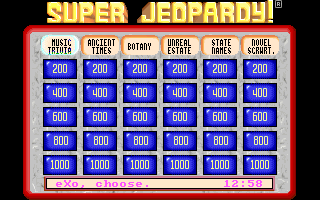
That 80-second limit feels generous until you make a typo under pressure. If you misspell a key word or let the timer expire, your accumulated earnings drop instantly, opening the door for the remaining three players to lock you out and steal the points. It creates a tense, fast-moving rhythm that punished sloppy typing just as hard as ignorance.
Audio Wizardry on a Native PC Speaker
Back in 1991, having a dedicated sound card like a Sound Blaster was still a luxury for many home computer owners. Developers MRH Software and GameTek bypassed that hurdle by pushing digital audio directly through the internal PC speaker and the Covox Speech Thing parallel-port adapter. Hearing recognizable voice prompts and sound effects directly from a basic system speaker without adding extra expansion cards was a genuine surprise for DOS users at the time.
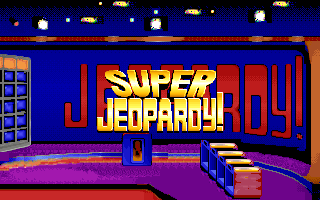
On the visual front, the game scales across CGA, EGA, MCGA, and top-tier VGA modes. In VGA mode, the bright colors on the main board pop sharply against the dark studio backdrop, mirroring the neon lighting of early nineties television. The host sprite rendered at the side of the stage wears a wild, exaggerated suit and moves with stiff animations, fitting the tacky studio setup the developers aimed for.
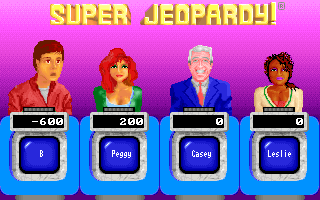
The audio presentation does have its dark side, however. While the voice samples impress technically, the buzzer tones and victory chimes emitted by the PC speaker can quickly become grating during a long session. If your rig lacked volume controls, those sharp digital chirps had a habit of cutting straight through a room.
Tournament Rounds and Category Repetition
The campaign structure follows the structure of the primetime television tournament across distinct phases:
- Quarter-Finals: Initial match-ups where four players battle to secure a spot in the upper bracket.
- Semi-Finals: Escalated difficulty with tougher category prompts and aggressive AI contestants.
- Final Round: The multi-stage showdown consisting of the Jeopardy Round, Double Jeopardy with hidden Daily Doubles, and the high-stakes Final Jeopardy wager.
Navigating through these tiers gives the campaign a clear sense of progress, especially when playing against maximum-difficulty computer players who buzz in with terrifying precision. The inclusion of Daily Doubles adds genuine strategic weight, forcing you to calculate exactly how much of your bankroll to risk based on how confident you feel in a given category.
Where the experience stumbles is in its question pool limits. Because data storage on floppy disks was tightly constrained, categories start to repeat themselves after several consecutive matches. Once you recognize a clue package for the second or third time, the competitive edge wears off, turning a test of general knowledge into a test of pattern memory.
Where This Quiz Port Lands Today
Among educational games and TV licenses released by GameTek, Inc., this adaptation gives you rapid-fire trivia execution without fluff. It strips away filler, focusing entirely on fast clues, quick buzzing, and strict spelling precision. Compared to other games from 1991, its multi-monitor display support and clever speaker programming showed actual effort on the technical side.
The core mechanic of wrestling for space around a single keyboard is definitely an awkward relic, and modern players will tire of the repeating prompt categories after a few championship runs. Yet for a quick evening of retro trivia, the speed of the gameplay and the sheer tension of the countdown clock keep the matches tense.
Play Super Jeopardy! online now
You can run this full MS-DOS release right in your browser window without downloading files or configuring old system settings. If you want to test your trivia recall against three computer opponents or share a keyboard with friends for a quick match, the complete tournament setup is ready to go.
Fire up a round to experience the aggressive 80-second timer and distinct digital PC speaker audio for yourself. Pick your contestant avatar, watch the board light up, and see if you can top the high score table in this classic game show adaptation.
How Super Jeopardy! is played — the keys the game listens to, grouped by what they do.
- Action
- Interface
Highlighted keys are mapped — hover or tap one to see what it does.
Player responses require exact character-for-character matching including spaces. Signaling keys 1 through 4 buzz in players 1 through 4 respectively from left to right.
Players' controls
Touch and gamepad controls
The on-screen keyboard and gamepad mapping the browser player uses on a phone, a tablet or a controller, as opposed to the real keys above. $PRO members make their own in the player and share them here; anyone can pick one to play with.
Make your own touch controlsPRO
- 1Open the editorSign in below, then pick what to make. The game starts with the editor open over it.
- 2Place your keysAdd keys and drag them where your thumbs rest, or map a controller's buttons. Test plays the game with them; Save keeps them, and you play with them from then on.
- 3Share themShare them right after saving in the game, or name and share them here. Players vote, and the best become this game's controls for everyone.
Go PROSee how it worksSign in+20 XP for sharing · +50 XP if yours become the game's own
- The game's own controlsKeyboardGamepadWhat every player starts with.In use
3 screenshots
From the archive
No gameplay video yet
No gameplay video for Super Jeopardy! yet. Sign in to add one.
No reviews yet
Tell the community what you think of Super Jeopardy!. Reviews are public and tied to your username.
No archived manuals for Super Jeopardy! yet
No manuals archived for this title yet. Sign in to upload the first scan.
Cheat codes, console commands and memory pokes for Super Jeopardy! — each one verified and attributed.
Sign in to submitNo cheats yet for this title
Know a working cheat, poke or trainer? Add it with the button above. Moderators check every entry before it goes live.
No archived soundtrack for Super Jeopardy! yet
No soundtrack archived for this title yet. Sign in to upload the first rip.
No save states for Super Jeopardy! yet
No save states for this title yet. Sign in to share one.
Discussions
Sign in to post- Threads0
- Total posts0
- Online now6
Community · Super Jeopardy!
Who's contributing, and what's new
- Reviews0
- Threads0
- Uploadsapproved0
- Contributors0
Recent activity
Nothing here yet
Reviews, discussion threads and approved uploads appear here as members add them.