Super Solvers Treasure Galaxy!
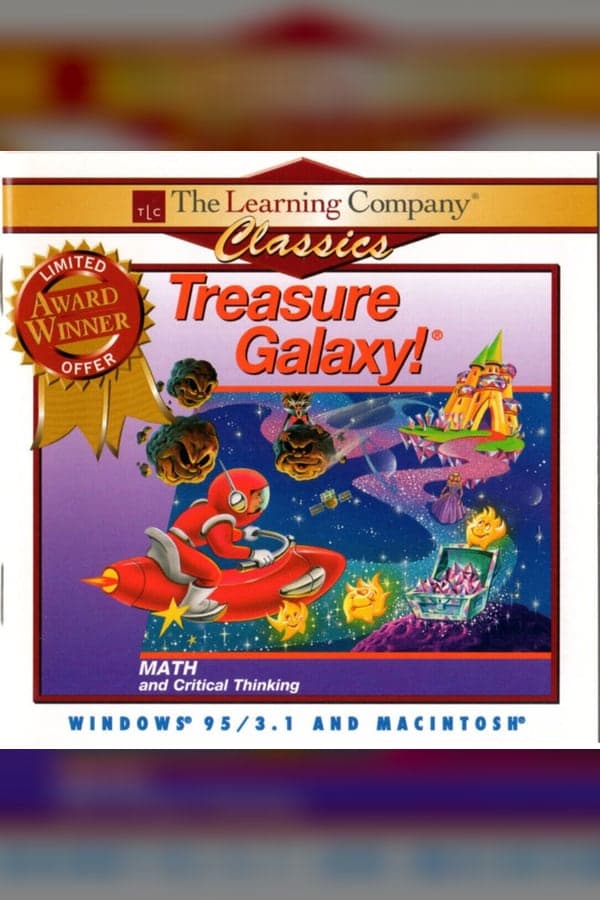
In Super Solvers Treasure Galaxy!, cruising through deep space on a bright red scooter feels like a victory lap until you realize Morty Maxwell expects you to solve hundreds of geometry and fraction puzzles just to get your gems back.
What Morty Maxwell actually demands from your brain
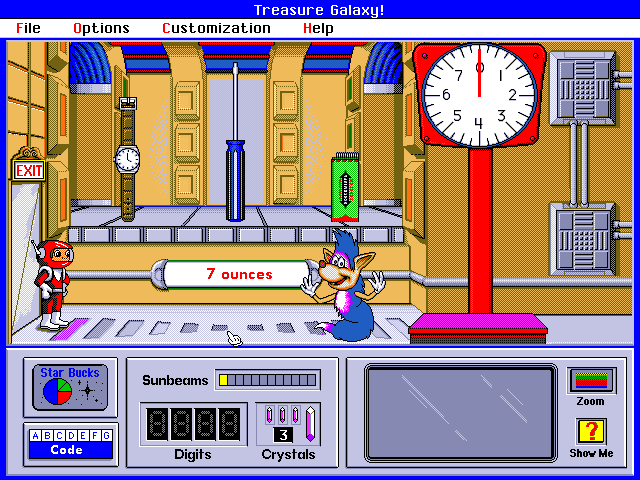
The core loop hits you immediately: you hover into Crystal City on a space scooter, tasked with recovering shattered crystal shards for Queen Astral. Morty Maxwell, the Master of Mischief, has turned ordinary rocks into aggressive flying Disasteroids. To survive, you ride through three distinct space orbits, using a beam zapper to freeze those incoming threats and snag glowing fireballs called sunbeams.
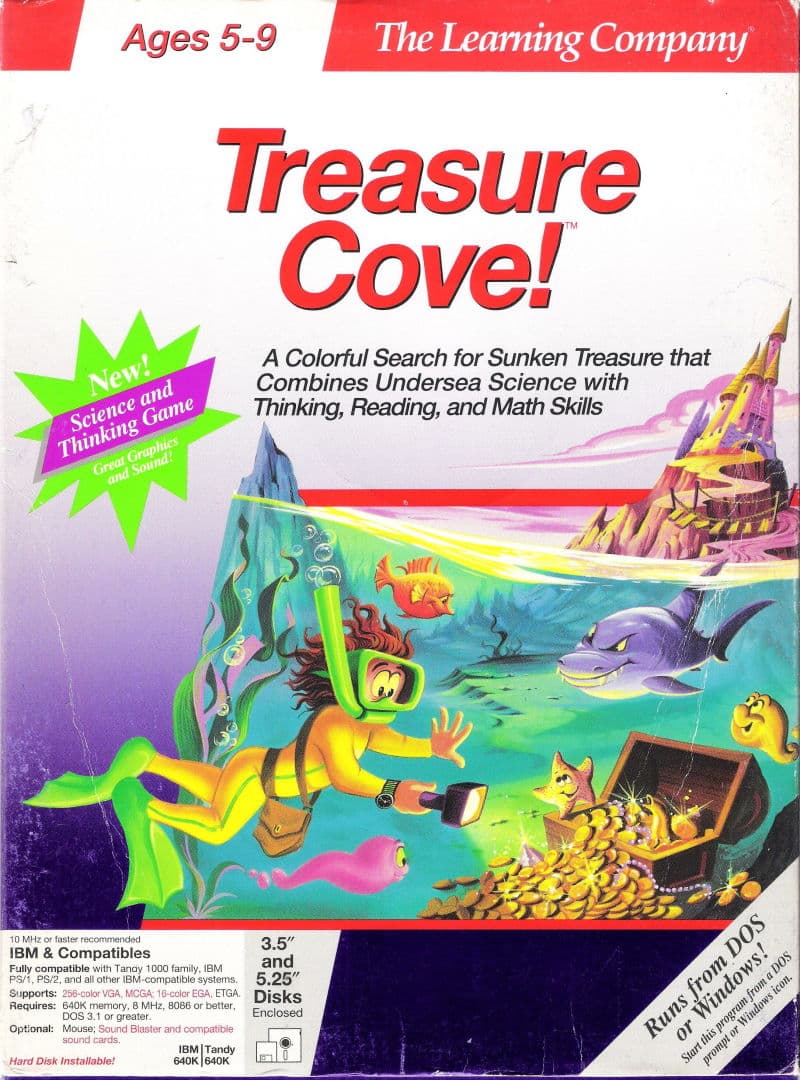
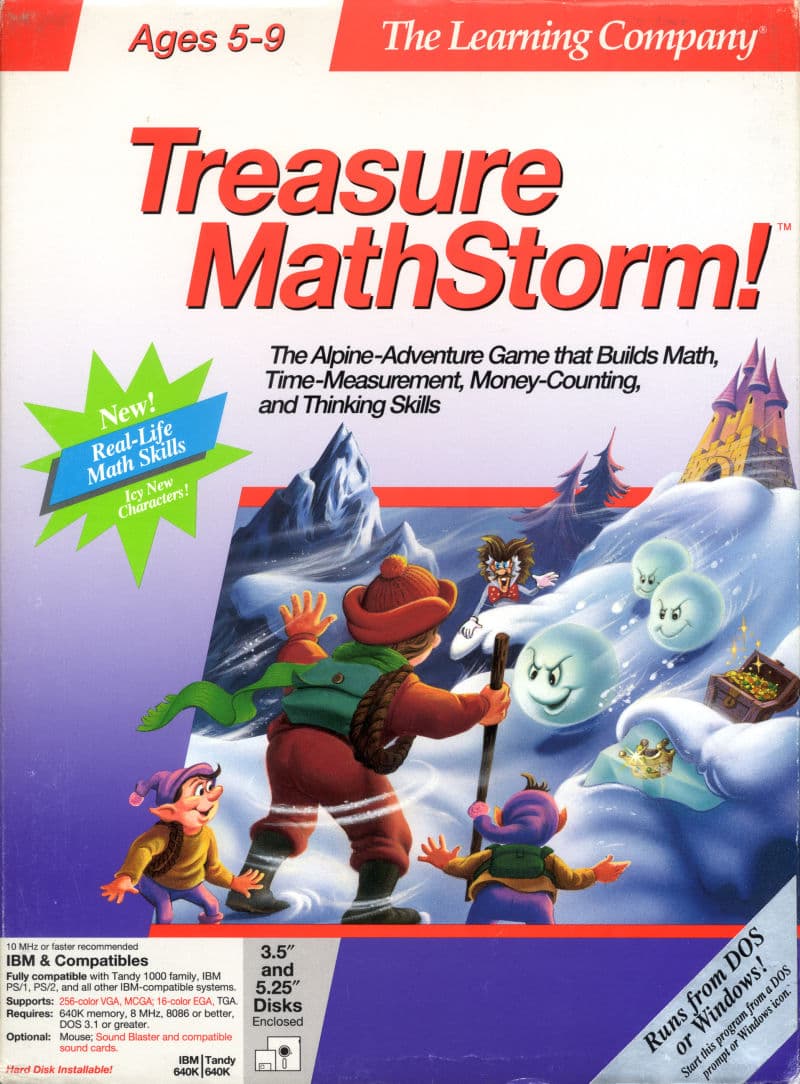
Catching a sunbeam triggers a pop-up challenge rather than a simple score bonus. Answering these tests rewards you with star bucks and cipher clues necessary to unlock code satellites across the stage. The Learning Company, Inc. published the game in 1994 as the fourth installment in its Treasure series, shifting the familiar search mechanics from underwater reefs and sunken caves into top-down space lanes.
Dodging Disasteroids and cracking satellite codes
The top-down perspective gives you room to dodge incoming hazards, but your primary concern is collecting the puzzle pieces required to move between sectors. Each of the three stages requires a unique four-digit passcode to pass through its stargate. You piece these passcodes together by cracking ciphers hidden inside the orbit's satellites.
The educational tasks avoid mindless multiple-choice guessing by forcing you to manipulate actual visual tools on screen. The game tests several distinct skills across its orbits:
- Arranging geometric shapes to complete flat tangram figures.
- Reading scales and rulers to calculate real-world measurements.
- Navigating calendar dates to figure out elapsed time and target days.
- Solving basic arithmetic and working out simple visual fractions.
Because the engine scales puzzle difficulty based on your success rate in each category, you cannot simply grind through easy math problems to bypass harder geometric shapes. If you keep getting measurement questions correct, the game ramps up the precision needed on the ruler.
The 450-crystal grind in Super Solvers Treasure Galaxy!
While the moment-to-moment zapping and riddle solving feel sharp, the overarching campaign goal turns into a serious test of patience. Filling Queen Astral's treasure chest requires accumulating up to 450 individual crystals. At the default starting difficulty, each completed satellite drop yields only a handful of gems, forcing you to run the same three orbits dozens of times.
Anyone who played this back on an 80486 machine remembers the burnout that sets in halfway through that tally. Once you master the four-digit stargate passcodes, repeating the exact same flight paths starts to feel like homework. Fortunately, there is a design trick built directly into the options menu that saves the experience from endless repetition.
If you manually crank the code satellite difficulty setting to maximum right away, the payout per orbit increases dramatically. Instead of dribbling two or three crystals into your chest per satellite, high-difficulty runs shower you with gems. This trick drastically cuts down the total stage completions needed to beat the Master of Mischief and see the ending sequence.
Play Super Solvers Treasure Galaxy! free in your browser
Trying to launch the original executable on modern systems usually results in missing dependency errors or speed bugs that render the space scooter unsteerable. Playing this The Learning Company, Inc. release as a classic MS-DOS game usually requires configuring sound channels and cycles by hand.
You can play Super Solvers Treasure Galaxy! online, free in your browser right here with zero setup needed. Launch the game above, hop onto the red scooter, and immediately adjust the satellite difficulty in the settings to skip the crystal grind and get straight to the code-cracking.