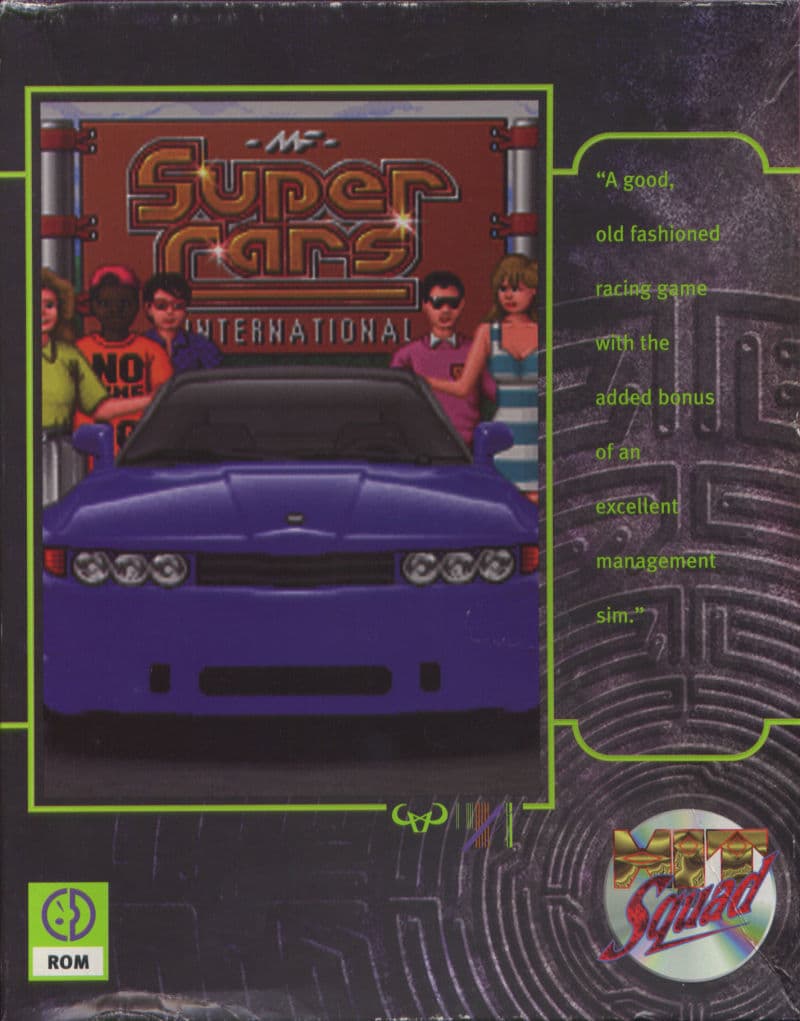
Supercars International
Checking…
If you ever wanted to pitch a missile directly into your friend's rear bumper on a tight hairpin, Supercars International delivered the exact high-speed top-down chaos PC gamers were begging for in 1996.
What happens when you launch Supercars International
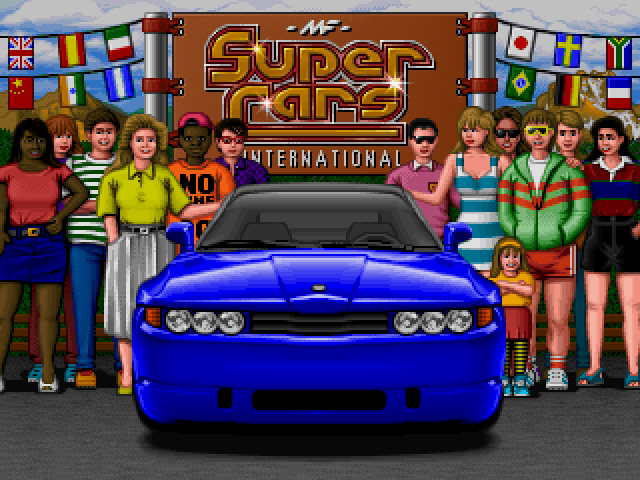
You drop straight onto a screen overflowing with fast cars, sharp curves, and heavy explosive fire. Developer Magnetic Fields Ltd. took their classic top-down driving formula and gave it a thorough hardware overhaul. Built as an updated 256-color VGA rebuild of the 1991 Amiga classic Super Cars II, this game targets high frame rates and quick reflexes above all else.
Every track throws real obstacles in your path. You will negotiate closing gates, jumps, railway crossings, and dark tunnels while trading painted fiberglass with three aggressive opponents. Sliding through corners actually feels fluid now. The new engine pushes a brisk 60 Hz refresh rate, which means steering responses feel immediate compared to older DOS racers.
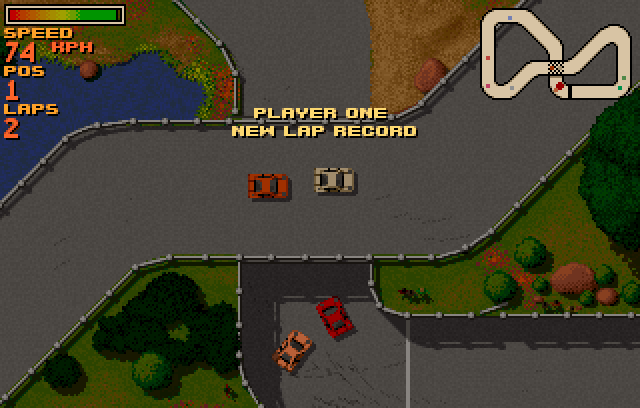
When vehicles hit walls or take direct missile strikes, they spin out, burn up, and leave behind dark skid marks and gaping craters. By the end of three laps, the road looks like a warzone. Dedicated controls let you switch between weapons on the fly, adding real tactics to every turn.
The financial hustle behind Supercars International track action
Winning on the track is only half the battle. If you choose to run a full season, you must manage your cash between races inside a deep off-track management mode. You negotiate vehicle prices at a car dealership through short dialogue mini-games, picking conversational options to push prices down.
Upgrading your garage is essential to survive late-game tracks. Newer cars carry heavier armor, run at higher top speeds, and house bigger missile bays. Between events, you must pay for chassis repairs, stock up on ammo, and adjust your loadout based on your current bank balance.
Market prices shift randomly after every event, creating a sneaky economic system. Smart players can treat weapons like financial commodities, buying up heavy missiles when cheap and selling them off for massive profits when prices jump. This extra cash helps fund quick engine swaps long before your opponents can afford them.
Random special events break up the calendar between races. You might get pulled into strange dialogue scenarios that hit your wallet or grant sudden bonuses. These small moments add real personality to what could have been a simple menu screen.
Where the mechanics break down on the track
Not every system in this overhaul works the way coder Shaun Southern intended. The most obvious issue hits your garage budget immediately: the vehicle armor system is fundamentally broken. Extra armor plates cost serious money, but damage calculations barely account for them during heavy pileups.
Buying extra armor is practically a waste of credits. A solid hit from a missile or a bad wall slam takes roughly the same massive chunk of health regardless of your theoretical protection level. You are much better off spending your cash on pure engine power and defensive mines.
The artificial intelligence also suffers from glaring pathfinding bugs. On courses with mechanical gates, computer drivers frequently fail to calculate opening timings. They will repeatedly drive straight into locked steel doors while you cruise past for an easy victory.
Track hazards and computer driver logic occasionally freeze up completely during custom seasons. While the raw driving feel remains smooth, these structural bugs make the game feel like a polished public test build at times. Artist Andrew Morris delivered great visual sprites, but the underlying driver math needed another pass.
Custom seasons and two-player split-screen mayhem
Despite these bugs, the sheer volume of content keeps you coming back for another lap. You get 21 distinct tracks spread across three built-in difficulty seasons: Easy, Medium, and Hard. Every single track can be raced in reverse, effectively doubling the layout variety.
Customization options let you tailor your campaign parameters. You can tweak lap counts, alter season lengths, or draft custom track lists. If you want a quick break from career management, you can jump straight into a quick arcade race without dealing with car dealers or repair bills.
The two-player split-screen mode remains the absolute highlight of the package. Racing against a human friend eliminates the silly computer AI issues entirely. Throwing a mine right in front of a friend on the final corner of a split-screen sprint creates instant, shouting-at-the-monitor rivalries.
The technical presentation delivers mixed results on vintage audio setups. While the smooth scrolling looks great in 256 colors, the sound production credited to "Pipe Smokers Cough" misses the style of the original Amiga chiptunes. Still, as a pure racing game from 1996, it goes extremely fast.
How to play Supercars International free today
If you want to experience this piece of computer history without hunting down disk images, you can published by The Hit Squad classic online immediately. The handling holds up shockingly well once you master how momentum carries through sharp turns, making it a great pick for retro arcade enthusiasts.
Modern players often assume top-down racers require gentle, conservative braking. In reality, you need to throw your car sideways into corners long before you think you should. Sliding wide while laying down rear-firing mines is the real secret to staying ahead of the pack.
You can play Supercars International online right now directly in your web browser. There is nothing to install and no complex emulator setup required to enjoy this classic Supercars International MS-DOS game. Just launch the game free in your browser, pick your car, and get ready to trade paint on the track.
Players' controls
Touch and gamepad controls
The on-screen keyboard and gamepad mapping the browser player uses on a phone, a tablet or a controller, as opposed to the real keys above. $PRO members make their own in the player and share them here; anyone can pick one to play with.
Make your own touch controlsPRO
- 1Open the editorSign in below, then pick what to make. The game starts with the editor open over it.
- 2Place your keysAdd keys and drag them where your thumbs rest, or map a controller's buttons. Test plays the game with them; Save keeps them, and you play with them from then on.
- 3Share themShare them right after saving in the game, or name and share them here. Players vote, and the best become this game's controls for everyone.
Go PROSee how it worksSign in+20 XP for sharing · +50 XP if yours become the game's own
- The game's own controlsNone yet: played with a real keyboard only.In use
2 screenshots
From the archive
No gameplay video yet
No gameplay video for Supercars International yet. Sign in to add one.
No reviews yet
Tell the community what you think of Supercars International. Reviews are public and tied to your username.
No archived manuals for Supercars International yet
No manuals archived for this title yet. Sign in to upload the first scan.
Cheat codes, console commands and memory pokes for Supercars International — each one verified and attributed.
Sign in to submitNo cheats yet for this title
Know a working cheat, poke or trainer? Add it with the button above. Moderators check every entry before it goes live.
No archived soundtrack for Supercars International yet
No soundtrack archived for this title yet. Sign in to upload the first rip.
No save states for Supercars International yet
No save states for this title yet. Sign in to share one.
Discussions
Sign in to post- Threads0
- Total posts0
- Online now6
Community · Supercars International
Who's contributing, and what's new
- Reviews0
- Threads0
- Uploadsapproved0
- Contributors0
Recent activity
Nothing here yet
Reviews, discussion threads and approved uploads appear here as members add them.