SuperSki III
aka SuperSki Pro · SuperSki Pro: Gripping Ski-race simulation
Checking…
Microïds brought winter arcade action to PCs with SuperSki III, sending players down mountain tracks at breakneck speeds where hitting a single turn wrong means slamming headfirst into a tree. It delivers fast-paced mountain races, but keeping your skier on course takes serious patience with its unforgiving controls.
Scaling the slopes in SuperSki III
Launching this sports game drops you straight onto the snowy courses of the French Alps. You choose between a skier and a snowboarder, picking from four distinct tracks in each event. The standard game packs six disciplines into its roster: Super Giant, Downhill, Slalom, Snowboard Giant Slalom, Snowboard Slalom, and Ski Jump. If you had the expanded CD-ROM release back then, you also got access to a seventh event in the Bobsleigh.
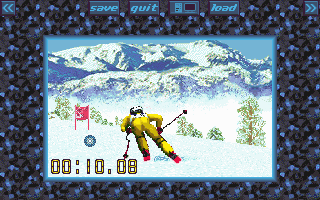
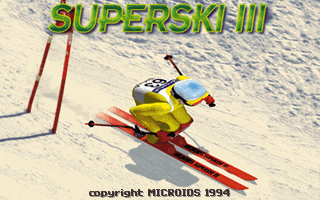
Microïds built the visual engine using a 3D bitmap technique similar to the raycasting approach seen in Wolfenstein 3D. The engine scales sprites rapidly to simulate real motion through three-dimensional space. Snow-covered trees, course markers, and rival athletes zoom toward your screen at frightening speeds. While this approach created a strong feeling of velocity on mid-nineties hardware, it comes at a clear visual cost. Everything on screen appears pixelated, making it tough to read the terrain far ahead.
You can tackle the mountain across three distinct play modes. Practice lets you learn individual runs without pressure. Medal Competition forces you to compete across every discipline to rack up podium finishes. Time/Points Competition tracks your absolute speed and technical scores against the clock. Up to four players can take turns in hot-seat multiplayer, passing the keyboard around after each run to set high scores.
Where the controls go downhill fast
The primary battle in this 1994 release is not against rival times, but against your own input device. Steering your athlete from the third-person camera perspective requires absolute precision. Third-person scaling creates tricky depth perception, making it hard to judge exact distances to upcoming slalom gates. The winding mountain paths leave very little margin for error when you enter a high-speed bank.
Keyboard controls present a severe hazard during tight maneuvers. Tapping directional keys too rapidly can cause your athlete to stop responding to commands entirely for a brief second. That short input lockup usually sends your skier sliding sideways directly into a pine tree at maximum speed. Switching over to mouse steering brings a different set of headaches. While smooth on wide curves, swinging the mouse across the pad during sharp turns feels awkward and unresponsive.
Visual presentation creates additional hurdles on the slalom courses. The developers rendered slalom poles in uniform colors rather than alternating bright red and blue flags. Reading the upcoming path on a low-resolution display becomes a guessing game as identical markers zoom past your field of view. A good run requires memorizing track layouts line by line rather than reacting naturally to what appears on screen.
- Downhill and Super Giant rely on maintaining maximum speed while hugging tight turn vectors.
- Slalom and Snowboard Slalom test your strict timing through narrow flag sequences.
- Ski Jump shifts the camera, demanding precise launch timing off the ramp edge.
- Bobsleigh adds high-walled channel navigation exclusive to the CD-ROM release.
Floppy disks, CD-ROM extras, and the French cable test
French developer Microïds distributed the game across multiple formats to capture different PC markets. The budget floppy disk edition catered to standard computer setups of the era. The CD-ROM version offered higher multimedia capacity, bundling the extra Bobsleigh track alongside richer audio. In its home territory of France, players could even download the SuperSki III MS-DOS game digitally through GameNet, an early cable television distribution experiment.
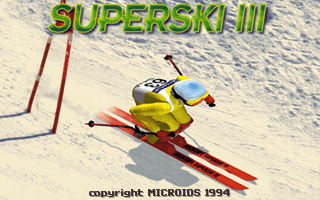
Mindscape handled the North American release, renaming the title to Winter Sports, while other European regions saw it on store shelves as SuperSki Pro. Magazine reviewers of the time offered split verdicts on the action. French publications praised the zooming 3D engine while pointing out the heavily pixelated athlete graphics. Computer Gaming World highlighted the fast pacing and competitive hot-seat modes, even as players struggled with the steep difficulty curve.
How SuperSki III holds up on modern screens
Testing your reflexes on these retro pistes is a tough challenge today. The scaling graphics preserve a distinct nineties PC aesthetic, even if the severe pixelation makes long sessions tiring on modern monitors. The speed of the downhill runs still provides genuine tension when you navigate around dense clusters of trees. However, the rigid keyboard lockups and awkward mouse steering keep the controls feeling clunky.
You do not need to hunt down old floppy disks or configure vintage hardware to tackle these slopes. You can play SuperSki III online free in your browser right now, with no extra installation required. Select your equipment, practice your steering taps on the practice slope, and see if you can clear the slalom gates without smashing into the timber.
How SuperSki III is played — the keys the game listens to, grouped by what they do.
- Movement
- Move mouse — Control sportsman
Highlighted keys are mapped — hover or tap one to see what it does.
Players' controls
Touch and gamepad controls
The on-screen keyboard and gamepad mapping the browser player uses on a phone, a tablet or a controller, as opposed to the real keys above. $PRO members make their own in the player and share them here; anyone can pick one to play with.
Make your own touch controlsPRO
- 1Open the editorSign in below, then pick what to make. The game starts with the editor open over it.
- 2Place your keysAdd keys and drag them where your thumbs rest, or map a controller's buttons. Test plays the game with them; Save keeps them, and you play with them from then on.
- 3Share themShare them right after saving in the game, or name and share them here. Players vote, and the best become this game's controls for everyone.
Go PROSee how it worksSign in+20 XP for sharing · +50 XP if yours become the game's own
- The game's own controlsKeyboardGamepadWhat every player starts with.In use
2 screenshots
From the archive
No gameplay video yet
No gameplay video for SuperSki III yet. Sign in to add one.
No reviews yet
Tell the community what you think of SuperSki III. Reviews are public and tied to your username.
No archived manuals for SuperSki III yet
No manuals archived for this title yet. Sign in to upload the first scan.
Cheat codes, console commands and memory pokes for SuperSki III — each one verified and attributed.
Sign in to submitNo cheats yet for this title
Know a working cheat, poke or trainer? Add it with the button above. Moderators check every entry before it goes live.
No archived soundtrack for SuperSki III yet
No soundtrack archived for this title yet. Sign in to upload the first rip.
No save states for SuperSki III yet
No save states for this title yet. Sign in to share one.
Discussions
Sign in to post- Threads0
- Total posts0
- Online now6
Community · SuperSki III
Who's contributing, and what's new
- Reviews0
- Threads0
- Uploadsapproved0
- Contributors0
Recent activity