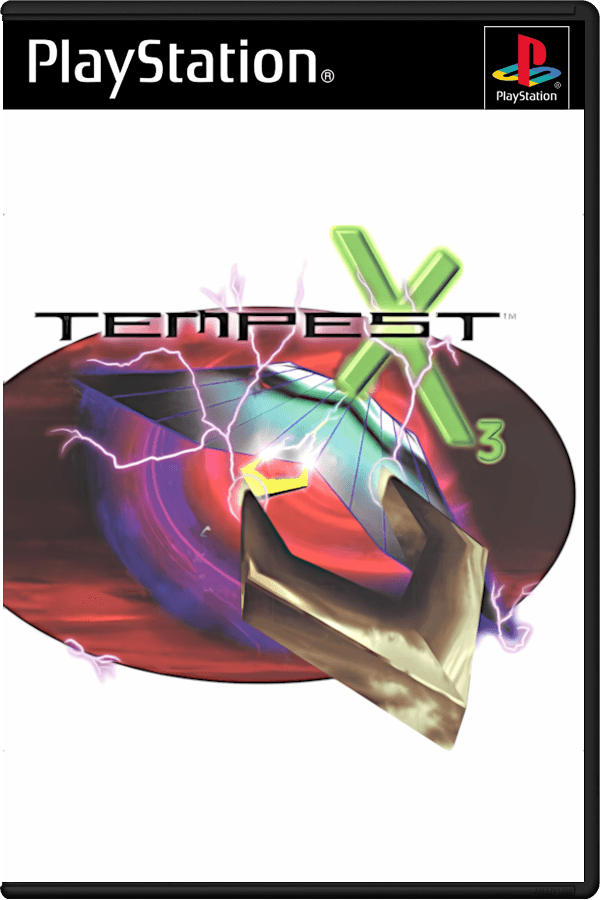

Tempest 2000 throws a claw-shaped Blaster onto the rim of neon geometric webs, tasking you with blasting Pulsars and geometric invaders before they crawl up to swallow your ship.
Riding the edge of Jeff Minter's vector storm
Dave Theurer built the original arcade Tempest around color vector lines and a rotary dial. In 1994, game designer Jeff Minter overhauled that framework for the Atari Jaguar, turning a austere arcade shooter into a hallucinatory barrage of particle explosions and techno beats. Ported to PC by developer Imagitec Design and published by Atari Interactive in 1996, this conversion brings the full spectrum of that chaos straight to MS-DOS displays.
You sit at the open end of a three-dimensional geometric tube or flat web, looking down toward its distant center. Wave after wave of glowing enemy shapes climb up the wire channels toward your perimeter position. If an enemy reaches the rim, it flips up onto the outer edge to track you down directly. Your primary weapon fires straight down the wire channels, obliterating anything in its trajectory before it lands.
The core tension comes from balance. Moving too slowly lets Pulsars electrify entire track lanes, locking off your escape routes. Moving too quickly without checking your lane leaves behind deadly spikes that destroy your craft when you clear the level and fly forward into the tube.
What happens when high-speed arcade action meets DOS controls
The central mechanical challenge of this action game on PC comes down to input devices. The arcade cabinet relied on a weighted rotary knob that let players spin across thirty lanes in a fraction of a second. Steering the Blaster with standard PC cursor keys or a keyboard feels distinctly different. You have to tap rhythmically to line up shots on tiny target lanes, which demands deliberate movement over frantic spinning.
Power-up items float up the web as spinning polygon shapes when you destroy key enemies. Catching these bonuses alters your survival odds dramatically:
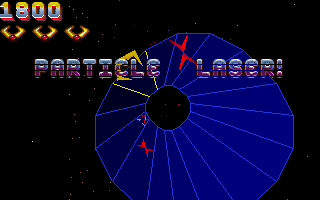
- Particle Laser: Replaces your standard single-shot blaster with high-velocity rapid fire that cuts down dense enemy lines.
- A.I. Droid: Deploys an autonomous companion craft that hovers above the web, target-lock firing on threats independently.
- Jump capability: Allows your ship to leap off the rim into mid-air, dodging crawling enemies on your lane while firing downward.
- SuperZapper: A emergency smart bomb that clears every enemy currently active on the web surface.
If you take damage, your firepower drops back to baseline. Losing a ship right when the level reaches peak density usually leads to immediate extra deaths, as standard guns struggle to clear swarms quickly enough.
Visual overload and the noise of the techno soundtrack
Playing the Tempest 2000 MS-DOS game at 320x200 VGA resolution is an aggressive sensory experience. Color schemes cycle dramatically every fifteen levels, shifting the geometric grids from cool blues to intense neon pinks and searing yellows. Particle effects shower the screen every time a target explodes, turning late-game stages into crowded light shows.
Back in 1996, period magazine tests noted this visual density cut into readable action. When six different enemy types crowd the rim alongside floating upgrade tokens and exploding debris, tracking your ship's exact physical footprint takes intense concentration. French publication Retro Archives scored the port 16/20, celebrating its fierce pacing while acknowledging that screen readability suffered during frantic moments.
The audio side of the port delivered serious hardware workouts for PC sound cards of the mid-nineties. Soundtracks composed by Alastair Lindsay, Ian Howe, and Kevin Saville supplied driving electronic dance tracks that pushed Sound Blaster and Gravis UltraSound cards to their limits. The musical score proved so popular with fans that Atari packaged it separately as a stand-alone audio CD.
Modes, secrets, and the elusive bonus stages in Tempest 2000
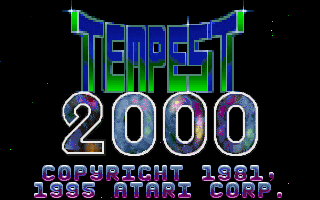
Four distinct game modes exist inside the package. Traditional Tempest strips away modern enhancements to recreate the raw 1981 arcade rulebook. Tempest Plus adds A.I. Droid assistance and dual-ship mechanics to classic layout designs. Tempest Duel pits two players against each other on opposite sides of the same shape, turning a defensive shooter into a competitive head-to-head match.
The main Tempest 2000 mode packs 100 levels of escalating speed and structural complexity. Grabbing floating Warp Tokens across successive stages grants access to relaxing Warp Bonus Rounds, where you pilot through floating green rings or navigate open spiral paths. Surviving all 100 levels unveils the infamous Beast Mode, which cranks enemy speed and spawn rates to extreme levels.
A well-known audio easter egg highlights the playful design touches scattered throughout the game. If you collect a power-up precise at the instant your ship warps off a completed grid, a high-pitched voice sample shouts "Yes! Yes! Yes!", rewarding your run with a free A.I. Droid right at the start of the subsequent level.
Why you should try a run on the grid right now
Despite stiff keyboard controls and occasionally blinding visual clutter, the game holds up because its core loop rewards pure focus. Period reviewer PC PowerPlay noted that while the difficulty could feel punishing, the mechanics remained strictly fair. Mistakes trace back to poor positioning or over-committing to a single lane rather than bad game logic.
You can play Tempest 2000 free in your browser right here on this page. Launch the game, pick up the basic keyboard layout, and see how long your ship survives the geometric assault once the music kicks in.